
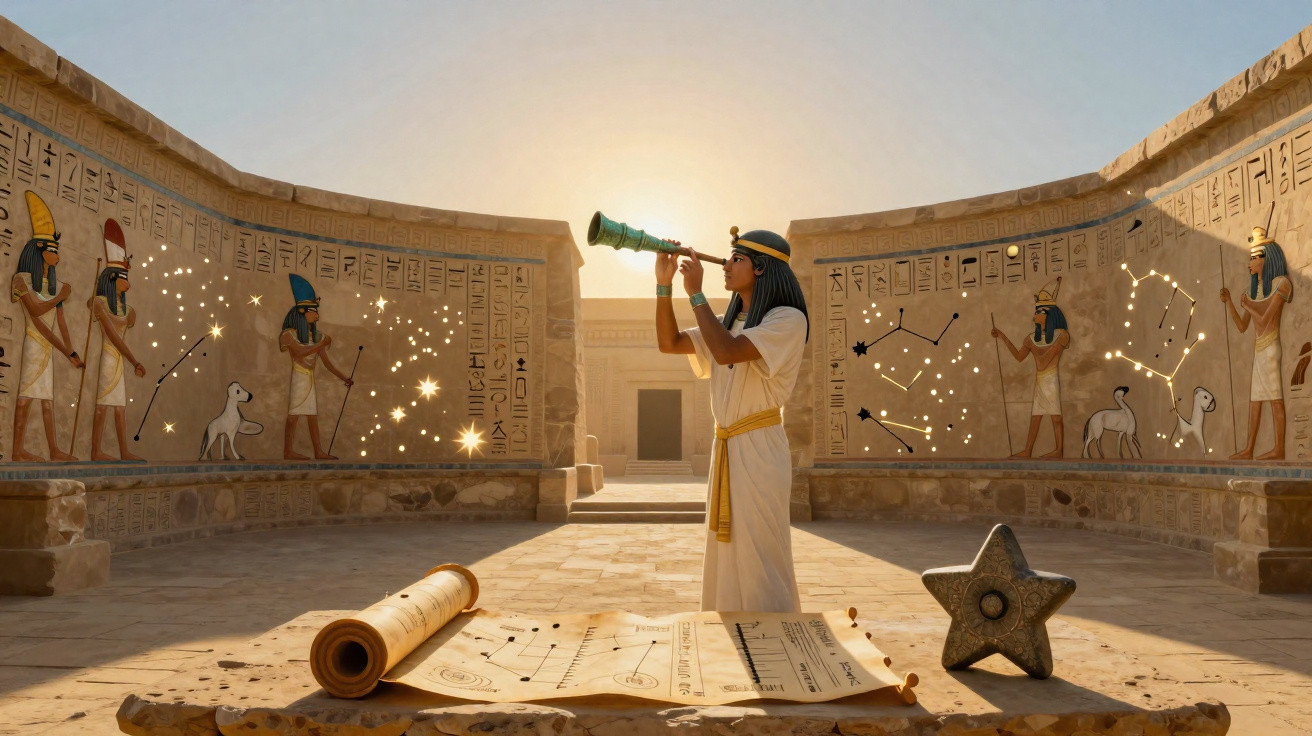
A ruined structure in Kafr El Sheikh once gave ancient Egyptians a place from which to look up at the stars.
More than 2,500 years ago, this building formed the largest astronomical observatory known in Egypt during the 6th century BCE. It was part of what is now known as the Temple of the Pharaohs in the town of Buto.
At this site, early astronomers carefully monitored the movements of the Sun and stars, carrying out work that was essential to ancient Egyptian life.
The Egyptians ranked among the most skilled astronomers of the ancient world, and their influence remains apparent today. Ancient Egypt produced the 365-day calendar and the 24-hour day. Its people charted the entire night sky and developed their own constellations and zodiac, with some signs still recognised today.
The recently uncovered observatory reveals these capabilities, despite the limited evidence that has survived the passing centuries.
The ancient Egyptian astronomical observatory at Buto
Constructed from mud bricks, the building occupied an area of 850 square metres (9,150 square feet). It had an L-shaped layout, supported by pillars, and its entrance faced east towards the rising Sun.
Inside, archaeologists from Egypt’s Ministry of Tourism and Antiquities uncovered artefacts and equipment connected with studying the heavens.
Most notably, they found a substantial inclined shadow clock, a form designed by the ancient Egyptians to measure time. These clocks functioned as sundials, following the movement of a shadow as the Sun crossed the sky to record the hours from dawn until dusk.
This example was made from a 4.8-metre (15.7-foot) stretch of limestone slabs, fitted with five flat limestone blocks: three upright and two horizontal. Though now worn by age, the blocks would originally have carried lines marking the changing angle of a shadow cast across them as the Sun moved.
Archaeologists also discovered a large stone block in a circular chamber, alongside two circular stone blocks, positioned to the north and west. This arrangement was likewise used to follow the Sun’s inclination.
Rooms, tower and painted hall
A row of five smaller rooms probably served as storage for the observatory’s instruments. Four small mud-brick rooms and one stone room appear to have formed the observatory’s tower. Excavators also revealed a large hall, where three walls had been covered with yellow mortar and decorated with painted murals.
The images included a ritual boat with eight niches and two oars at its rear. At the boat’s front, archaeologists identified an illustration of the head of Horus and the Udjat Eye. These symbols were associated not only with the Universe and cosmos, but also with the god Horus and the goddess Wadjet, Buto’s most important deities.
At the centre of the hall is a stone platform bearing inscriptions, chiefly astronomical scenes showing sunrise and sunset across the three seasons recognised in ancient Egypt.
Artefacts and the importance of Egyptian astronomy
Objects recovered from the observatory included bronze statues of Osiris and Nemes, a terracotta statue of the god Bes, and a granite statue from the 26th Dynasty, during the reign of pharaoh Wahibre Psamtik I. The granite statue represents Osiris and bears an inscription for the priest Psamtik-Seneb, including the title Royal Seal Bearer.
Further discoveries comprised measuring instruments, a faience menat necklace, a faience figure of the god Ptah, faience religious symbols, pottery objects, amphora covers made from mortar, and offering tables.
Astronomy held profound importance for the ancient Egyptians. Their intricate calendar enabled them to track time and establish the dates of religious and political ceremonies, including festivals and coronations. It was also crucial for following the Nile’s annual flooding, farming and navigation.
Today, the calendar is so familiar that it seems simply part of everyday life across the world.
However, it is due in part to the labour and ingenuity of ancient Egyptian astronomers that we have it - and to their durable engineering that temples such as this remain standing, allowing their work to be examined thousands of years after their own lives vanished into the sand.






Comments
No comments yet. Be the first to comment!
Leave a Comment