
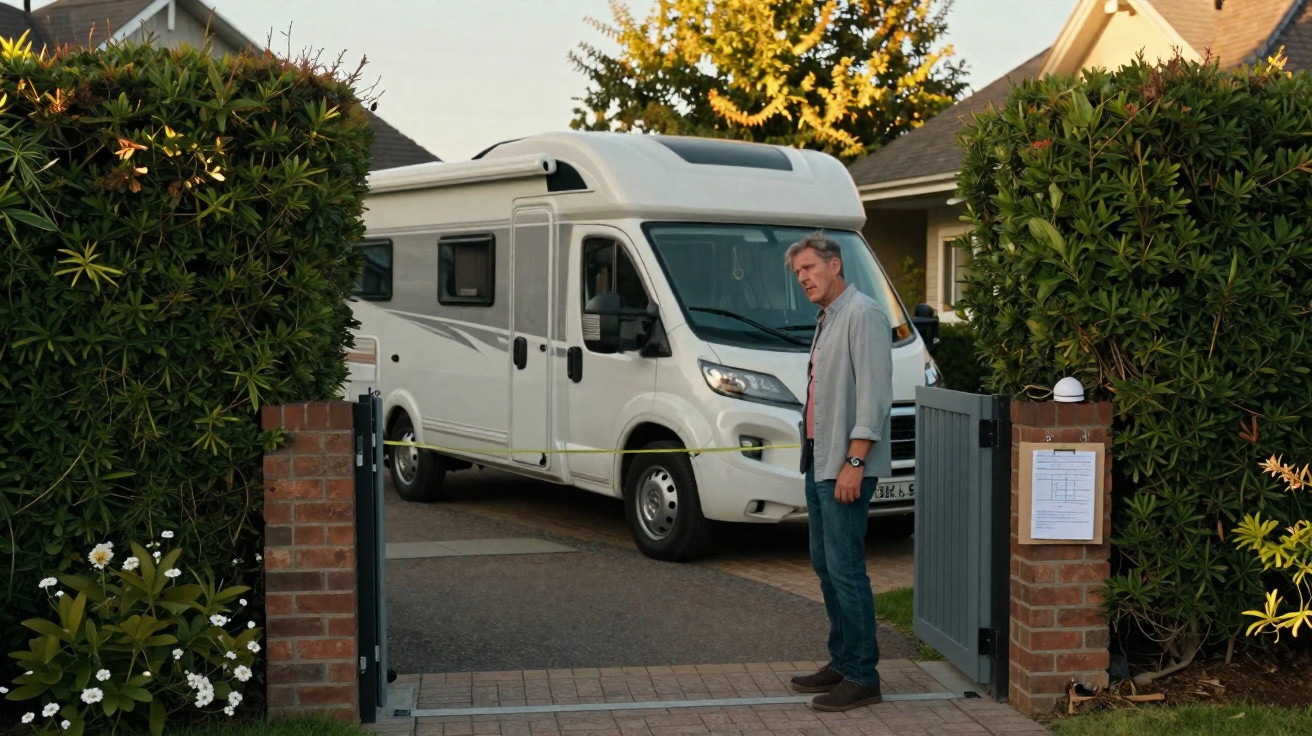
Alain, 68, had selected the spot with great care. His motorhome, a slightly bulky white model kept in immaculate condition, was almost entirely concealed by the tall laurel hedge running alongside his plot. From the road, only the roof was barely visible. He believed he had struck the perfect balance: no unsightly view for neighbours, no vehicle on the pavement and no dispute. Yet one morning, a letter from the local council landed on his doormat. It said nothing about the vehicle’s height, nor did it mention the hedge. The issue lay elsewhere, in a detail many property owners realise matters only when it is too late.
A motorhome is not simply an object parked at the bottom of the garden
In his village, Alain felt that he was doing everything properly. After every trip, he brought the vehicle home, shut the gate and let the hedge act as a natural screen. We all know that feeling: once something is on our own land, surely nobody has any reason to scrutinise it. However, a motorhome remains a substantial vehicle, with a footprint, an access route and sometimes uses that can draw the attention of planning departments.
The council’s letter was not about white bodywork glimpsed through gaps in the branches. The authority was querying the altered access area: at the rear of the plot, Alain had created a firm surface using gravel and a gentle ramp, allowing him to manoeuvre without getting stuck in mud. In some local authority areas, this kind of work may affect rainwater run-off or change the appearance of the land. Depending on local planning policy and the precise nature of the works, prior approval may therefore be required.
The sensitive issue is not necessarily the motorhome parking itself. Keeping a vehicle on private property is usually allowed, provided it continues to be used as a vehicle rather than becoming a permanent installation. What may create difficulties is the alteration of the land: a concrete slab, excavation work, a new access onto the public highway, utility connections, a fixed shelter or excessive hard surfacing. A hedge may hide a vehicle, but it does not remove the rules governing the land beneath it.
What Alain could have checked before bringing in his motorhome
The first practical step is to check the local development plan for the relevant council area. This document sets out the rules applying to the plot, including protected areas, distances from the road, rainwater management, boundary treatments and vehicle access. Requirements can change dramatically if the land lies close to a listed building, within a residential development or in an agricultural area. A straightforward call to the planning department can often prevent weeks of uncertainty and unnecessary expense.
A common mistake is to assume that gravel does not count as a genuine alteration. That is understandable: a few tonnes of stone, an edging strip and two ground-stabilising panels seldom feel like building work. Let us be honest: nobody undertakes this sort of work every day. Nevertheless, where an area is permanently prepared to accommodate a large vehicle, the council may assess whether it has created impermeable surfacing or altered the ground, particularly after a complaint from a neighbour.
Alain should also have assessed his property entrance from the carriageway. A hedge that is too dense, combined with a gate and a motorhome that has to reverse out, can limit visibility for drivers, cyclists and pedestrians. At that point, the concern is no longer mainly visual; it becomes a safety matter.
“It is not the motorhome behind the hedge that concerns us; it is the way it enters and leaves the property,” explains a council officer accustomed to dealing with this type of case.
- Check local development plan rules before creating a stabilised parking area;
- Assess visibility when exiting through the gate;
- Maintain the natural flow of rainwater;
- Avoid permanent connections that would turn the vehicle into a long-term installation.
An access detail that may cost far more than trimming a hedge
In Alain’s case, the answer was neither to move the hedge nor to sell the motorhome. The council asked him to provide details about the prepared parking area and the exit onto the road. He eventually cut back part of the planted section near the gate, fitted a safety mirror and had the rainwater drainage reviewed by a professional. None of these changes was dramatic, but they eased the concerns. The vehicle itself stayed where it was.
This case shows that a motorhome parked on private property does not automatically constitute a breach of planning rules. Everything depends on how it is used, how long it remains stationary, the facilities added and the local requirements. A vehicle ready to set off on holiday is not viewed in the same way as accommodation installed all year round with a deck, awning, water supply and electricity. The dividing line is often found in the details-the ones that cannot be seen from the road.
Neighbours may also become part of the issue. A blocked view, engine noise early in the morning or access considered unsafe can be enough to strain an otherwise friendly relationship. It is better to explain the project before work starts, show that a discreet solution is being sought and keep a record of discussions with the council. For many people, a motorhome represents freedom patiently earned in retirement. It would be a shame for that freedom to become a source of worry because of an awkward turn at the gate or three square metres of poorly planned gravel.
| Key point | Detail | Benefit for the reader |
|---|---|---|
| Private parking | A motorhome can often be kept at home provided it remains a vehicle rather than a fixed installation. | Avoid confusing permitted parking with a permanent installation. |
| Land alteration | Gravel, a slab, a ramp or excavation work may be subject to local development plan rules. | Identify which works should be checked with the council. |
| Road access | Visibility when leaving private property may become the real issue. | Reduce the risk of accidents and disputes with the council. |





Comments
No comments yet. Be the first to comment!
Leave a Comment