
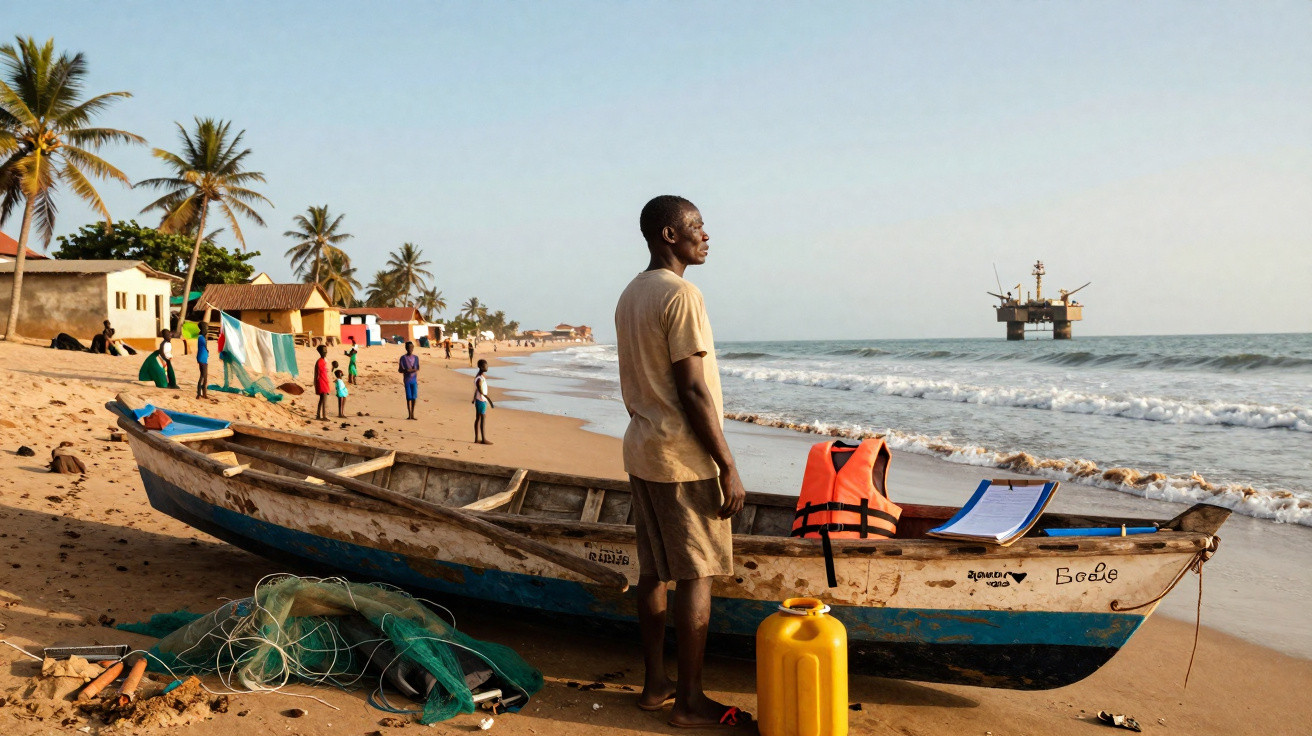
In Joal-Fadiouth, on Senegal’s coast, pirogues still leave before sunrise, their engines drowning out the conversations on the quay. Further offshore, away from homes and fishing nets, the Sangomar oil facilities have altered the landscape without being truly visible: they sit on the horizon, almost abstractly, yet everyone talks about them. Some people hoped for jobs, roads, a better-equipped school or simply a livelier market. Others soon realised that oil does not naturally flow down to villages. Between public pledges, contracts that are difficult to understand and decisions made in capital cities, a sense of unease remains. Black gold mainly shines for those who already hold the keys. And anger is beginning to build.
A treasure beneath the sea, while life on the coast stands still
The start of production at the offshore Sangomar oil field in 2024 was portrayed as a historic turning point for Senegal. Project reserves are estimated at several hundred million recoverable barrels, a dizzying figure in a country where many households still depend on fishing, small-scale trade or seasonal farming. On the quayside, however, oil remains a distant reality: residents can see support vessels and may occasionally hear about platforms, but they cannot access the facilities. The sea remains their workplace, except that it is now shared with an industry far more powerful than their own.
Senegalese authorities have highlighted future revenue, intended to feed the national budget and fund development. According to information released at its launch, the Sangomar field was designed to produce around 100,000 barrels per day at full capacity. For a local fisherman, that figure means little when fuel prices rise or certain marine areas become harder to reach. We all know the feeling when a spectacular announcement appears to be made for everyone, but all that arrives in the end is a press release. Here, that feeling becomes a very tangible concern.
The belief that “everything has been kept” does not necessarily mean the money vanishes into a locked room. Oil revenues move through complex channels: operating companies, state ownership, taxation, investment repayments, public funds and budgetary choices. The problem starts when these arrangements remain incomprehensible to those living near the site in question. Oil transparency is not simply about publishing amounts in a report running to several hundred pages. It also means explaining, in plain language, what goes to the country, what goes to local authorities and what can genuinely improve everyday life.
What residents can request, check and protect
The first practical step is to seek specific information rather than accepting broad promises. A council, neighbourhood association, fishermen’s collective or co-operative can call for the publication of exclusion zones, environmental impact assessments, compensation arrangements and local employment commitments. The right approach is to ask questions tied to dates: how many jobs have been created for local residents since the project began? What budget is allocated to protecting fish stocks? Who monitors discharges and any incidents? Let us be honest: nobody really does this every day, especially when they first have to earn a living.
A common mistake is expecting a major industrial project to transform an area automatically. An offshore platform often relies on highly specialised teams, with technical skills that cannot be acquired in a few weeks. That does not make local expectations any less legitimate; quite the opposite. Residents can demand training funded over several years, contracts accessible to small local businesses, independent monitoring of fishing and funds earmarked for visible projects. A properly equipped clinic, a maintained road or a cold chain for fishermen may seem less dramatic than an oil well, but these are the details that change a day, then a life.
Dialogue must not be used merely to ease tensions for a few months: it needs to leave a record, deadlines and clearly identifiable people accountable.
“A barrel does not fill a plate until the money reaches the villages.”
To prevent that sentence from becoming nothing more than a slogan, several levers can be monitored closely:
- regular publication of revenue paid to the state;
- a breakdown of local jobs, including skilled positions;
- the compensation planned for affected fishermen;
- a clear reporting system in the event of pollution;
- public meetings where responses are recorded in writing.
Sangomar oil can enrich a country or widen the gap between its people
The real issue extends beyond a platform off the coast of Senegal. Wherever a deposit is discovered, the same pattern is often repeated: maps circulate, impressive figures emerge and officials promise a new future. Residents then wait to discover what that wealth will change for them. Oil revenue can fund robust public services, reduce certain economic dependencies and support useful infrastructure. It can also create lasting frustration when decisions remain concentrated among a handful of institutions, companies and experts. Sharing wealth is not measured only in state accounts: it is visible in schools, healthcare, water, jobs and trust.
| Key point | Detail | Value for the reader |
|---|---|---|
| Offshore wealth | Sangomar oil is produced far from residential areas, but its effects directly reach the coast. | Understand why local residents may feel excluded despite a national discovery. |
| Complex revenues | Income passes through contracts, taxes, operating costs and budget decisions. | Avoid the simplistic belief that every barrel produced immediately brings money to villages. |
| Practical demands | Local employment, training, environmental monitoring and data publication are measures that can be verified. | Identify what can be requested from authorities and operators instead of remaining in waiting. |
FAQ
- Why do people living near an oil deposit not receive a direct share of the revenue? Oil revenue is generally paid to the state through taxes, royalties or public ownership in the project. Its use then depends on the national budget, applicable laws and priorities set by the authorities, often creating a gap between the production area and the people who actually benefit.
- Is the Sangomar field close to Senegalese villages? The project is located at sea, off Senegal’s coast. That physical distance does not remove local consequences: fishermen may be affected by navigation zones, maritime safety rules, environmental risks and changes in coastal economic activity.
- What local benefits can be expected from an oil project? The most useful benefits are often indirect: vocational training, contracts for local businesses, infrastructure, health programmes, support for fishing and funding for public services. They need to be clearly announced, monitored over time and accessible to the people concerned.
- How can oil revenue amounts be checked? Citizens can consult documents from the ministry responsible for Energy, budget reports, publications from the Extractive Industries Transparency Initiative and data released by operators. Local associations also play an essential role in translating these figures and demanding explanations.
- Is oil necessarily bad news for communities living nearby? No. A discovery can become a genuine opportunity if revenue is managed transparently, environmental effects are monitored and residents take part in decisions. Everything depends on how this wealth is distributed, overseen and converted into visible improvements.





Comments
No comments yet. Be the first to comment!
Leave a Comment