
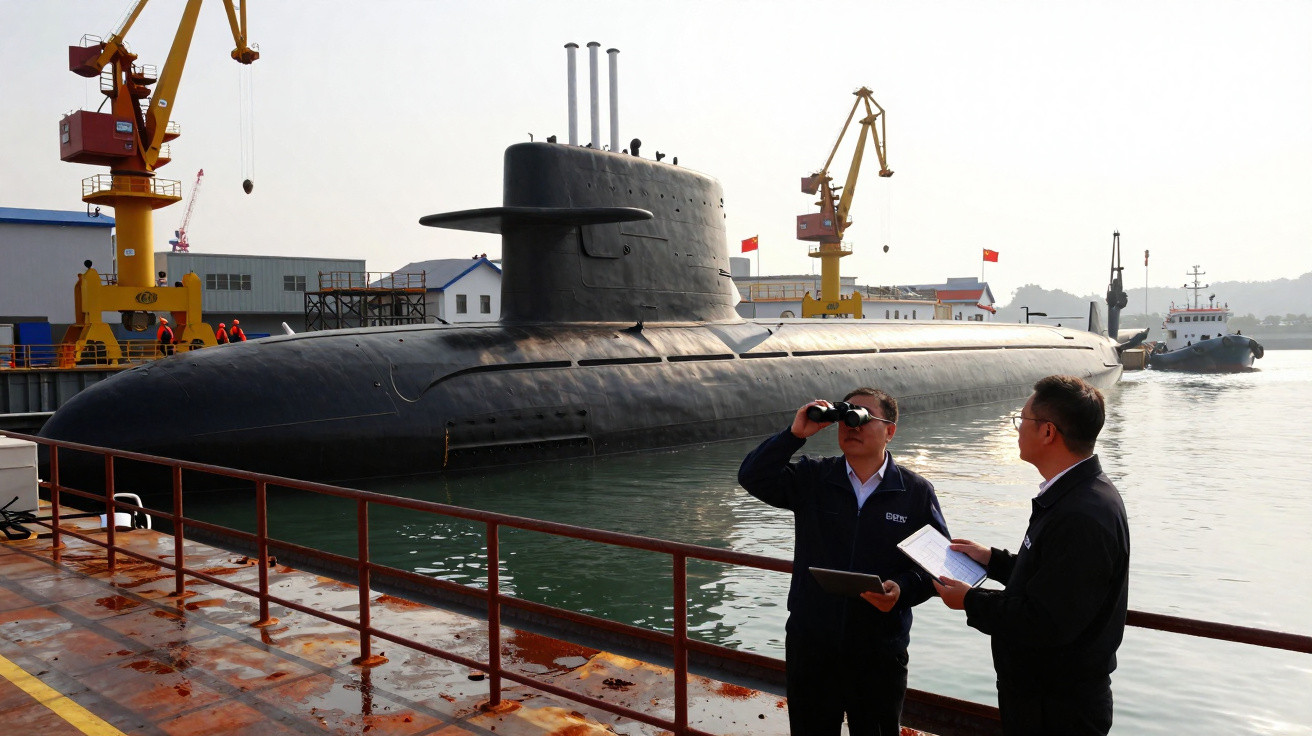
On a screen, it starts with a dark shape set against the grey water of a shipyard. A handful of pixels, an enormous hull and stationary cranes surrounding it can be enough to create a very tangible sense of unease. Recent satellite imagery of the Huludao site in north-east China has revived speculation about an unusually large submarine whose outline appears to lack a visible conning tower. At first glance, the object can seem almost unfinished. Yet its length, bulk and industrial setting suggest something far more strategic. The sea gives nothing away; the images, however, are already speaking volumes.
An unusual silhouette spotted at a Chinese shipyard
The Bohai Shipbuilding Heavy Industry facility in Huludao has long been watched by naval analysts. China builds part of its nuclear submarine fleet there, away from direct observation but never entirely beyond the reach of commercial satellites. This time, the puzzle is not simply the presence of another hull but its appearance: it seems exceptionally substantial, with a notably smooth upper line and no conning tower that can be clearly identified in the released images.
In the secretive world of submarines, the tower - also known as the sail or fin - is no minor visual feature. It normally contains masts, periscopes, aerials and several vital navigation systems. A hull that appears to be without one therefore immediately raises questions. Dimensions suggested by several observers would exceed those of many known attack submarines, although Beijing has published no official measurements. At this scale, every metre matters.
Satellite imagery nevertheless calls for level-headedness. A tower may be fitted later in the construction sequence, concealed beneath a cover, obscured by the viewing angle or incorporated into a design less conspicuous than those of conventional models. One image never tells the full story of a warship. What does appear certain, however, is that a large hull is being launched or prepared for naval fitting-out at a complex already linked with the rapid modernisation of China’s submarine fleet.
Why the apparent lack of a conning tower interests specialists
The most useful way to interpret this type of imagery without slipping into fantasy is to compare multiple dates. A single view can mislead, while a series of images can track the arrival of hull sections, crane movements, dock openings and changes to upper structures. Specialists also match the imagery against quay lengths, shed dimensions and cast shadows. Despite digital tools, it remains patient, almost craft-like work.
A common mistake is to declare a “revolutionary” submarine or unknown weapon too quickly. We all know the moment when a blurry photograph appears to prove a spectacular theory, especially when it spreads rapidly across social media. Military matters contain many blind spots, and Chinese authorities rarely communicate about sensitive programmes. Let us be honest: hardly anyone compares crane shadows and hull lines in photographs taken from space every day.
Above all, analysts look for physical evidence rather than a perfect scenario assembled within a few hours. No visible tower may reflect a design decision, an incomplete stage or a section deliberately shielded from view; it becomes significant when combined with other consistent signals.
“Satellite imagery makes it possible to observe activity, but it does not automatically reveal a vessel’s precise mission or the full extent of its capabilities.”
- The estimated length of the hull and its apparent displacement;
- The presence of infrastructure associated with nuclear submarines;
- Visible changes across several satellite passes;
- Missing features, including the conning tower, that require careful verification.
A further sign of Beijing’s growing naval power
This sighting comes as the Chinese navy is increasingly open about its ambition to become a force able to operate far from its coasts. Aircraft carriers, destroyers, amphibious vessels and submarines are leaving shipyards at a pace that impresses Western observers. The Chinese fleet is expanding quickly, and the facilities at Huludao are among the most closely watched barometers of this development. A giant hull alone does not demonstrate a technological breakthrough, but it reinforces a trend that is already clearly visible.
The most sensitive question, naturally, concerns the vessel’s potential role. Is it a nuclear-powered ballistic missile submarine intended for deterrence? An attack submarine equipped with new sensors? A prototype still far from entering service? No definitive answer can be drawn from the available images alone. The uncertainty is genuine, even if the craft’s size appears to point to an ambitious, expensive and long-term programme.
For neighbouring countries, this episode is a reminder of a reality less abstract than it may appear. A modern submarine can remain undetected for weeks, monitor maritime routes, escort a naval group or strengthen a strategic nuclear capability. India, Japan, the United States and Australia are therefore watching these signs closely. This is not merely a story of metal and shipbuilding: it also concerns regional balance, fragile trust and messages conveyed without a word.
| Key point | Detail | Value for the reader |
|---|---|---|
| A substantial hull has been observed | The images show a very large vessel at the Huludao site | Understand why this shipyard attracts so much attention |
| The tower is not clearly visible | It may be absent, concealed or added at a later stage | Avoid reaching hasty conclusions from a single image |
| The naval context matters | China has been accelerating the renewal of its fleet for several years | Link this observation to a broader strategic issue |
Ultimately, these images are compelling because they expose the limits of what we think we can see. A dark hull photographed from hundreds of kilometres above Earth can become the focus of a global debate within hours. It fuels theories, concerns and sometimes exaggeration. Caution does not diminish the spectacle: a giant submarine does indeed appear to be taking shape in a Chinese shipyard, while its silhouette challenges familiar reference points. The remaining question is what future satellite passes will show: an added tower, new equipment, a departure to sea, or perhaps an unexpected detail that entirely changes how this strange image is interpreted.





Comments
No comments yet. Be the first to comment!
Leave a Comment