
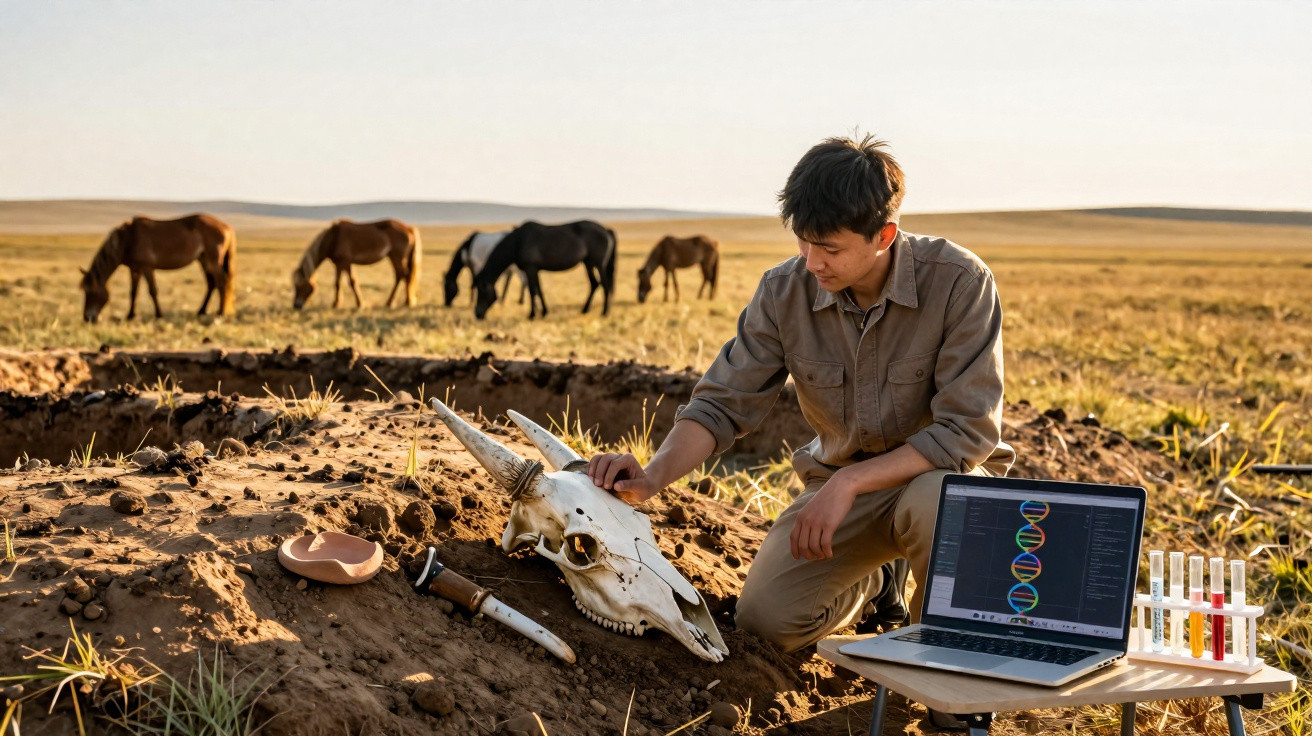
Throughout human history, no other animal has influenced human societies as profoundly as the horse. Yet the timing and process of horse domestication have remained a persistent scientific puzzle.
More than half a million years ago, early human ancestors pursued horses using wooden spears - humanity’s earliest weapons - and fashioned primitive tools from their bones.
By the late Palaeolithic, at least 30,000 years ago, wild horses had become a favoured subject for ancient artists. They are the animal most frequently represented in Eurasian cave art.
Once horses were first domesticated, they underpinned herding communities on Inner Asia’s grasslands. Major technological developments, including the chariot, saddle and stirrup, then made horses the leading form of transport for travel, communication, farming and warfare throughout much of the ancient world.
Assisted by seafaring voyages, horses eventually arrived on the shores of every major landmass - including, for a short time, Antarctica.
As they expanded across the world, horses transformed environments, social organisation and economies on an unprecedented scale. Only industrial mechanisation eventually replaced their almost universal social role.
Given their immense part in forming our shared human past, establishing when, why and how horses were domesticated is essential to understanding the world we inhabit today.
That task has turned out to be unexpectedly difficult. In my new book, "Hoof Beats: How Horses Shaped Human History," I bring together fresh archaeological evidence that is changing what scientists such as me believed they knew about this history.
A hypothesis about horse domestication
Over the years, researchers have proposed nearly every era and region on Earth as the birthplace of horse domestication, from Europe tens of thousands of years ago to Saudi Arabia, Anatolia, China and even the Americas.
However, the overwhelmingly influential explanation has been the Indo-European hypothesis, often called the "Kurgan hypothesis."
According to this theory, sometime during or before the fourth millennium BCE, the Yamnaya - people living on the western Asian and Black Sea steppes who constructed large burial mounds known as kurgans - began riding horses.
The increased mobility of these first riders, the account suggests, helped trigger vast migrations across the continent, carrying ancestral Indo-European languages and cultures throughout Eurasia.
But what evidence actually supports the Kurgan hypothesis as an explanation for the first horse domestication? Some of the most significant evidence comes from ancient animal bones and teeth, examined through the field of archaeozoology.
During the past 20 years, archaeozoological findings appeared to support the view that horses were initially domesticated at sites associated with the Botai culture in Kazakhstan. Scientists recovered substantial numbers of horse bones from these sites, which date to the fourth millennium BCE.
Additional persuasive, though indirect, evidence also accumulated. Archaeologists identified what appeared to be post holes that may once have formed parts of ancient enclosures.
They also uncovered pottery sherds bearing fatty horse residues. Isotope analysis suggests these residues were left during summer, when milk from domesticated horses could have been gathered.
The apparent scientific clincher for early horse domestication was a group of changes observed in certain Botai horse teeth and jawbones. As with many modern and historic ridden horses, Botai teeth seemed to have been worn by a bridle’s mouthpiece, or bit.
Taken together, this evidence strongly suggested that horses were domesticated in northern Kazakhstan around 3500 BCE. This was not quite within the Yamnaya homeland, but it was geographically close enough to preserve the central Kurgan hypothesis.
Yet parts of the Botai account never fully fitted together. From the beginning, several studies showed that the combination of horse remains at Botai differed from that seen in most later pastoral societies: the horses were divided evenly between males and females, with most in healthy breeding age.
Routinely killing healthy animals of breeding age would severely damage a breeding herd. However, such a demographic pattern is common in hunted animal populations.
Projectile points remain lodged in the ribs of some Botai horses, demonstrating that they were killed while hunting rather than through managed slaughter.
These unanswered questions cast doubt over the broad agreement that connected the Botai culture with horse domestication.
New scientific methods create further questions
In recent years, rapidly advancing archaeological and scientific techniques have overturned important assumptions about Botai, the Yamnaya and the earliest stages of the human-horse relationship.
Firstly, better biomolecular methods indicate that whatever occurred at Botai had little connection to the domestication of horses alive today.
In 2018, nuclear genome sequencing showed that Botai horses were not ancestors of domestic horses. Instead, they were ancestors of Przewalski’s horse, a wild steppe relative that, at least in recorded history, has never been domesticated.
Then, when my colleagues and I reassessed skeletal traits associated with riding at Botai, we found comparable features in Ice Age wild horses from North America, which certainly had never carried riders.
Although riding can produce recognisable alterations in the teeth and jawbones, we argued that the minor traits identified in Botai horses could plausibly reflect natural variation or an animal’s life history.
That conclusion revived an important question: was horse transport present at Botai at all?
Moving beyond the Kurgan hypothesis
Over the past several years, efforts to interpret the archaeological evidence for horse domestication have become increasingly contradictory.
For instance, in 2023, archaeologists observed that hip and leg skeletal issues in Yamnaya and early eastern European burials closely resembled those found in mounted riders, which is compatible with the Kurgan hypothesis.
However, such conditions can also result from other animal-powered transport, including the cattle carts found at sites from the Yamnaya period.
How, then, should archaeologists interpret these opposing indications?
A more definite answer may be nearer than it appears. A comprehensive genomic study of early Eurasian horses, published in Nature in June 2024, found that Yamnaya horses were not ancestral to the earliest domestic horses, termed the DOM2 lineage.
Nor did Yamnaya horses display genetic signs of tightly managed reproduction, such as changes associated with inbreeding.
Instead, the first DOM2 horses emerge shortly before 2000 BCE, well after the Yamnaya migrations and immediately before horse-and-chariot burials first appear in the archaeological record.
At present, the various strands of evidence appear to support the idea that horse domestication probably occurred on the Black Sea steppes, but considerably later than the Kurgan hypothesis demands.
Rather, human management of horses accelerated just before horses and chariots spread rapidly across Eurasia in the early second millennium BCE.
There is still much to resolve. In the newest study, its authors highlight unusual patterns in the Botai evidence, particularly variation in genetic estimates of generation time - in other words, the average period required for an animal population to produce offspring.
Could this mean that Botai people kept wild Przewalski’s horses in captivity, but only for meat and not for transport? Possibly. Future research should provide a firm answer.
Regardless, one point has emerged clearly from these conflicting findings: the earliest chapters of the human-horse story are due to be retold.
William Taylor, Assistant Professor and Curator of Archaeology, University of Colorado Boulder
This article is republished from The Conversation under a Creative Commons licence. Read the original article.






Comments
No comments yet. Be the first to comment!
Leave a Comment