
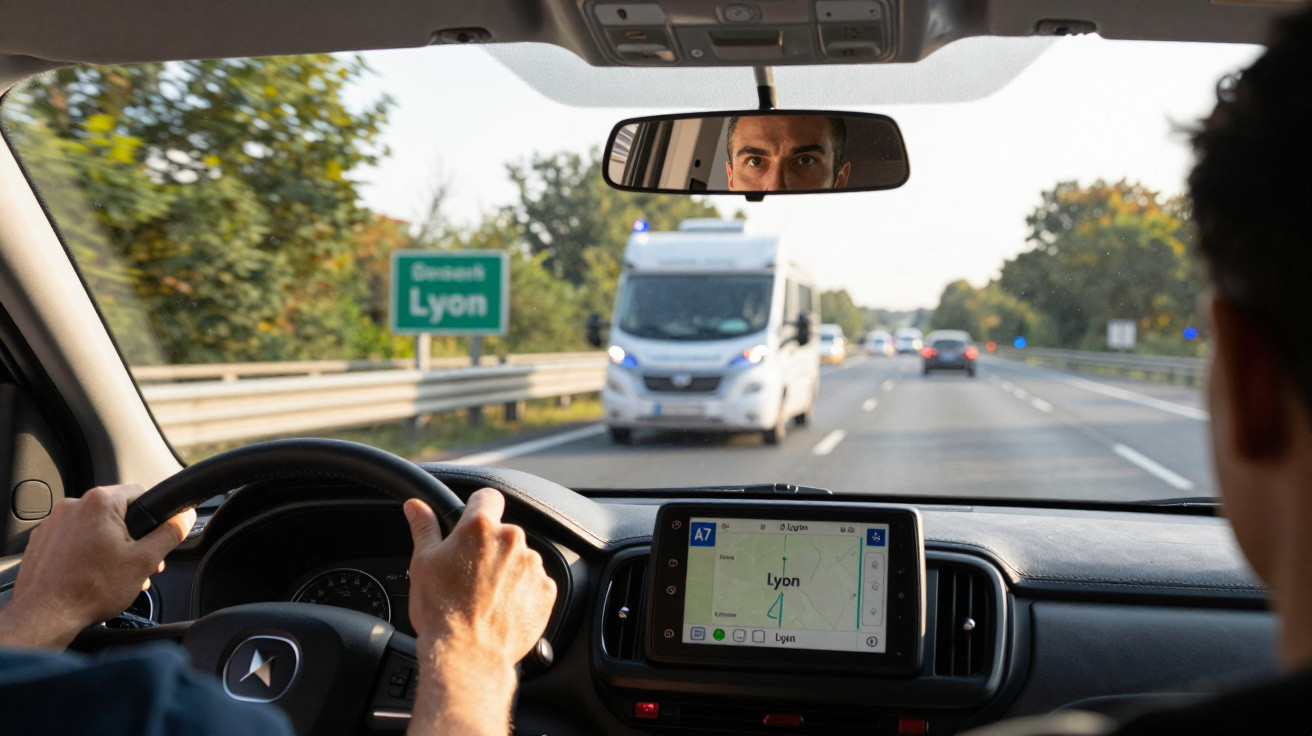
On a road near Lyon, the roar of an engine eventually drowned out conversations and car radios. Motorists saw a motorhome speeding past, with police and gendarmerie vehicles following at a distance, creating an almost unreal scene for people simply heading home. The pursuit is said to have continued for more than 20 kilometres along a route where every bend could have changed the outcome. Drivers in passing cars reacted instinctively: slowing down, pulling over and checking their mirrors. We all know that moment when traffic suddenly feels far from ordinary, as though the road no longer really belongs to us. This time, the fleeing vehicle was not an inconspicuous saloon. It was a large motorhome.
Near Lyon, a motorhome involved in a high-risk escape
A motorhome is hardly designed to weave between lanes or rush through roundabouts. That is precisely what makes this chase near Lyon so striking: a tall, heavy and cumbersome vehicle fleeing for more than 20 kilometres while police officers and gendarmes pursued it. According to the initial information reported about the incident, the driver allegedly failed to stop when ordered to do so before making off, forcing the emergency services to adjust their response. Witnesses remember a white or light-coloured mass appearing in traffic at a speed they considered alarming. On an everyday road, just a few seconds can turn an ordinary journey into a crisis.
Twenty kilometres may look like a short distance on a map. In practice, it means a lengthy sequence of traffic lights, slip roads, junctions, restricted stretches and sometimes built-up areas, where a pedestrian, cyclist or car leaving a parking space may appear without warning. The motorhome reportedly travelled through several areas before the intervention ended, involving both the police and gendarmerie. That distance conveys the pressure faced by the responding teams, as well as by motorists caught in the same flow of traffic. Let us be honest: seeing a leisure vehicle become the focus of a security operation during an escape is not something anyone encounters every day.
In this kind of pursuit, the challenge is not simply catching up with a driver. The emergency services must also prevent any additional danger to other road users, particularly when dealing with a vehicle whose size raises the risks in a collision or loss of control. A motorhome can weigh several tonnes, have reduced visibility in certain areas and behave very differently from a light car during sudden braking. The approach often involves maintaining pressure, sharing relevant information and preparing an interception at the safest possible location. Behind the blue lights, then, is a clear rationale: make the road safe before trying to win the chase.
Why motorists should resist the urge to watch
When a pursuit appears ahead, the most useful first step is straightforward: stay calm and make space. Drivers should slow down gradually, indicate their intentions, move left where possible and never try to follow the convoy, whether out of curiosity or to film it. Holding a phone while driving is especially dangerous in such circumstances, as attention is already drawn by sirens, braking and the unpredictable actions of other vehicles. Any visible or audible instruction from the emergency services must be followed without argument. The best way to help is often to avoid becoming an obstruction. A few metres of clear road can make an enormous difference.
Many drivers believe they are doing the right thing by pulling over sharply as soon as they spot blue lights in their mirror. It is a common mistake, and an understandable one: stress creates an urge to clear the way immediately. It is better to assess the surrounding traffic, check blind spots, ease off smoothly and choose a clear, predictable path for vehicles approaching from behind. Braking hard in the middle of a fast road or turning without indicating can cause exactly the collision everyone is trying to avoid. Passengers also have a quiet but useful role: turn off the music, avoid panicked remarks and help monitor the traffic. In moments like these, the simplest response is often the best one.
Once clear of the affected area, a witness can pass practical information to the relevant services without putting themselves at risk or sharing footage that could complicate an investigation. The rule can be summed up in one sentence:
“Witnessing an incident does not give anyone the right to put themselves in danger: getting home without creating further risk remains the priority.”
The most helpful details are often the most basic:
- the exact location and direction of travel;
- the approximate time of the sighting;
- a description of the vehicle and its behaviour;
- whether there is any immediate hazard on the road.
There is no need to play detective from behind the wheel. A call to 17, when justified and made safely, can alert the teams to something they may not yet have seen.
Beyond the spectacular images, a road disrupted within minutes
This pursuit of more than 20 kilometres near Lyon is a reminder of something easily forgotten when images begin circulating: an escape never affects only the person at the wheel. It involves officers responding to the incident, families in nearby cars, employees travelling home late and residents woken by sirens. The phrase “mad” motorhome stays in the mind because it conveys how unusual the scene was. Yet behind that label was, above all, a heavy vehicle placed in a situation where the smallest mistake could have lasting consequences. The road is a shared space, even when someone suddenly chooses to disregard its rules.
Some witnesses will probably remember the noise, the flashes of blue in their mirrors and one blunt question: how could such an escape have lasted so long? The answers depend on the investigation, the exact circumstances and the decisions made on the ground. For other road users, the incident offers a more immediate lesson: keep your distance, do not give in to fascination, follow instructions and accept that a diversion or a few lost minutes are always preferable to a reckless action. These scenes stand out because they interrupt everyday life. They should also encourage us to discuss our driving instincts, away from hasty comments and videos shared at speed.
| Key point | Detail | Benefit for the reader |
|---|---|---|
| An escape lasting more than 20 km | A motorhome allegedly failed to stop near Lyon, prompting a joint police and gendarmerie response. | Helps assess the level of risk created during an otherwise familiar journey. |
| The right response on the road | Slow down without braking sharply, move over carefully and allow priority vehicles through. | Reduces danger for you, your passengers and the responding teams. |
| The role of witnesses | Record useful facts without following the incident or filming while driving. | Makes it possible to report information effectively without worsening the situation. |


Comments
No comments yet. Be the first to comment!
Leave a Comment