
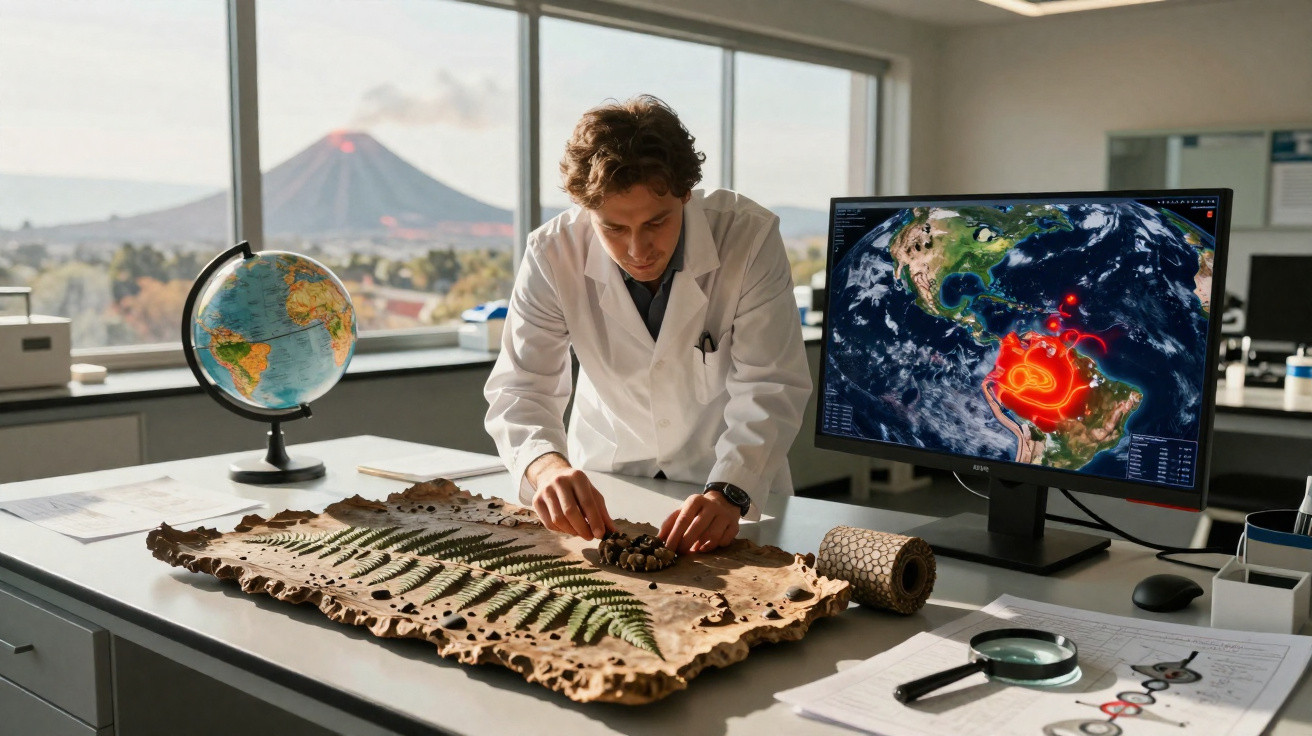
A quarter of a billion years ago, life faced its most severe test as extinction events devastated Earth’s biosphere, leaving only a small number of species struggling to survive.
Known as the ‘Great Dying’, this catastrophe seems to have resulted from a complicated chain of events. New research suggests that extended, extreme climate swings resembling modern El Niños almost certainly made an already disastrous situation far worse.
Using proxy evidence to measure changes in seawater temperature alongside updated climate models, an international research group led by China University of Geosciences geologist Yadong Sun simulated the shifting oceanic and atmospheric currents of around 250 million years ago.
The world before the Great Dying
During the eons before the mass extinctions that ended the Permian and ushered in the Triassic, the first era of the dinosaurs, life had become increasingly diverse. One global ocean encircled a combined landmass of continents, producing an arid interior bordered by cooler coastal waters.
Conifers grew into dense forests, while the four-legged forebears of today’s mammals, birds and reptiles darted beneath their boughs.
Then conditions changed dramatically. Of these expanding tetrapod lineages, perhaps only 10 percent went on to establish later generations. Millions of years afterwards, marine species began disappearing in succession, leaving just one in five alive.
The planet has not experienced a comparable loss of life since, leading scientists to investigate what made this period especially lethal.
Volcanic upheaval and climate instability
A vast deposit of igneous rock in present-day Siberia indicates a major period of volcanic activity across the Permian-Triassic boundary 252 million years ago, a coincidence too striking to dismiss.
Bringing together other lines of evidence, the researchers propose that continuous eruptions triggered a range of cascading effects. These included ozone depletion and the release of more than enough carbon dioxide to heat the atmosphere, while microbial blooms filled the oceans with oxygen before drawing it back out again.
Although this may sound cataclysmic, Earth’s biosphere has endured similar devastation without approaching such extreme losses. More resilient species can adjust to otherwise hostile environmental changes, for example by migrating towards the poles or locating new supplies of water and shelter.
Until now, however, researchers had not accounted for the effects of major short-term shifts in temperature and rainfall. Even in the present day, abrupt weather changes that cause floods, droughts, heat waves and cold snaps lead to extensive ecological damage.
By examining oxygen-isotope ratios in fossilised teeth from ancient marine organisms, the team reconstructed a temperature-change timeline. When assessed alongside wider climate systems, it pointed to a substantial weakening of atmospheric air currents.
‘Mega’ El Niño conditions at the Permian-Triassic boundary
Today, comparable zonal variations in sea-surface temperatures interact through a feedback loop with the Walker circulation. When this circulation weakens from its normal strength, the air rotation eases, altering the distribution of Pacific surface waters. Warm, moist air is then directed eastwards towards South America, while dry air moves westwards, parching Australia and Indonesia.
Such El Niño events are problematic, to say the least, even though they typically continue for only a year or two. Similar late-Permian changes may have produced ‘mega’ El Niño periods that were not only longer-lasting, but also considerably more severe.
Faced with alternating drought and flooding, as well as heat and milder conditions, species capable of enduring major climate changes may nevertheless have found it difficult to adapt. This could have accelerated the pace of extinction.
While the models indicate climate oscillations, the scientists would need to find more direct geological evidence for fluctuating conditions before they could be fully certain of the explanation.
The results may nevertheless cast today’s climate crisis in a different light. Modern El Niño events are forecast to become more powerful and more frequent, with the potential to affect numerous ecosystems worldwide.
Life ultimately flourished once more after the Great Dying. Yet, if the climate record offers any lesson, it is a sobering reminder that every species has its limits.
This research was published in Science.




Comments
No comments yet. Be the first to comment!
Leave a Comment