
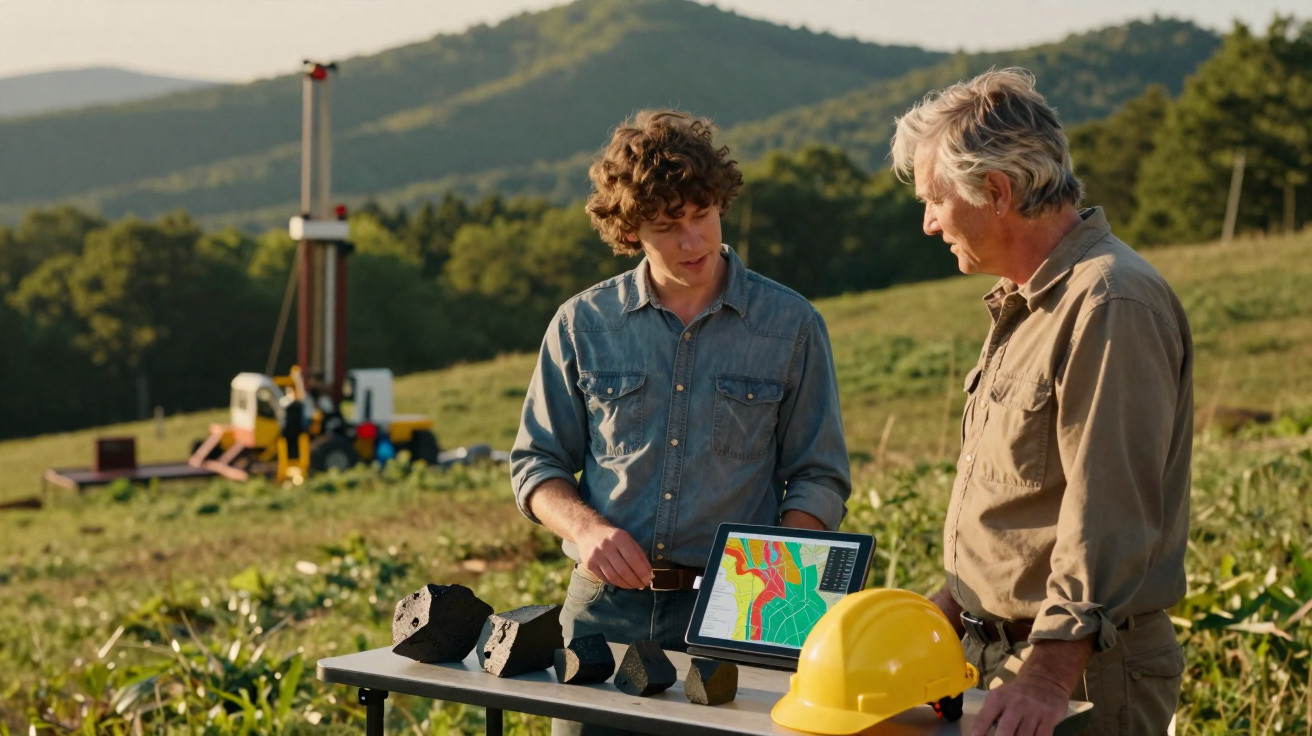
In Woodstock, New Brunswick, winter has a way of muting industrial landscapes. Beneath the snow, old exploration tracks and forgotten drill cores reveal nothing to hurried passers-by. Yet in this part of Canada, explored as far back as 1943, a manganese deposit long confined to archive files is drawing attention once again. Its theoretical value, cited in several financial analyses, is now said to exceed €18 billion. It is a staggering, almost unreal figure for ground once considered unremarkable. Manganese has neither gold’s prestige nor lithium’s shine. Grey, understated and often overlooked, it could nevertheless become one of the vital materials of the energy transition. This old discovery may not have had its final word.
A mineral treasure overlooked for decades
The Battery Hill site, near Woodstock, was identified during the Second World War, when manganese was mainly of interest to the steel and armaments industries. Surveys carried out in 1943 confirmed that the metal was present, but they did not trigger a spectacular mining rush. The world faced other emergencies and priorities, while developing the deposit appeared too expensive or too complex at the time.
Nearly 80 years later, geological assessments are operating on a different scale. Studies published in connection with the project refer to tens of millions of tonnes of mineral resources, with manganese grades considered promising for modern industrial processing. The figure of more than €18 billion is a gross estimate of the ground’s potential, based on assumptions about prices, recovery rates and processing.
That distinction is crucial. An “in-ground” value does not mean a company will receive €18 billion tomorrow. Between ore and a battery lie roads, permits, processing plants, power supplies, employees and years of work. A deposit can look vast on a map while remaining economically uncertain in reality. That is what makes this story so compelling.
Why Battery Hill manganese is back in focus
Manganese has long been recognised for its part in steelmaking. It increases alloy hardness and helps remove certain impurities during production. Its future, however, may also lie in batteries, where it could help cut reliance on more expensive or controversial metals such as cobalt.
We all know the moment when an ordinary item suddenly takes on another significance: an old box found in the loft, a family plot of land or a forgotten notebook. Battery Hill’s manganese is somewhat like that, except this “memory” weighs millions of tonnes. Electric vehicles, energy storage and efforts to secure supply chains have now given the metal a strategic value that nobody would have imagined in 1943.
The €18 billion calculation follows a straightforward logic, although it can mislead when read too quickly: the estimated ore volume, the recoverable quantity of manganese, the expected market price and the attainable purity level. Investors are chiefly watching whether battery-grade manganese can be produced. That is where the most profitable promise lies, but it is also the project’s most demanding element.
What the reassessment really means for investors and local residents
When confronted with such an impressive number, the most useful first step is to examine the source of the valuation. An “indicated” or “inferred” resource does not carry the same status as a mineable reserve supported by a full economic study. It is also necessary to establish whether the stated amount is the metal’s gross value or the potential net value after extraction, processing and transport costs.
The common mistake is to assume that an area becomes wealthy as soon as a deposit is announced. Let us be honest: few people read a technical report running to several hundred pages before sharing a spectacular piece of news. Yet the details are decisive: ore quality, water access, social acceptance, environmental effects, taxation and the global manganese price.
For people living in the region, this possible revival brings both the prospect of jobs and infrastructure and very tangible concerns about the local landscape. A mine is never simply a line on a financial chart. It changes roads, daily routines and sometimes the very identity of a community.
“The true wealth of a deposit is measured not only by what it contains, but by what can be extracted cleanly, sustainably and at an acceptable cost.”
- What to watch: feasibility studies and environmental approvals.
- The project’s ability to produce manganese for batteries.
- Changes in global prices and competition from other producing countries.
A striking figure, but a story still unfolding
The reassessment of this deposit, overlooked since 1943, says something broader than Battery Hill’s fate alone. It illustrates how the energy transition is changing the way we view what lies beneath the ground. Metals regarded as secondary yesterday are becoming sought-after pieces in the race for batteries, electricity grids and low-carbon industry. Manganese could be one of these quiet winners.
A less comfortable question remains: can more be extracted without repeating mining’s past mistakes? Promises of wealth are appealing, particularly in regions seeking employment and investment. But residents also expect assurances concerning water, soils, waste and site restoration. The real test will begin on the ground, far from glowing estimates.
This Canadian deposit also serves as a reminder that geological archives can still hold surprises. An old report, a historic drilling campaign or a new technology can sometimes be enough to put an entire area back on the global raw-materials map. The €18 billion naturally captures the imagination. How this wealth is assessed, developed or protected will reveal much about our era.
| Key point | Detail | Value for the reader |
|---|---|---|
| Origin of the deposit | Battery Hill area, explored in New Brunswick from 1943 | Understand why the project is described as a rediscovery |
| Announced amount | More than €18 billion, based on a theoretical valuation of the mineral potential | Avoid confusing gross value with genuinely recoverable profit |
| Strategic issue | Historic use in steel and growing interest for certain batteries | Assess manganese’s possible role in the energy transition |
FAQ
- Why had this manganese deposit been forgotten since 1943? Manganese was identified in the Woodstock area during the 1940s, but economic conditions, industrial demand and processing technologies did not necessarily make development attractive at that time.
- Is the €18 billion guaranteed? No. This amount is an estimated valuation of the metal potentially contained in the deposit. It represents neither assured revenue nor net profit for a future mining company.
- What is manganese used for today? Its main use is in steelmaking. Its role in certain battery chemistries is also attracting attention because it can help reduce the use of other, more costly metals.
- Could the project create jobs in New Brunswick? A mining operation could generate direct and indirect jobs, notably in construction, transport, maintenance and local services. Everything will depend on approvals and the final investment decision.
- What are the main risks associated with this type of project? The risks involve financing, price volatility, the ore’s actual quality, technical performance and environmental consequences. A major mining promise is always a project that still has to be proven.






Comments
No comments yet. Be the first to comment!
Leave a Comment