
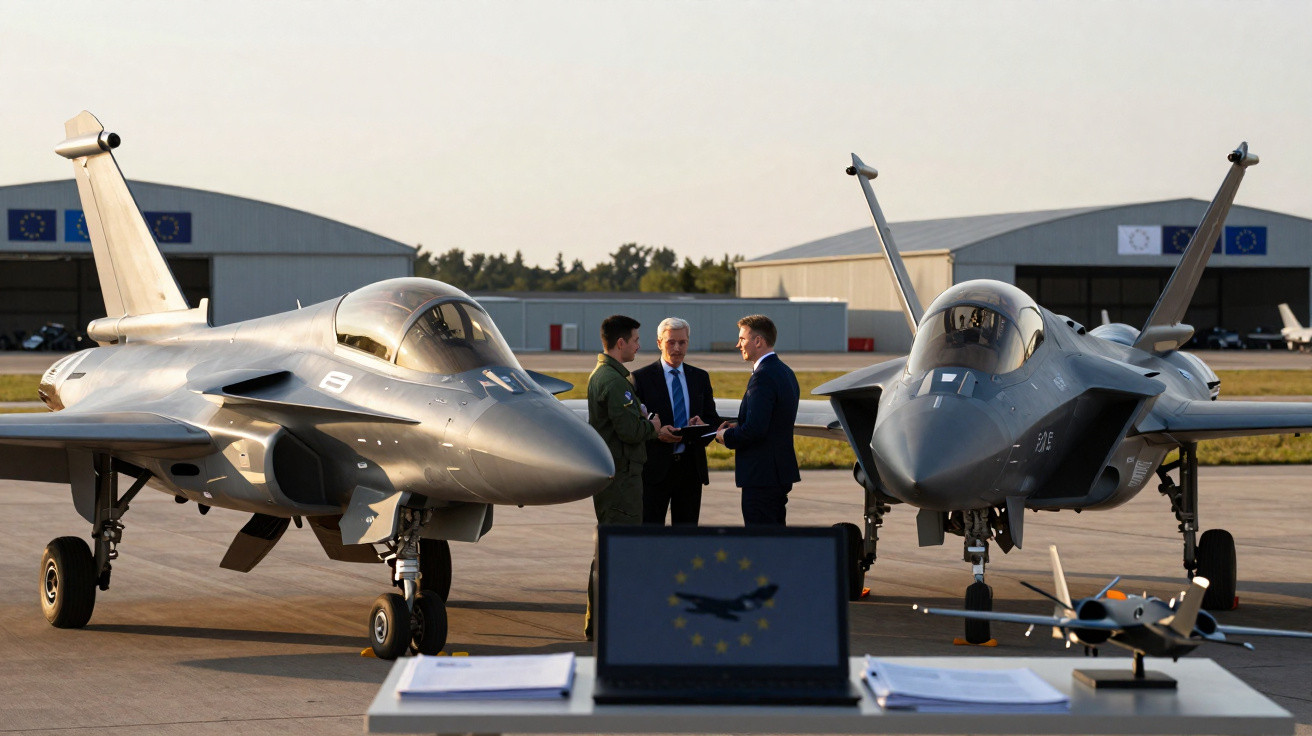
At the hushed stands of aerospace shows, scale models of the Rafale and F-35 draw delegations speaking quietly, phones in hand. Behind the official smiles, one question keeps returning: which aircraft will genuinely be able to fly, carry weapons and be repaired if a crisis erupts at the worst possible moment? For years, European countries answered by looking to Washington. In recent months, the discussion has shifted, driven by transatlantic tensions, the war in Ukraine and the now less theoretical prospect of European military autonomy. Some contracts are already firmly secured. Others remain surprisingly vulnerable. Every choice could shift billions of euros, jobs and a measure of sovereignty. The contest is not over.
The F-35 remains ahead, but the American choice is no longer automatic
The F-35 currently dominates European fighter procurement, having gradually become an almost instinctive choice. Germany, Belgium, Denmark, Finland, Italy, Norway, the Netherlands, Poland, the Czech Republic, Romania and the United Kingdom have selected the US aircraft to varying extents, attracted by its stealth characteristics and its place within the NATO ecosystem.
The figures are striking: Germany has ordered 35 F-35As to replace part of its Tornado fleet, while Poland has signed for 32 aircraft. Greece has also received US approval for 20 aircraft, with an option for a further 20. Across a map of Europe, the outlines of the Lightning II are multiplying.
Yet this momentum does not tell the entire story. Procuring a fighter aircraft is not like buying a car, however premium it may be: it commits a country for 30 or 40 years through software, spare-parts stocks, munitions, training and operating rules. Dependence cannot be judged solely by the listed price.
Rafale versus F-35: fresh European doubts reshape the contest
In Portugal, replacing ageing F-16s has become as much a political issue as a military one. Lisbon was long associated with the F-35, but comments by Portuguese officials in 2025 about the need to examine alternatives revived a contest that many had regarded as settled. The Rafale, Eurofighter and even other options have regained room to manoeuvre.
Spain reflects the same uncertainty. Madrid has not signed an F-35 contract and officially favours the Eurofighter for part of its requirements, while still facing the need to replace its naval AV-8B Harriers. The F-35B remains the clearest candidate for operations from the Juan Carlos I aircraft carrier, but military logic alone does not always determine the outcome.
We all know the feeling: an option looks perfect on paper, then becomes less reassuring when circumstances change. European countries are discovering it on the scale of entire states. A combat aircraft is also a political promise, and political promises can sometimes age faster than airframes.
What upcoming contracts could really mean for Dassault and Lockheed Martin
To assess the Rafale-F-35 rivalry without being carried away by announcements, three practical factors matter: delivery schedules, available weapons and the customer's freedom to decide. An aircraft may be excellent yet arrive too late to replace an ageing fleet. Within an air force, transition years are costly and place strain on crews.
The Rafale has a powerful advantage: France controls the aircraft's design, its development and a large share of its weapons. Countries such as Croatia, which has taken delivery of second-hand Rafales, and Serbia, which ordered 12 new aircraft in 2024, see it as a credible European offer. Let us be honest: hardly anyone compares supply chains, source codes and support clauses calmly every day.
The trap is to reduce the contest to the F-35's stealth versus the Rafale's versatility.
“The F-35 is designed to give allied forces a decisive advantage in the most contested environments,” Lockheed Martin states in its official presentation of the programme.
- The F-35 relies on low radar visibility and extensive data-sharing.
- The Rafale highlights operational autonomy, flexibility and French-led upgrades.
- The winner will also be determined by timings, funding and the alliances of the day.
Will forthcoming orders alter Europe's air-power balance?
The next procurement campaigns could matter more than contracts already signed. Portugal, Spain, Switzerland, Greece and several Central European countries remain under close watch, each with its own constraints. This is not always a direct contest between Dassault and Lockheed Martin: the Eurofighter, Gripen and future European programmes also feature in the calculations.
Switzerland's case captures this tension. Bern selected the F-35A following a very close competition, then had to defend the choice in a national debate shaped by costs, sovereignty and relations with the United States. An industrial decision can quickly become a matter of public trust, particularly when bills extend across decades.
The Rafale will not displace the F-35 wave already under way in Europe tomorrow. However, its growing export success shows that it is no longer merely the French aircraft viewed with curiosity. If European capitals want to retain room for manoeuvre, they will have to choose between the strength of an established allied network and the ability to make their own decisions when conditions become more difficult. The issue reaches far beyond the cockpit.
| Key point | Detail | Value for the reader |
|---|---|---|
| F-35's current advantage | The US fighter has an already extensive European network, advanced stealth capabilities and sought-after interoperability within NATO. German, Polish, Czech, Finnish and Romanian orders generate industrial and operational momentum. | Understand why so many governments select the F-35, even when public debate focuses on its costs, previous delays or technological dependence on the United States. |
| Rafale's strategic strength | The Rafale provides a European-designed solution, with French control over upgrades, maintenance and weapons. It can undertake a wide range of missions: air defence, strike, reconnaissance and, for France, nuclear deterrence. | See that the competition is not determined by raw performance alone: political independence, aircraft availability and access to weapons are equally important. |
| Contracts to watch | Portuguese requirements, Spanish uncertainty over replacing the Harrier, Greek decisions and future fleet modernisation could still reshape the market. Every tender will depend on the diplomatic context at the time. | Identify the countries whose decisions could revive Rafale momentum, reinforce the F-35's position or open a route for other European aircraft. |




Comments
No comments yet. Be the first to comment!
Leave a Comment