
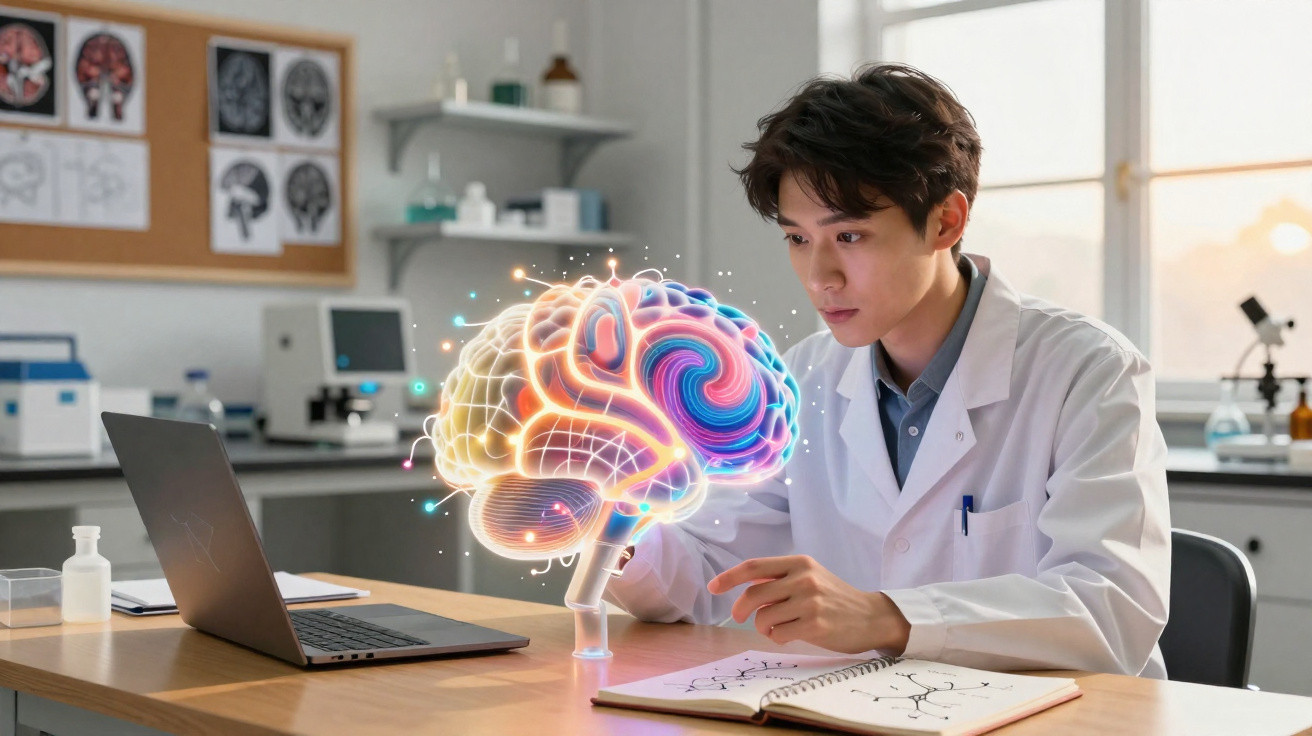
Consciousness, entropy and the brain
It is striking enough that human brains are composed of the same ‘star stuff’ that makes up the Universe, yet a provocative study published in 2016 proposed that this may not be their only shared feature.
The paper suggests that, much like the Universe, the brain may be driven to maximise disorder in a way resembling the principle of entropy - with consciousness potentially emerging merely as a by-product.
For centuries, people have sought to explain human consciousness: our capacity to recognise ourselves and perceive our environment. Despite being fundamental to human existence, scientists are still trying to establish where consciousness originates, when it begins and why we possess it.
A 2016 study led by researchers in France and Canada offered another possibility. Could consciousness arise naturally because the brain maximises the amount of information it contains? Put differently, might consciousness result incidentally as the brain shifts towards an entropic state?
How entropy shapes the Universe
Entropy broadly describes a system’s movement from order towards disorder. Consider an egg: while its yolk and white remain neatly separate, it has low entropy; once it has been scrambled, it has high entropy, representing its most disordered state.
Many physicists believe that this process is occurring throughout the Universe. Since the Big Bang, the Universe has steadily progressed from low to high entropy. As the second law of thermodynamics says that entropy in a system can only rise, this may account for why time’s arrow moves in only one direction: forwards.
The researchers therefore applied this idea to the brain’s neural connections, examining whether they follow particular organisational patterns when we are conscious.
Brain networks in conscious and unconscious states
A team from the University of Toronto and Paris Descartes University used statistical mechanics, a branch of probability theory, to model networks of neurons in the brains of nine people, seven of whom had epilepsy.
More precisely, they examined neuron synchronisation - whether neurons oscillated in phase with one another - to determine whether brain cells were connected.
The team assessed two sets of data. First, they compared connectivity patterns while participants were awake with those seen during sleep. They then studied five of the participants with epilepsy, comparing their brain activity during seizures with that observed when their brains were in a normal, ‘alert’ state.
Both comparisons revealed the same pattern: participants’ brains showed greater entropy during fully conscious states.
"We find a surprisingly simple result: Normal wakeful states are characterized by the greatest number of possible configurations of interactions between brain networks, representing highest entropy values," the researchers wrote.
From this, the team suggested that consciousness may simply be an "emergent property" of a system attempting to maximise the exchange of information.
Why the findings need further research
However, there are substantial limits to the work, most notably its small sample. It is difficult to identify firm patterns from just nine individuals, especially because each person’s brain responded somewhat differently across the various states. For now, the idea also remains largely speculative.
Peter McClintock, a physicist at Lancaster University in the UK who did not take part in the research, told Edwin Cartlidge at Physics World that the findings were "intriguing". However, he said they would need to be reproduced in a larger group of participants, with experiments covering other brain states too, including when patients are under anaesthesia.
Even so, the study offers a useful foundation for future work and points towards a possible new hypothesis for why the brain is generally conscious.
We are only starting to understand how the brain’s organisation may influence consciousness, but it is a remarkably absorbing line of enquiry. It is also a welcome reminder that the laws governing the Universe connect us all.
The research was published in Physical Review E.
A version of this article was originally published in January 2018.






Comments
No comments yet. Be the first to comment!
Leave a Comment