
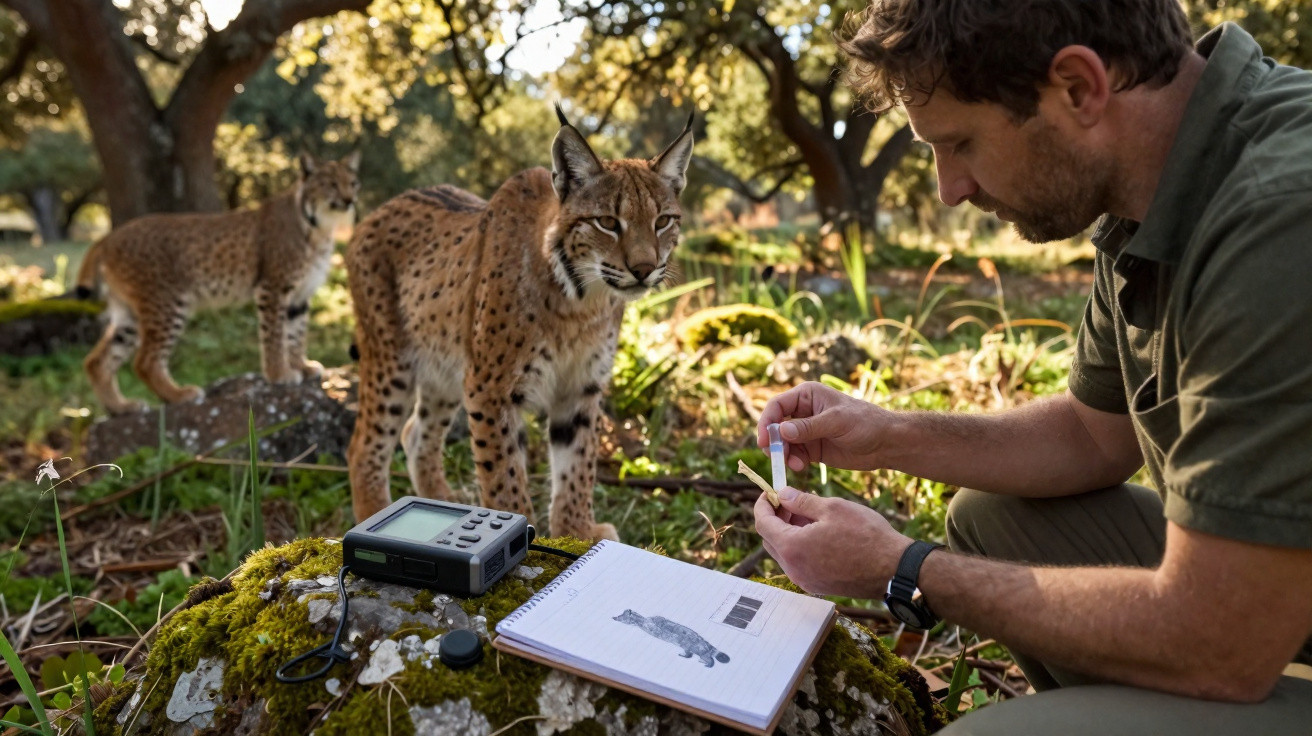
Many large mammal species have experienced a loss of genetic diversity, frequently because human activities have reduced their numbers. The consequences can be serious: without this diversity, a population lacks the “genetic database” it needs to adapt to environmental change.
The Iberian lynx (Lynx pardinus) has also suffered this decline in diversity.
Human pressures have brought its populations down to perilously low levels, narrowing its genetic pool. As a result, the lynx may be less able to respond to changing conditions, jeopardising its long-term survival.
Our research team has shown that, over the past several thousand years, Iberian lynx interbred with their relative, the Eurasian lynx (Lynx lynx).
This genetic mixing may have increased genetic diversity in the Iberian lynx. That could be vital to the species’ survival, particularly given its uncertain future.
Genetic diversity and conservation risk
Low levels of genetic diversity can cause “inbreeding depression”, in which closely related animals reproduce and produce offspring that are less capable of surviving. In severe circumstances, this can drive whole populations - or even species - towards extinction.
To increase diversity in populations close to collapse, conservationists sometimes use “genetic rescue”. This means introducing animals from separate populations in the expectation that they will breed with local individuals, lowering inbreeding and increasing genetic diversity.
Although the approach can work, it also carries risks.
Bringing in animals that are genetically too dissimilar may interfere with or weaken useful traits, potentially reducing a population’s capacity to survive and reproduce. This is known as “outbreeding depression”.
Even with these concerns, genetic rescue remains an important conservation measure, although it is generally used carefully.
The Iberian lynx represents one of the most extreme examples of diminished genetic diversity. Once regarded as the world’s most threatened cat species, it is now found mainly in areas of Spain and Portugal.
Rescue and recovery
The Iberian lynx is now rebounding from near extinction. The 2023 census recorded more than 400 reproductive females.
That figure marks a dramatic rise from only 25 in 2002. The recovery has been driven largely by an ambitious conservation programme over the past two decades, including coordinated breeding schemes and reintroductions.
Some of this achievement stems from the “genetic rescue” effect: combining the two remaining genetically distinct populations helped raise the species’ genetic diversity.
Nevertheless, major difficulties remain for the Iberian lynx.
Its population is still well below the 1,100 reproductive females required for it to be considered genetically viable. Its genetic diversity therefore remains among the lowest ever documented.
Additional genetic rescue might increase this diversity. However, there is an obstacle: no other Iberian lynx populations anywhere in the world could provide fresh genetic material.
Ancient Iberian lynx DNA
Scientists can obtain ancient DNA from historic remains or subfossil samples - animals that are neither old enough to qualify as genuine fossils nor recent enough to be considered modern.
Examining such material gives researchers important evidence of a species’ genetic history and creates a striking comparison with present-day animals.
In 2015, our colleague Maria Lucena-Perez first travelled to the German laboratory of another colleague, Michael Hofreiter, to produce the first whole-genome data from ancient Iberian lynx bones.
Recovering ancient DNA from bone is a highly specialised procedure, requiring dedicated clean-room facilities to avoid contamination by modern DNA.
Together, our team extracted nuclear DNA from three ancient Iberian lynx specimens.
Two specimens were around 2,500 years old, while the third was more than 4,000 years old.
It was the first occasion on which nuclear DNA had been recovered from ancient Iberian lynx. Maria’s work has greatly improved our knowledge of how the Iberian lynx’s genetic make-up has changed across thousands of years.
We analysed the DNA and compared it with that of modern Iberian lynx. Unexpectedly, the ancient animals had even less genetic diversity than their modern descendants.
Considering the steep population decline during the past few centuries, this result was both surprising and difficult to explain.
Species interbreeding
The key to resolving this puzzle was the finding that modern Iberian lynx populations share more genetic variants with the closely related Eurasian lynx than the ancient specimens did.
This indicates that the two species successfully interbred during the past 2,500 years, increasing genetic diversity in present-day Iberian lynx.
The results match substantial genomic evidence for ancient gene flow from Eurasian lynx into the Iberian lynx genome. Although the species do not occupy the same habitats today, they previously lived alongside one another on the Iberian Peninsula, and perhaps also in southern France and northern Italy.
Such overlap would have created many chances for interbreeding.
As both species continue expanding their ranges, the likelihood that they could meet and breed naturally is increasing again. This may create new future opportunities to add genetic diversity.
Whole nuclear genome analysis, developed over the past 30 years, has uncovered many examples of interspecies breeding, including polar bears and brown bears. The lynx case may therefore be less exceptional than it first appears.
However, the Iberian lynx is the first recorded example in which breeding between species substantially raised genetic diversity across an entire species.
We do not yet completely understand the precise consequences of this genetic increase, especially whether it enhanced population fitness and survival. One compelling possibility is that Iberian lynx have persisted despite exceptionally low genetic diversity because Eurasian lynx repeatedly provided genetic rescues.
Although much remains to be discovered, our work provides an unexpected but significant case study for the wider debate about genetic rescue.
If we become better able to forecast the likelihood of inbreeding and outbreeding depression when interbreeding occurs, genetic rescue could be used more effectively as a conservation tool during the continuing biodiversity crisis.
Johanna L.A. Paijmans, Postdoctoral Research Fellow in Zoology, University of Cambridge; Axel Barlow, Lecturer in Zoology, Bangor University; and José A. Godoy, Conservation Genomics Researcher, Doñana Biological Station (EBD-CSIC)
This article is republished from The Conversation under a Creative Commons licence. Read the original article.





Comments
No comments yet. Be the first to comment!
Leave a Comment