
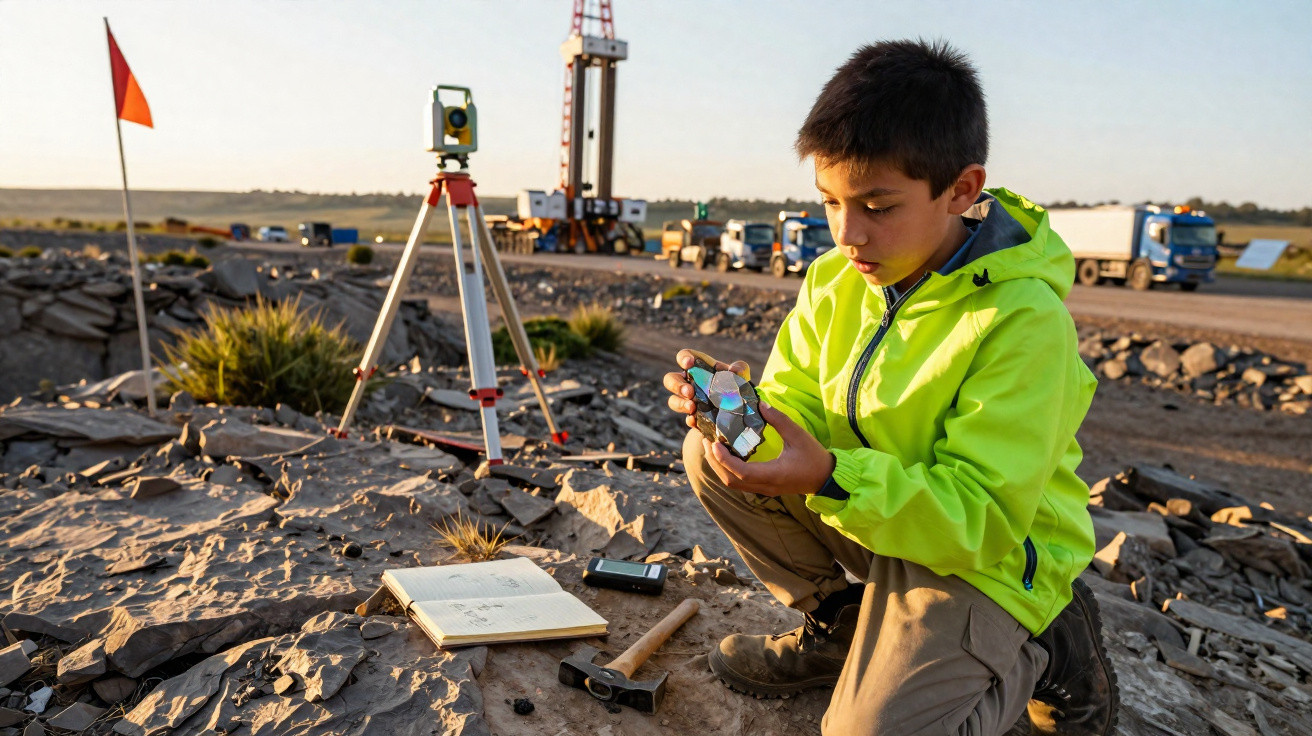
A geologist’s hammer, a dust-covered notebook and a few stones stored in a plastic bag: the find could easily have gone unnoticed. During fieldwork, a geology student is said to have identified clues suggesting the presence of a rare earth deposit valued at almost €110 million. Barely had the news circulated among specialists when a private company reportedly asserted rights over the area in question. In university corridors and in villages near the site, the same question is being asked: who really owns a discovery made in the field? Behind the headline figure lie a young researcher, complex mining rules and a resource that has become strategically important. The story is only just beginning.
A student discovery that could be worth a great deal
The situation echoes the field days familiar to Earth science students: walking for hours, studying outcrops, recording a rock’s colour, then returning with samples that look unremarkable to everyone else. It was in this setting that a geology student reportedly spotted an unusual mineral anomaly consistent with the presence of rare earths. These metals do not necessarily glitter when held in the hand. They are often concealed within complex formations, mixed with other minerals and far removed from the spectacular image of a gold vein.
The stated €110 million figure is based on the deposit’s assumed potential and on the market prices of highly sought-after metals such as neodymium, dysprosium and praseodymium. They are used to make permanent magnets, wind turbines, electric car motors and certain electronic equipment. One fact changes the picture: according to estimates regularly cited by European institutions, China still overwhelmingly dominates rare earth processing supply chains. The discovery of a new source on the continent therefore quickly attracts attention.
It is nevertheless important to remain level-headed. The gap between a promising geological anomaly and a profitable mine is wide, expensive and sometimes disappointing. An interesting rock is not yet an exploitable deposit. Grades must be confirmed, volumes measured, depth assessed, and access to water, roads and electricity examined. To be honest, no one really does this every day, not even major mining groups.
Why a private company can claim the rare earth site
The first step is to establish the precise legal status of the land and the subsoil. In many countries, owning a plot does not automatically mean owning the mineral resources beneath it. Exploration licences, concessions and mining titles are governed by separate rules, often issued by the state or a regional authority. Before discussing a reward or ownership, the student, the university and the local residents concerned must therefore check official registers and cadastral maps.
A common mistake would be to assume that whoever finds a mineral indication automatically becomes entitled to its value. It is understandable: everyone knows the feeling of believing they have found something unique. Yet a private company may have funded earlier surveys, hold a valid licence or have an option over the area. The student’s discovery may then strengthen its case without granting the student any direct right to the extraction. This mismatch often creates a sense of unfairness.
The best safeguard is traceability: date the samples, retain the GPS coordinates, document the analyses and inform the university before publishing detailed information. As a rule often repeated in the mining industry puts it:
“A declared resource must be proven before it is sold as a reserve.”
The points requiring checks are clear:
- the validity of the licence held by the private company;
- the method used to estimate the €110 million;
- any rights held by the student and their university;
- the environmental consequences of future extraction.
A strategic resource, but never without consequences
Rare earths have a misleading name: they are not always scarce in the Earth’s crust, but they are seldom concentrated in quantities that are easy to extract. Processing them requires heavy industrial methods and can produce complex waste, sometimes associated with naturally occurring radioactive elements. The economic promise of €110 million must therefore be weighed against the real cost of an operation. The figure is alluring, but the ground sets the rules.
For nearby residents, this matter goes beyond scientific curiosity alone. A mine can generate jobs, bring in roads and support a weakened local economy; it can also transform familiar landscapes, place pressure on water resources and divide a community. When a private company quickly claims a site, transparency becomes crucial. Residents need to know what has been found, what is merely assumed and what has already been legally secured.
This student’s case also exposes a highly current tension: Europe and many states want to reduce their dependence on imports of critical metals while avoiding the mining damage condemned elsewhere being repeated on their own soil. A discovery can be an opportunity without becoming a blank cheque. Between the pride of identifying an exceptional area and the necessary caution, the debate deserves more than rapid announcements or overly dazzling promises.
| Key point | Detail | Added value for the reader |
|---|---|---|
| Geological discovery | A student reportedly identified indications consistent with rare earths. | Understand that a promising sample is not enough to validate a mine. |
| Stated estimate | The site’s potential has been put at €110 million. | Distinguish between theoretical value, a resource and an exploitable reserve. |
| Private claim | A company may rely on a licence or earlier rights. | Identify the legal issues behind a scientific find. |
FAQ
- Why are rare earths so sought after? They are used in powerful magnets, electric vehicles, wind turbines, smartphones, medical equipment and certain defence technologies. Their role in the energy transition has increased their strategic importance.
- Is €110 million the amount the student could receive? No. This sum would represent an estimate of the deposit’s potential value, not a personal reward. The student’s rights would depend on the country, the land, the university and existing contracts.
- Can a private company take ownership of a discovery? It can develop or claim an area if it holds a valid mining title. It must still comply with administrative and environmental procedures and, in some cases, public consultation requirements.
- What is the difference between a resource and a reserve? A resource is an identified mineral concentration with a certain level of potential. A reserve is the portion whose extraction is considered technically, economically and legally feasible after detailed studies.
- What should a student do after such a discovery? They should retain all field evidence, alert their university supervisors, avoid revealing precise coordinates too quickly and seek independent legal advice before signing any document.






Comments
No comments yet. Be the first to comment!
Leave a Comment