
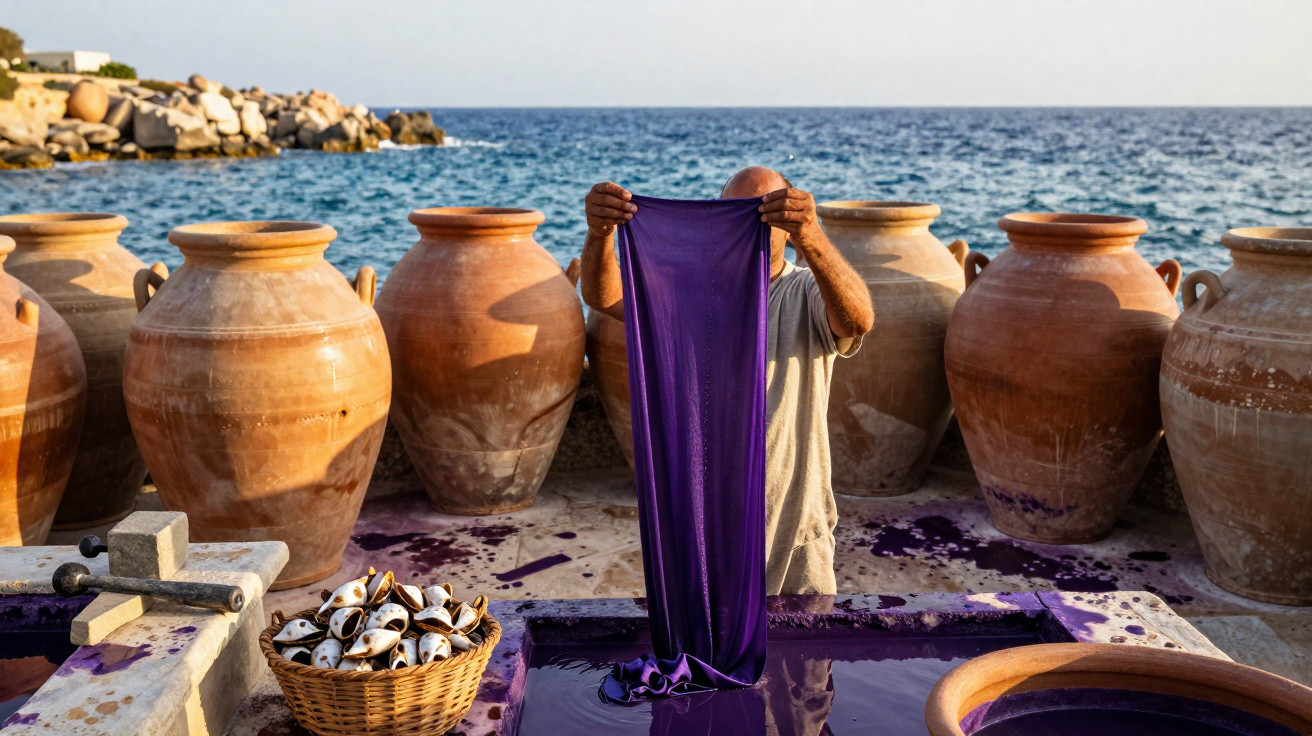
On Israel’s Haifa coast, Tel Shiqmona preserved purple stains on pottery for almost three millennia. A 2025 study brought together more than a hundred dyed objects and large industrial vessels, demonstrating that the site operated as a specialised centre for producing purple dye from marine molluscs.
What did archaeologists find at Tel Shiqmona?
The site includes Iron Age layers occupied from roughly 1100 to 600 BC. By reassessing earlier excavations alongside more recently recovered material, researchers identified 176 objects connected with dye production; 135 of these bore purple staining. Twenty-eight samples underwent detailed chemical testing.
The findings confirmed compounds typical of dye extracted from molluscs in the Muricidae family. The volume and recurring nature of the traces make this assemblage unusual evidence for continuous production on an industrial scale, rather than an occasional experiment by a small household workshop.
How does a sea snail become purple dye?
The dye came from a small gland in marine molluscs known as murex. When first extracted, the substance was pale or greenish, then underwent controlled chemical reactions involving air exposure, light, heating and further processing stages, ultimately creating shades ranging from blue to purple.
Each animal yielded very little raw material, meaning that dyed textiles required huge numbers of molluscs and considerable labour. The procedure also produced a strong smell. The challenge of obtaining and converting the pigment helps explain why purple fabrics could command exceptional prices and become linked with elite status and power.
Why were the large vessels so striking?
The evidence includes large jars capable of holding hundreds of litres, as well as specialised tools and fragments. In some periods, several vessels appear to have been used simultaneously. This standardisation points to planned production, management of raw materials and technical knowledge passed down through generations.
The article, published in PLOS One, identifies Tel Shiqmona as the first known unambiguous evidence of a purple-dye factory that operated in a specialised and long-lasting way in the ancient Mediterranean. The activity expanded particularly from the 9th century BC.
- The study assembled 176 objects related to production, including 135 items with purple stains.
- Chemical tests on 28 samples confirmed dye compounds derived from Muricidae molluscs.
- Large vessels could hold hundreds of litres during processing stages.
- Industrial specialisation is particularly clear from the 9th century BC and continued for centuries.
Watch the video shared by the YouTube channel Clean City – Israel, showing excavations taking place at Tel Shiqmona.
Who bought such an expensive colour?
Marine purple was associated with prestige across several Mediterranean societies. Dyed fabrics could move through political elites, temples and long-distance trading networks. Since fibres readily decay in coastal conditions, archaeologists did not find deposits of finished textiles comparable in quantity to the vessels.
The lack of cloth does not undermine the interpretation, because pigment became embedded in vessel walls and can be chemically identified. Here, the pottery serves as an indirect record of a vanished commodity. The laboratory can recognise the industry even when its organic end product has already disappeared.
What does this factory change about ancient luxury?
The site demonstrates that luxury goods relied on complex supply chains long before the Roman Empire. Molluscs had to be collected, their secretions processed, reactions controlled, vessels maintained and the product distributed. This required skilled workers and an economic organisation capable of supporting an expensive activity.
When purple fabric appears in an image of a king or priest, it is easy to see only the colour. Tel Shiqmona reveals the factory hidden behind the symbol. Thousands of small animals and numerous stages of labour were concentrated into every rare shade that reached the clothing of Mediterranean elites.




Comments
No comments yet. Be the first to comment!
Leave a Comment