
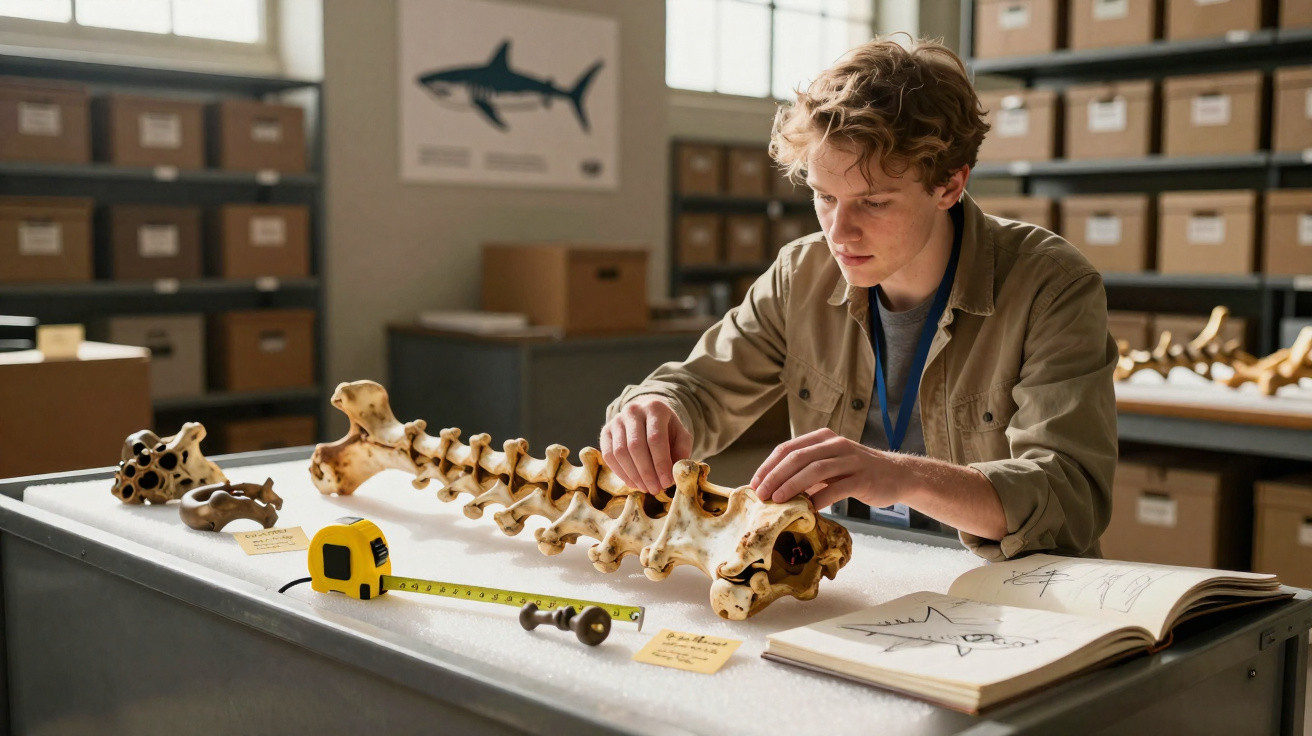
For decades, one of the most significant clues to the megalodon’s size appeared to have vanished. Giant vertebrae recovered in Denmark were damaged during a collection move in 1989 and subsequently regarded as lost. Fragments identified years later enabled scientists to confirm something remarkable: this Otodus megalodon may have reached roughly 24.3 metres in length.
How did such important fossils become forgotten?
The vertebrae were excavated in 1978 from the Gram Formation, a Late Miocene deposit in Denmark, before being taken to Copenhagen’s Geological Museum, now part of the Natural History Museum of Denmark. During a transfer between storage facilities in 1989, the material was badly damaged and came to be considered lost to science.
Some fragments had nevertheless survived. A study published in the journal Palaeontologia Electronica in 2026 states that the material was recognised within the collection in 2017 and is now catalogued as NHMD 157890. Its rediscovery allowed researchers to examine directly measurements that had long been known chiefly from old photographs and descriptions.
What did the vertebrae reveal about megalodon size?
The largest surviving vertebra verified a diameter of around 23 centimetres, matching the exceptional measurement recorded decades earlier. Palaeobiologist Kenshu Shimada and his colleagues describe it as the largest known vertebra of O. megalodon and, to the authors’ current knowledge, the largest documented for any non-tetrapod vertebrate.
By comparing this measurement with another set of megalodon vertebrae attributed to an animal estimated at 16.4 metres long, the researchers calculated a projected length of 24.3 metres for the Danish individual. There is, however, an important qualification: the team itself calls this reconstruction hypothetical, as it relies on body proportions inferred from incomplete fossils.
- The vertebrae are about 10.8 million years old and were found in Denmark’s Gram Formation.
- The largest specimen confirmed a diameter of approximately 23 centimetres.
- The individual’s length was tentatively estimated at about 24.3 metres.
- The growth model indicated a birth size close to 3.6 metres.
- The more conservative analysis suggested a theoretical lifespan of up to roughly 96 years.
Did a baby megalodon measure 3.6 metres at birth?
Vertebrae preserve marks associated with growth, allowing researchers to attempt a reconstruction of the animal’s different life stages. Using models applied in earlier studies, the team estimated a length at birth of about 3.6 metres. This would mean that a newly born megalodon could have been larger than many adult sharks living today.
The model the authors considered most plausible also indicated a theoretical lifespan of around 96 years, along with the potential for an even greater growth limit. The scientists stress, however, that these estimates carry a wide margin of uncertainty because the growth bands are incomplete and the calculation is based on just one fossilised individual.
Why is the maximum size of this shark so difficult to establish?
The difficulty begins with the skeleton itself. Sharks have predominantly cartilaginous structures, whose fossilisation potential differs from that of the bones of many vertebrates. Consequently, much of what is known about megalodon comes from teeth and comparatively rare sets of vertebrae, leaving many body dimensions dependent on reconstructions and comparisons.
The study’s authors state that a more complete skeletal specimen, ideally found with its own teeth, would be needed to advance the debate over the species’ maximum size with confidence. Therefore, 24.3 metres should not be viewed as a definitive measurement for every large megalodon, but rather as an estimate supported by this exceptional material.
How many discoveries might still be hidden in museums?
This story also demonstrates that a palaeontological discovery does not have to begin with a fresh excavation. Major museums hold millions of items, many of which are primarily accessible to researchers. The Natural History Museum in London, for instance, says it looks after more than 80 million objects, only a small proportion of which are on public display.
In the case of the Danish megalodon, identifying damaged fragments restored to science evidence that had seemed to exist only in historical records. These vertebrae now help reconstruct not only the size, but also the growth of one of the largest marine predators known. It is worth looking again at museum shelves: some may hold answers that science believes it has lost.






Comments
No comments yet. Be the first to comment!
Leave a Comment