
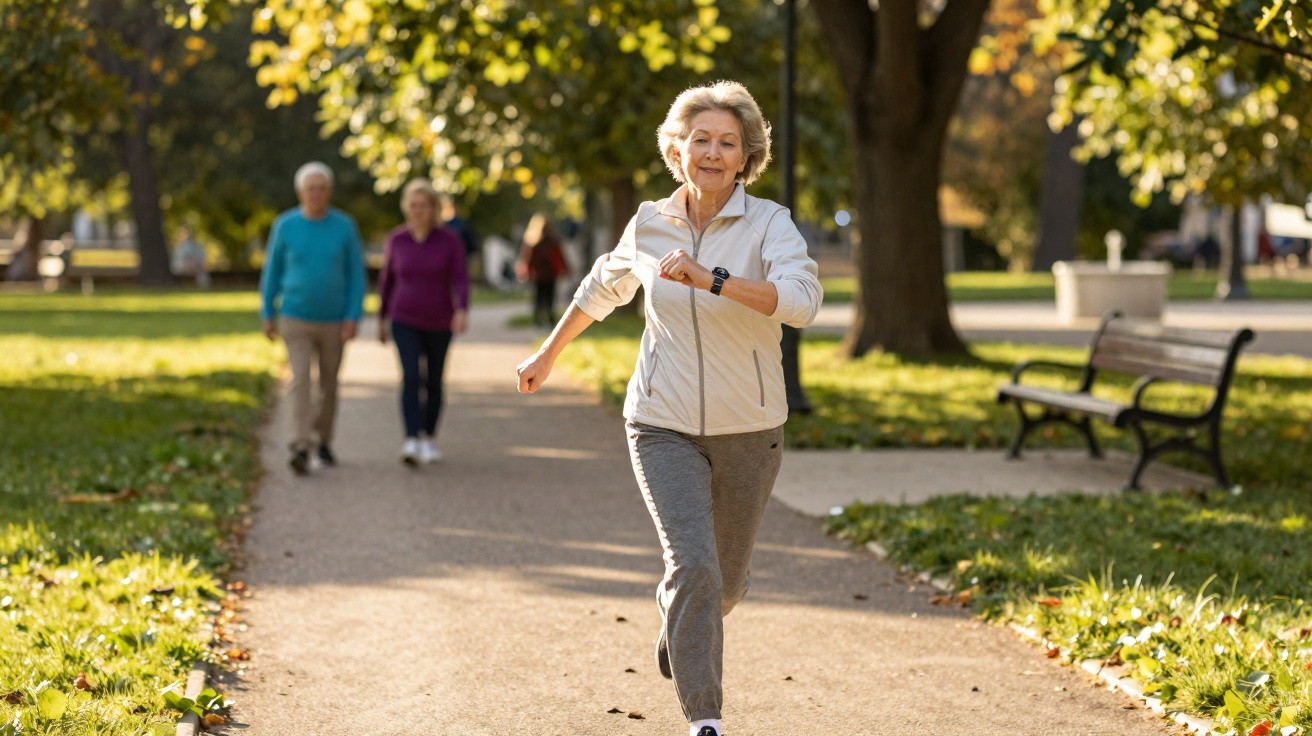
For Rafael Hidalgo, starting to move more after 70 does not require lengthy walks or a commitment to reaching 10,000 steps every day. “If someone over 70 walks for 20 minutes a day, they already gain benefits,” says the Spanish trainer. His approach is to use an achievable duration as a starting point for improving fitness, mobility and wellbeing, then gradually increasing the effort in line with each person’s ability.
Why can walking for just 20 minutes make a difference?
Moving from a sedentary routine to a daily walk immediately raises the total amount of activity accumulated across the week. The heart works harder, large muscle groups in the legs are engaged and the joints repeatedly take part in the movement, creating stimulation that is absent during long spells spent sitting down.
Hidalgo suggests 20 to 30 minutes as a practical starting benchmark, rather than a threshold below which exercise no longer has an effect. International guidance itself stresses that some physical activity is better than none, and advises older people to begin with small amounts when necessary.
- Walking increases the daily volume of physical activity;
- It can fit into everyday life without special equipment;
- The duration can be extended as fitness improves;
- Short breaks do not cancel out the minutes already completed;
- Consistency is generally more sustainable than occasional, very intense efforts.
Is it essential to reach 10,000 steps every day?
No. A target of 10,000 steps may encourage some people, but it is not a biological dividing line between gaining benefits and gaining none. For a person who currently moves very little, beginning to walk regularly is already progress, even if their daily total remains far below that figure.
How can you increase walking without making exercise exhausting?
Hidalgo’s recommendation is to progress gradually. Once 20 or 30 minutes feels comfortable, some people can slowly move on to longer periods. Intensity should also match fitness levels: the aim is not to endure an exhausting walk, but to build up minutes of movement with a safe, steady gait.
For people over 70, a few small adjustments can make the habit easier to maintain:
- Start with a duration that feels comfortable;
- Take breaks if excessive fatigue appears;
- Increase time or pace gradually;
- Choose flat, safe routes at first;
- Wear stable footwear suited to walking;
- Reduce the effort if dizziness, pain or unusual shortness of breath occurs.
Is walking alone enough after 70?
Walking is valuable for aerobic capacity, but it does not address every component needed to maintain independence. Guidelines for people aged 65 and over recommend 150 to 300 minutes of moderate aerobic activity each week for substantial benefits, alongside strengthening the major muscle groups on at least two days a week. Activities that combine strength and balance are advised on three or more days to help maintain functional ability and prevent falls.
- Walking mainly develops aerobic endurance;
- Strength exercises help preserve muscle;
- Balance training prepares the body for unstable situations;
- Climbing steps and rising from a chair add functional stimulus;
- These types of activity can be combined across the same week.
After 70, the aim is not to break records, but to keep moving
The message from Rafael Hidalgo is particularly relevant for people who see extensive exercise recommendations and decide that it is already too late to begin. Twenty minutes is neither a compulsory formula nor an amount that will have the same effect for everyone. It is an attainable target that can help someone leave behind a sedentary lifestyle and create a path towards a progressively more active routine.
As the years pass, the clearest benefit lies in activities that support independence: walking to a shop, leaving the house without fear, keeping up with family, climbing stairs and continuing to carry out everyday tasks. For those with significant limitations, cardiovascular conditions, recurrent falls or symptoms during exertion, the routine needs to be adapted to individual circumstances. For everyone else, starting with a few minutes and repeating the movement regularly may be far more useful than waiting for the perfect moment to meet a difficult target.






Comments
No comments yet. Be the first to comment!
Leave a Comment