
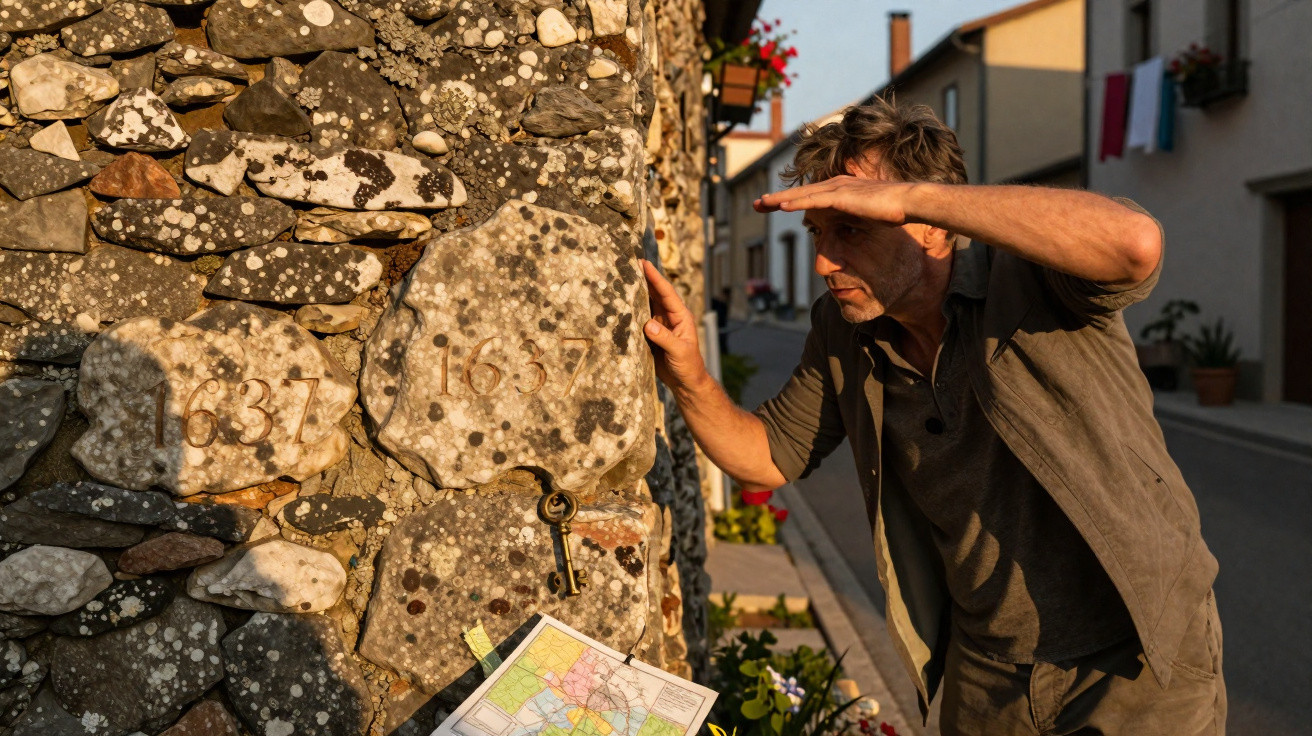
The low wall had bordered the lane for so long that nobody truly noticed it any more. Every morning, André Lemaire walked past it with his dog, between damp gardens and the former communal barn, never suspecting that one stone, slightly darker than the rest, held a fragment of memory. One Tuesday in March, after a shower, moss slipped away from the lime joint. A fine, uneven sequence of numerals emerged: 1637. André initially assumed it was a mason’s mark, but almost automatically took a photograph. By the next day, the image was already being shared at the town hall. A few days afterwards, a local historian was examining the wall, holding a small brush in one hand and archive records under the other arm. It did not take him long to realise that the date told a story far greater than a simple frontage repair.
The stone the whole village had stopped seeing
We have all known the moment when somewhere familiar suddenly feels unfamiliar: the usual street, a neighbour’s gate, the old bench outside the school. For André, it was this low wall, barely 80 centimetres high and built from pale stone, which he had passed thousands of times over fifteen years. The carving was far from spectacular. Erosion had consumed two of the digits, while a tiny cross separated the date from a mark resembling a flower. Yet once the moss had been cleared away, the stone seemed almost able to speak. Traces of the past do not always call out; sometimes, they simply wait for us to slow down.
The village in question, a rural community of fewer than 900 residents, had no record of this wall in its heritage inventory. Volunteer historian Julien Morel compared André’s photograph with a parish register kept at the departmental archives. The year 1637 appears there repeatedly, in a far more serious setting: an outbreak of dysentery struck the valley during the summer. Over three months, 46 residents were reportedly buried-a substantial number for a parish then home to around 280 people. The wall may therefore have been more than an ordinary boundary structure.
Research has produced a convincing theory, although some uncertainties remain. The stone may have identified the site of a former “sick enclosure”, a temporary area set apart from homes when infection spread through the settlement. The land, now divided between vegetable plots and outbuildings, may have provided a place for rest, storage and monitoring for isolated families. This date, 1637, is not decorative. It may mark the point at which villagers built an initial stone boundary to manage an emergency using whatever resources they had. It was a rudimentary response, but a profoundly human one.
How an ordinary walk can bring buried history to light
When an old inscription emerges on a wall, well or beam, the first useful step is to photograph it without touching it. Take several images: one wider view to show its location, a close-up, then photographs in raking light where possible, either in the morning or late afternoon. A lamp shone from the side often reveals indentations that the naked eye cannot detect. Also record the address, approximate coordinates and discovery date. These details may seem minor, but they allow local history groups to cross-check information without wasting time.
It is tempting to scrape away moss, use a wire brush or “clean it up a little” to make the lettering clearer. This is a common mistake, and rarely made with bad intentions. Old stone is more delicate than it appears: an overly forceful movement can erase an inscription already weakened by four centuries of rain, frost and heat. Let us be honest: no one really does this every day. The right approach is therefore to contact the town hall, an archive service or a local learned society before doing anything at all, however minor it may seem.
In this village, the discovery followed a fairly straightforward route: a photograph posted in a residents’ group, a call to the town hall, followed by a specialist’s visit. Julien Morel stresses the importance of local people, who are often the first to spot a forgotten detail.
“Archives provide names and dates, but the land provides presence. When the two meet, a silent story finds its voice again.”
- Photograph the stone from several angles, without using products or rubbing it.
- Record the precise location and the overall condition of the surface.
- Notify the local authority or a nearby heritage organisation.
- Compare possible explanations with cadastral maps, registers and local accounts.
This approach also prevents people from jumping to conclusions. An engraved date may relate to construction, a repair, a death, a flood or a boundary marker: context matters as much as the numbers themselves.
1637, a modest date that changes how an entire neighbourhood is seen
Since the stone was deciphered, residents have not travelled along the lane in quite the same way. Some recall their grandparents mentioning a “fever garden”, without knowing what the expression meant. Others have brought out old notarial deeds, family photographs and a postcard showing the wall before ivy covered it. Not every part of the story has yet been proven, but the fragments are beginning to connect. The village has not uncovered a lost castle: it has rediscovered an everyday wound, experienced by families facing illness and fear.
The town hall is now considering installing a discreet interpretive panel, without turning the spot into an artificial attraction. The proposal is to explain the 1637 epidemic, the enclosure’s presumed purpose and André’s discovery, while also emphasising that the wall remains part of a living landscape today. Schoolchildren could contribute by collecting memories from older residents. One class has already suggested drawing the hamlet as it may have looked in the 17th century. Such projects are especially valuable because they bring heritage closer to the people who pass it every day.
A wider, almost personal question remains. How many dates, names and signs are still sleeping in the stones of our villages-behind a gutter, beneath render or at the bottom of a garden? We live quickly, our attention captured by screens, schedules and errands. Yet a detour lasting only a few seconds can sometimes open a door onto several generations. André was not looking for anything that morning. He was simply walking his dog. That ordinariness makes the story even more unsettling: collective memory can sometimes rest in a groove in a stone, at eye level.
| Key point | Detail | Value for the reader |
|---|---|---|
| A date revealed by rain | The engraving “1637”, concealed beneath moss on an old low wall, was spotted by a walker who had used the lane for years. | It shows that a familiar feature can conceal a heritage clue, even when it is not on a listed site or in a museum. |
| A cross-checked historical lead | Parish archives refer to a severe dysentery outbreak in the same year, with 46 deaths recorded in a community of around 280 people. | Readers can see how an inscription gains meaning by bringing together field observation, old documents and oral memory. |
| The right response to an inscription | Photographing, locating, reporting and not cleaning a stone yourself help protect material that may be more fragile than it looks. | These straightforward actions can prevent a historic detail from disappearing and help a community recover part of its story. |






Comments
No comments yet. Be the first to comment!
Leave a Comment