
Add Zona Militar on Google
Why follow us? Receive the latest updates from Zona Militar in your Google feed.
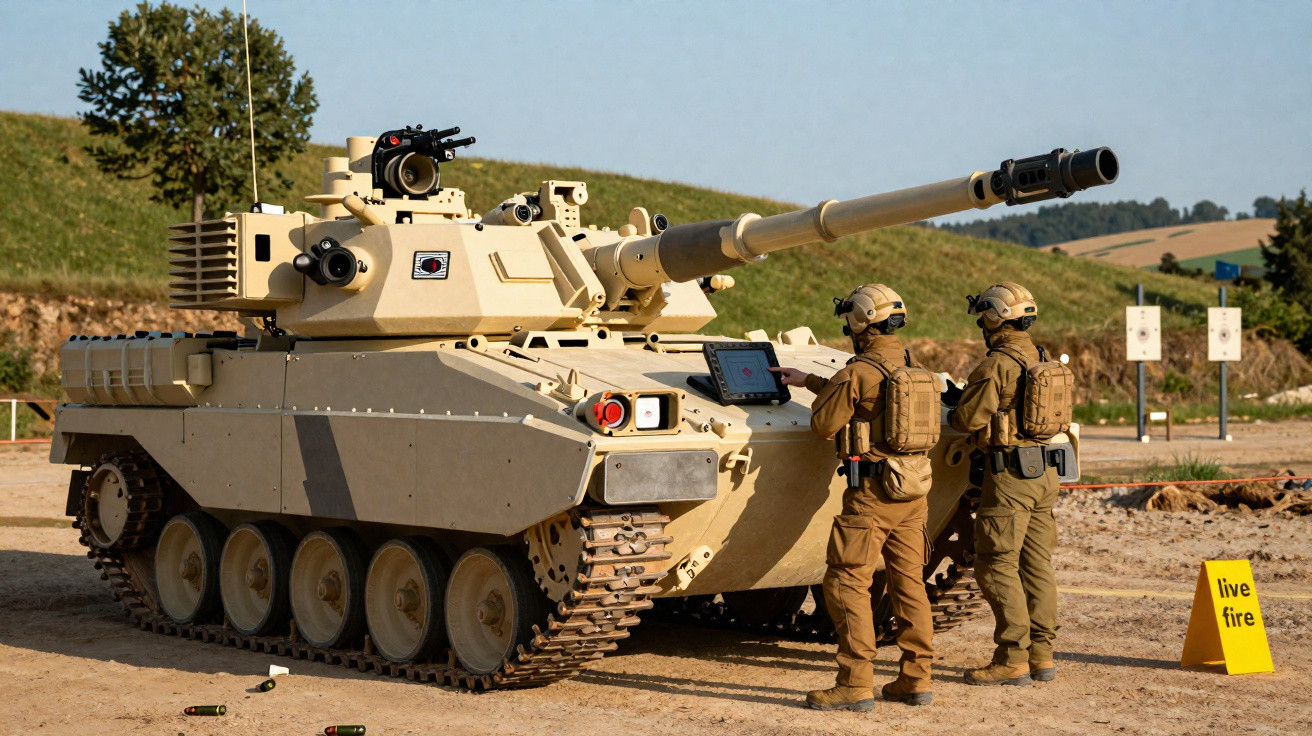
The U.S. Army has moved a step closer to deploying its newest Stryker variant in Europe, as the 3rd Squadron, 2nd Cavalry Regiment carried out live-fire and gunnery exercises with the new Double V-Hull A1 vehicles fitted with a 30 mm cannon at Germany’s Grafenwoehr Training Area.
👉 Read more: U.S. Air Force Declares Initial Operational Capability for New MH-139A Grey Wolf Helicopter to Strengthen Nuclear Arsenal
This activity forms part of a wider familiarisation and qualification programme for crews operating the new platforms, which started arriving with the Germany-based regiment earlier this year. According to the Army, the training is intended to prepare personnel to use the new vehicles while developing combat-ready formations through live-fire and collective drills.
A new generation of Strykers for U.S. forces in Europe
The vehicles now being issued to the 2nd Cavalry Regiment are built on the Stryker Double V-Hull A1 configuration and feature the ICVVA1-30mm Medium Caliber Weapon System. This new turret gives the platform substantially more firepower than the machine-gun-equipped variants traditionally used by Stryker units.
📌 You may also like
- EDA Programme: US progresses with delivery of 17 Stryker 8×8 VCBRs for the Thai Army
- U.S. Air Force deploys B-52H bombers to Australia to strengthen the Indo-Pacific
The Army’s modernisation plans have also concentrated on increasing the vehicle’s survivability and improving its onboard systems, with enhancements to mobility, optics, communications and target acquisition. A practical benefit emphasised during training is the possibility of completing certain weapons-related activities and maintenance tasks while protected by armour.
Although the procurement of new Double V-Hull A1 vehicles has ended, the 30 mm Stryker programme remains a significant element of the Army’s modernisation drive. Existing plans still provide for the fielding and additional capability upgrades of the ICVVA1-30mm fleet, including further ammunition testing and future counter-unmanned aerial system capabilities.
Training for faster target engagement
In addition to the extra firepower delivered by the 30 mm cannon, the new configuration is intended to reduce the time needed to detect and engage threats. Infantry commanders can identify targets through their own observation systems, enabling that information to be quickly relayed to the vehicle’s weapon operator.
This capability is especially pertinent to the 2nd Cavalry Regiment, one of the U.S. Army’s main Stryker formations permanently based in Europe. The regiment has become increasingly involved in testing emerging battlefield technologies, including unmanned systems and counter-drone capabilities.
The arrival of the 30 mm-armed Stryker coincides with the U.S. Army’s continued effort to adapt its European forces to lessons emerging from the war in Ukraine, where armoured formations confront an increasingly complex mix of conventional threats, drones and rapidly developing targeting systems.
The most recent live-fire training at Grafenwoehr is therefore more than a standard gunnery exercise. For the 2nd Cavalry Regiment, it represents another step towards incorporating a more heavily armed Stryker fleet into one of the Army’s principal forward-deployed formations in Europe.
Image credits to their respective owners.
Comments
No comments yet. Be the first to comment!
Leave a Comment