
Add Zona Militar to Google
Why add us? Get Zona Militar news on Google.
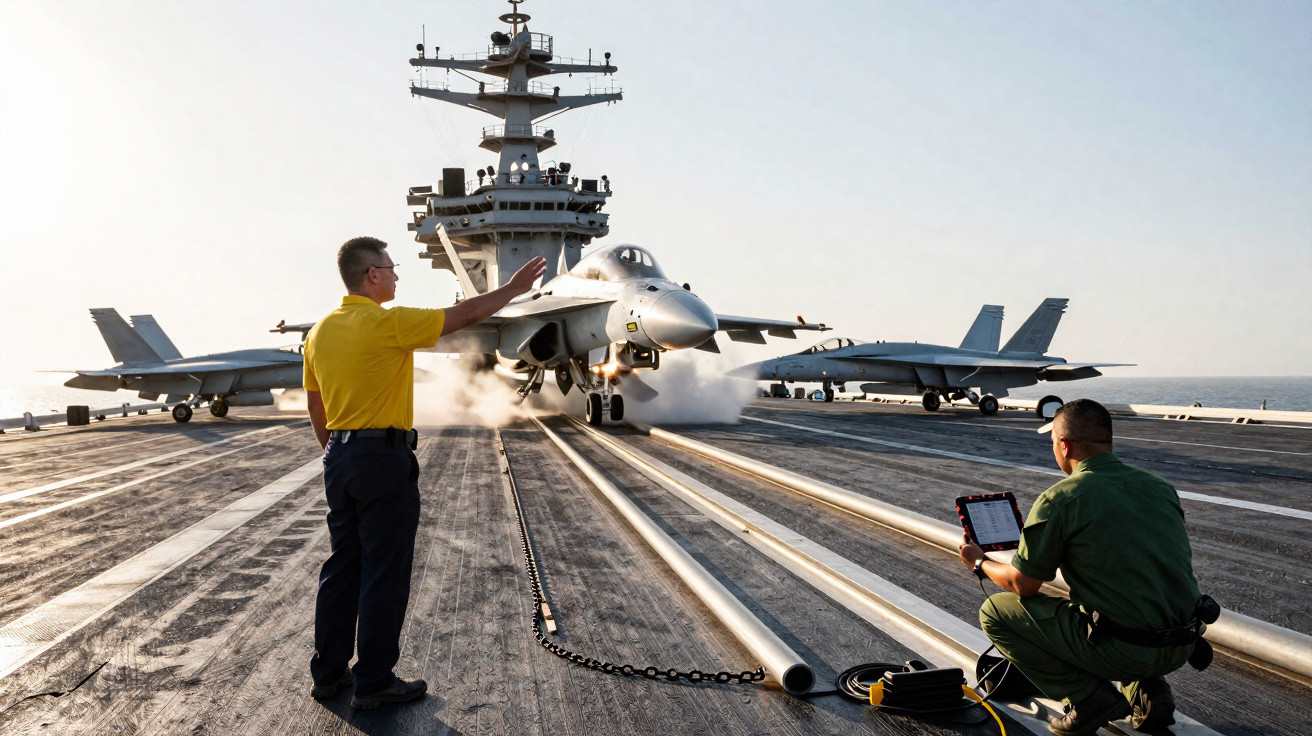
After weeks of discussion about the future of electromagnetic catapults, the US Navy has finally defended their use aboard its Gerald R. Ford-class nuclear aircraft carriers. According to Chief of Naval Operations Admiral Daryl Caudle, USS Gerald R. Ford (CVN-78) outperformed Nimitz-class aircraft carriers in a sortie generation rate test.
👉 Read more: US Air Force declares Initial Operational Capability for the new MH-139A Grey Wolf helicopter to strengthen the nuclear arsenal
USS Gerald R. Ford exceeds Nimitz-class aircraft carrier rates
Conducted in February, the test involved the Electromagnetic Aircraft Launch System (EMALS) and Advanced Arresting Gear (AAG). It assessed, as an integrated whole, the launch and recovery systems fitted aboard the USS Gerald R. Ford nuclear aircraft carrier.
Speaking during a roundtable at the Tailhook Symposium in Reno, Nevada, Caudle detailed the results. The trial took place in the Caribbean Sea before the carrier continued its deployment towards the US European Command (EUCOM) area of responsibility and then the Red Sea.
📌 You may also be interested in:
- South Korean Navy: KSS-III Dosan Ahn Chang-ho submarine completes historic Pacific mission
- US Air Force deploys B-52H bombers to Australia to reinforce the Indo-Pacific
“The way you measure performance is through a test that we conduct, called a sortie generation rate test, which the Ford conducted,” Caudle said. The admiral added that the vessel achieved between 120% and 130% of the rate recorded by Nimitz-class aircraft carriers.
According to Caudle, the outcome cannot be attributed solely to the electromagnetic catapults or the arresting system. “It’s not just the catapults and the arresting gear. It’s all the technologies, it’s the whole system,” the Chief of Naval Operations explained.
Sortie generation test capacity
The available figures put the trial result into perspective. According to the Pentagon’s Office of the Director of Operational Test and Evaluation, a Nimitz-class aircraft carrier can conduct around 120 launch and recovery operations over 12 hours.
That capacity can rise to as many as 240 operations across 24 hours. If USS Gerald R. Ford reached 130% of that rate, it could carry out around 160 operations in 12 hours and approximately 312 over a 24-hour period.
The US Navy has not yet released all the data from the four-day test. However, its senior officials have indicated that the findings received a positive assessment within the service, particularly because of the combined capability of the carrier’s various systems.
The debate over electromagnetic catapults
The results come amid a debate over the future of EMALS aboard US nuclear aircraft carriers. On 13 August, President Donald Trump instructed the US Navy to draw up a plan to replace electromagnetic catapults with steam systems on future Gerald R. Ford-class vessels.
The directive initially covers the future USS Doris Miller (CVN-81), which is under construction in Newport News. By contrast, the first three ships in the class - USS Gerald R. Ford, USS John F. Kennedy (CVN-79) and USS Enterprise (CVN-80) - will retain the electromagnetic system.
USS John F. Kennedy is also at a significant stage in its programme. The second aircraft carrier of the class recently completed further sea acceptance trials and returned to Newport News Shipbuilding, where work continues ahead of its entry into service with the US Navy.
USS Gerald R. Ford’s experience adds fresh information to the debate over these systems. For now, the US Navy maintains that an aircraft carrier’s performance relies on the integrated operation of its technologies rather than a single component, while Washington considers changes for future vessels.
Images used for illustrative purposes.
Comments
No comments yet. Be the first to comment!
Leave a Comment