
- ADD ZONA MILITAR TO
Why add us? Get the latest from Zona Militar in your Google feed.
JOIN THE WHATSAPP CHANNEL
Join our official WhatsApp channel and receive the news as it happens.
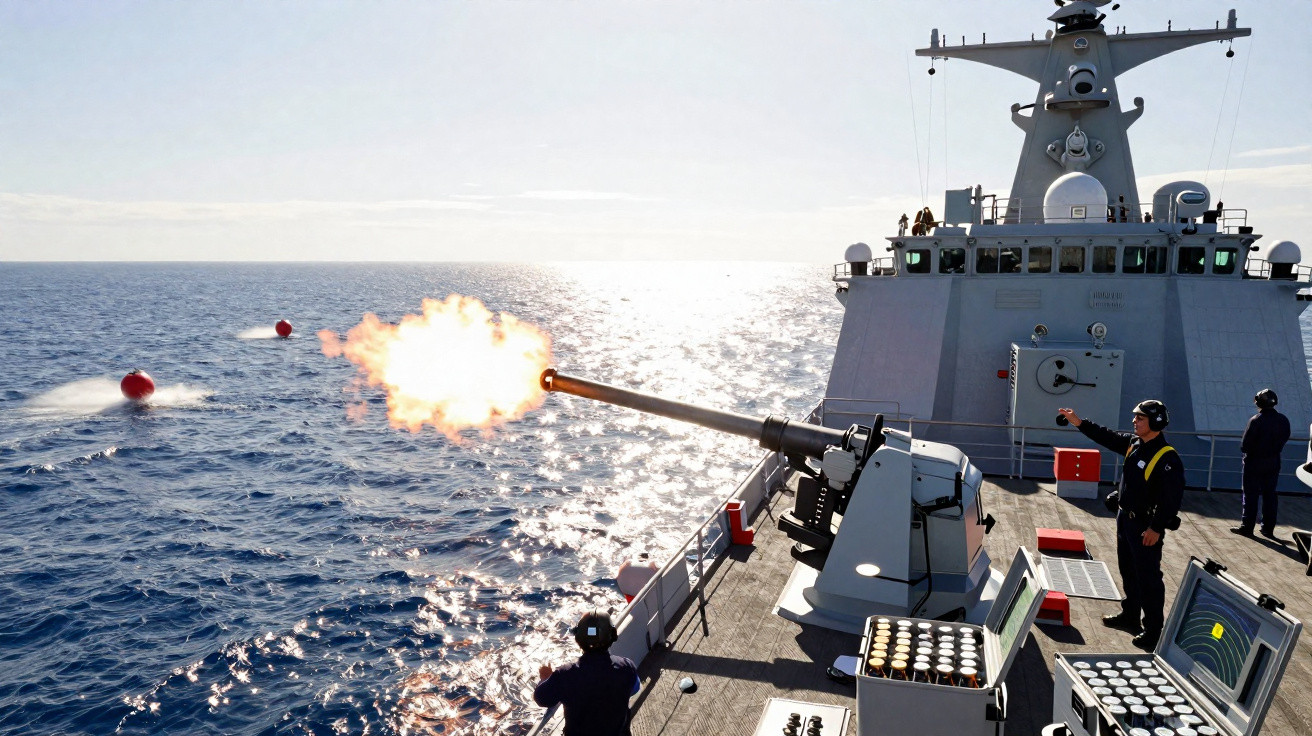
During the demanding sea phase of Exercise Fraterno XXXIX in the South Atlantic, the crews of both navies faced one of surface gunnery’s most established and exacting challenges: the Tomato Killer. To explore the doctrinal complexity, technological accuracy and human element behind every live-fire salvo, Zona Militar spoke exclusively with Lieutenant María Eugenia Navarro, who held one of the exercise’s pivotal posts as Fire Control Officer aboard the destroyer ARA La Argentina (D-11).
👉 Read also: With Airfox drones and 8 countries involved, the Spanish Navy deploys the BAM Meteoro in the Gulf of Guinea
Tomato Killer: a naval precision-firing exercise
In the interview, Lieutenant Navarro explained that the well-known “Tomato Killer” is essentially a precision naval firing drill against a bright orange floating target, deployed at a designated position in open waters. The purpose is not merely to fire freely, but to practise accuracy in detail and confirm the weapons systems’ correction calculations in line with the strict doctrinal requirements of the Sea Fleet.
A curious feature of naval doctrine is that, during some combined training activities, the operations order expressly instructs crews not to fire directly at the target, but rather nearby. This is intended to keep the “Tomato” afloat, enabling every unit in the line ahead to complete its firing sequence. On this particular occasion, however, every ship in the fleet sailed with the instruction to centre its fire and test the actual calibration of its integrated systems.
📌 You may be interested in:
- The Brazilian Navy mobilised South America’s largest warship for the first time in the Rio Grande Uplift
- The British aircraft carrier HMS Queen Elizabeth returns to service to lead a three-month deployment in Northern Europe
Weapons and teams aboard ARA La Argentina
Detailing the weapons configuration used, Lieutenant Navarro stated that the main surface-firing role is normally carried out by large-calibre mounts: the Argentine destroyer’s 127 mm gun and the 76 mm guns carried by Espora-class corvettes. The drill can also be conducted using the 40 mm anti-aircraft mounts fitted to both platform types.
Although these latter weapons fire ammunition in continuous bursts and do not allow individual impacts to be counted, they provide an excellent operational means of checking the data-transmission lines’ overall performance, confirming gun alignment and practising the entry of dynamic corrections into the ship’s automatic fire-control systems.
The success of an operation of this kind depends on flawless co-ordination across several shipboard departments, covering the entire combat role. As the Argentine Navy officer described, firing involves two teams operating in complete harmony: personnel stationed at the gun itself and the console operators working inside the Combat Information Centre (CIC).
The procedure begins at the gun mount, where the local gunners must carefully ensure that every physical and safety interlock on the weapon is in order before transferring control from local to remote operation. Once the gun comes under the CIC’s authority, the Lirot optronic radar takes over. Its optical sensors and high-resolution tracking cameras allow the floating target to be locked on and slaved with millimetre precision.
Lieutenant Navarro noted with technical pride that the destroyer ARA La Argentina had both Lirot sensors fully operational, allowing the firing to be carried out flawlessly through this advanced tracking system.
Fire-control sequence and live-fire corrections
Once the target’s position has been established, control of the firing solution and responsibility for opening fire pass through a highly strict chain of command. The fire director formally requests permission to commence firing, while the ship’s Commander is the sole authority able to grant the final “free to fire” order.
After approval is given, direct communications are established with a third crucial figure on the command bridge: the Spotter. Using high-powered binoculars, this specially trained gunner watches the horizon to visually assess the precise point at which the projectile strikes the water, technically known as the “splash”.
In precise terms, ARA La Argentina’s firing sequence comprised two salvos of 16 rounds each. When the first salvo was fired, both the console operator and the fire director checked the flight times estimated by the system’s computer on screen. Using the Spotter’s visual report and the clear feed from the Lirot cameras, the team established that the first burst had fallen short and slightly to the left of the target.
With this initial deviation data, Lieutenant Navarro immediately entered a live correction into the fire-control computer, increasing elevation and moving the guns’ azimuth to the right and slightly higher. When the second and final regulation salvo was fired, the adjustment proved fully effective: the 40 mm projectile splashes clearly surrounded and closed on the target, centring the floating marker with a very tightly grouped bracket of fire.
The exercise ended with a valuable technical assessment that enabled the performance of the combined crews at sea to be compared. The firing order was opened by the Brazilian frigate MB Tamandaré (F-200), followed second by the frigate MB União (F-45). The destroyer ARA La Argentina occupied third place in the firing line, before the corvette ARA Espora (P-41) took its turn. The corvette ARA Robinson (P-45) completed the planned sequence.
Satisfied with having directed the destroyer’s guns to an outstanding standard, Lieutenant Navarro concluded by stressing the enormous value of these live-fire practices. They ensure that the Sea Fleet’s complex weapons systems respond with complete reliability and accuracy whenever the defence of national sovereignty requires it.
Special acknowledgement: My sincere gratitude and admiration to Lieutenant María Eugenia Navarro and all personnel of the fire-control division aboard ARA “La Argentina”.
Photographs: Zona Militar
Comments
No comments yet. Be the first to comment!
Leave a Comment