
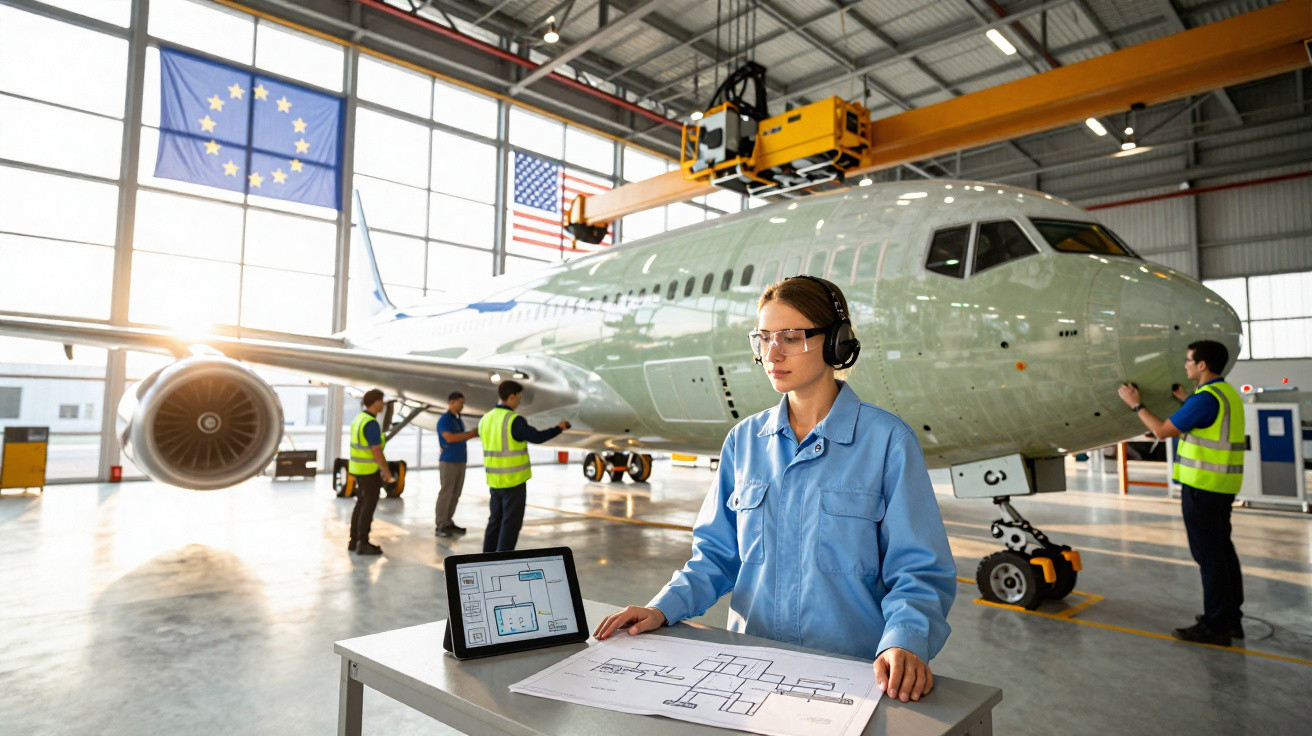
Airbus is quietly but firmly applying the brakes to its dependence on the United States, moving to take over six key facilities from its supplier Spirit AeroSystems.
Away from the headlines surrounding Boeing and the worldwide aircraft boom, the European aircraft manufacturer is expanding its own manufacturing network. The seemingly modest figure of €377 million represents a strategic shift: Airbus is seeking greater control over critical components while reducing its exposure to disruption in the US supply chain.
Why Airbus is moving on Spirit AeroSystems now
Spirit AeroSystems is regarded as one of the most important suppliers in global aircraft manufacturing. It makes fuselage sections, wing parts and structural components, frequently for both Boeing and Airbus. The industry has long viewed Spirit as heavily Boeing-focused, but the group has faced mounting pressure in recent months over quality concerns, financial difficulties, and disputes about pricing and production rates.
This is precisely where Airbus sees an opportunity. By acquiring six major Spirit industrial sites for €377 million, the company aims to contain its own risk. Rather than relying on an unstable US partner, Airbus is bringing the manufacture of certain components more firmly under its own control.
Airbus is using the deal to target precisely those factories that feed directly into the value chain of major Airbus programmes, from the short-haul A220 jet to the long-haul A350 mainstay.
Against the multi-billion budgets typical of aircraft manufacturing, €377 million may appear relatively small. Behind the scenes, however, this is about considerably more than a straightforward factory purchase. It concerns influence over production capacity, quality control and geopolitical independence.
Which Spirit sites Airbus is taking over
According to media reports, the six facilities Airbus is acquiring are mainly located in Europe and North America. They have worked almost exclusively on Airbus programmes for years and are already deeply integrated into its manufacturing processes. For the employees affected, the immediate employer will change, but the product they make will not.
- Factories supplying structural parts for the A320neo family
- Sites manufacturing components for the A220
- Production operations for fuselage and wing structures used in long-haul aircraft such as the A350
- Facilities processing complex composite materials and metal components
This secures crucial nodes in the production network for the European manufacturer. Suppliers become in-house operations, giving Airbus direct influence over planning, staffing and investment. The company is therefore reducing the number of critical interfaces where delivery failures could put its entire delivery schedule at risk.
What the deal reveals about Airbus’s relationship with the US
Airbus has officially stressed its commitment to global partnerships for years. In practice, though, the balance of power is shifting. By taking stakes in the Spirit facilities, the company is sending a message: political tensions, trade disputes and the close links between Boeing and Spirit have made reliance on US supply chains a strategic risk.
The underlying message is clear: Airbus wants its future to depend less on decisions made in Washington, Kansas or Seattle, and to manage more of it from Toulouse, Hamburg and Dublin.
Airbus will remain dependent on international suppliers. Yet where structurally vital parts are concerned, and where their absence could halt final assembly, the group wants to face fewer unexpected disruptions in future. The Spirit deal is one piece of this broader realignment.
Tension with Boeing’s Spirit rescue plan
At the same time, Boeing is working on its own rescue package for Spirit AeroSystems. The US aircraft manufacturer is considering bringing parts of the business back into the group to regain greater control over 737 and 787 production following numerous quality issues. While Boeing works on reintegration, Airbus is using the moment to take the divisions that already work almost exclusively for Airbus.
| Aspect | Boeing | Airbus |
|---|---|---|
| Objective with Spirit | Stabilise and bring core divisions back in-house | Acquire specific Airbus facilities |
| Motivation | Quality problems, safety pressure | Supply-chain control, geopolitical independence |
| Financial scope | Several billion dollars under discussion | €377 million for six sites |
| Long-term effect | Stronger Spirit-Boeing ties | De facto partial nationalisation of the supply chain within the Airbus sphere |
Spirit is therefore effectively splitting into two worlds: a US-centred Boeing track and a European-led Airbus track. This may reduce the supplier’s scope for diversification, but it reflects a trend across many industries, where manufacturers are bringing critical activities closer to home again.
What the Airbus Spirit AeroSystems deal means for the supply chain
Since the pandemic, the aerospace sector has been strained by material shortages, labour gaps and logistical disruption. Aluminium profiles, titanium and electronics can all become bottlenecks. Many airlines are waiting months longer than planned for new jets. For Airbus, every delay poses a risk to revenue and customer relationships.
Owning its own factories puts Airbus more deeply in the line of responsibility: whoever owns the plant can manage investment, shift patterns and inventory more directly - but also carries the full burden when something goes wrong.
The group expects the move to offer several benefits:
- Greater transparency: production data sits directly with Airbus rather than an external supplier.
- Faster decisions: changes to production rates or processes can be coordinated internally.
- Better synchronisation: capacity can be matched more precisely to demand and programme planning.
- Stronger bargaining power for raw materials: larger combined purchasing volumes strengthen Airbus’s position with material suppliers.
There is also a downside: Airbus will assume the risk of rising costs at these facilities. Pay increases, energy prices and investment in new machinery will all feed directly into its own accounts in future. The transaction is therefore not only about sovereignty; it is also a bet on the group’s ability to run these sites efficiently.
Strategic independence: more than a political buzzword
The agreement fits neatly into Europe’s debate on “strategic autonomy”. The EU wants to reduce dependence on foreign key technologies and sensitive supply chains, whether in semiconductors, batteries or aerospace. Airbus is acting almost as the industrial arm of that strategy.
The move also has a highly practical advantage for the group. Trade conflicts, punitive tariffs and export controls can substantially delay or increase the cost of projects. Concentrating critical structures and manufacturing at European sites, or in locations with stable political alignment, reduces exposure to such risks.
The acquisition of the Spirit factories therefore acts as a shield against political shocks, from the next tariff dispute to sanctions between major powers.
At the same time, the internal balance of power changes. Factory management and engineering teams in Europe and Canada gain influence because they are no longer merely the “extended workbench” of a US supplier, but part of the Airbus family.
What this move means for employees and regions
For employees at the affected sites, the key question is how secure jobs and facilities will be after the transfer. Airbus has a direct interest in retaining established teams. Aircraft structural components cannot simply be reproduced quickly with entirely new workforces. Expertise resides in people’s minds, not only in machinery.
The regions concerned could benefit economically. If Airbus commits to long-term investment, it will support local suppliers, technology partners and training centres. Small and medium-sized businesses around the sites would gain greater planning certainty and, in the best case, access to innovation projects involving lightweight construction, automation or hydrogen technologies.
Terms and background: what “Tier 1 supplier” and “structural component” mean
Spirit AeroSystems is known as a Tier 1 supplier. In other words, it delivers directly to the aircraft manufacturer rather than to another supplier. Tier 1 companies take responsibility for complete assemblies, including design, material management and final inspection. If a Tier 1 supplier fails, final assembly can quickly come to a standstill.
Structural components are the parts that form an aircraft’s load-bearing framework, including fuselage sections, frames, stringers and parts of the wings. They must withstand high loads while remaining as light as possible. Defects in such parts can have fatal consequences, which is why they are subject to particularly strict inspections.
Scenario: what a supply problem could have looked like without the deal
Imagine a bottleneck scenario of the kind the industry has experienced in recent years. Spirit encounters a quality issue with fuselage sections for an Airbus model. Rectification takes weeks. Airbus cannot meet its planned deliveries. Airlines postpone fleet plans, leasing costs rise and compensation claims loom.
Under the previous structure, Airbus would have to negotiate with an independent US supplier. Production decisions would be made by managers whose priority might lie more with Boeing. With the factories now being acquired, responsibilities change. Airbus can bring engineers, quality inspectors and production planners directly together and implement solutions more quickly. This does not guarantee perfect stability, but it reduces the number of external uncertainties.
Risks and opportunities in the years ahead
Taking over the six Spirit sites is not a cure-all. Airbus is taking on complex factories that may require substantial investment. Modernising machinery, digitising production and training the workforce all demand money and management attention. If demand develops more weakly than expected, excess capacity could emerge.
At the same time, the move opens up new options. Airbus can introduce technologies more selectively, including automated riveting lines, robotics in wing assembly and data-driven quality control. Environmental objectives, such as reducing scrap material and making manufacturing more energy-efficient, can also be enforced more consistently in company-owned sites.
Ultimately, the deal represents a clear bet: Airbus is backing long-term growth, greater in-house manufacturing depth and more industrial sovereignty - and is prepared to take on substantial responsibility to achieve it.


Comments
No comments yet. Be the first to comment!
Leave a Comment