
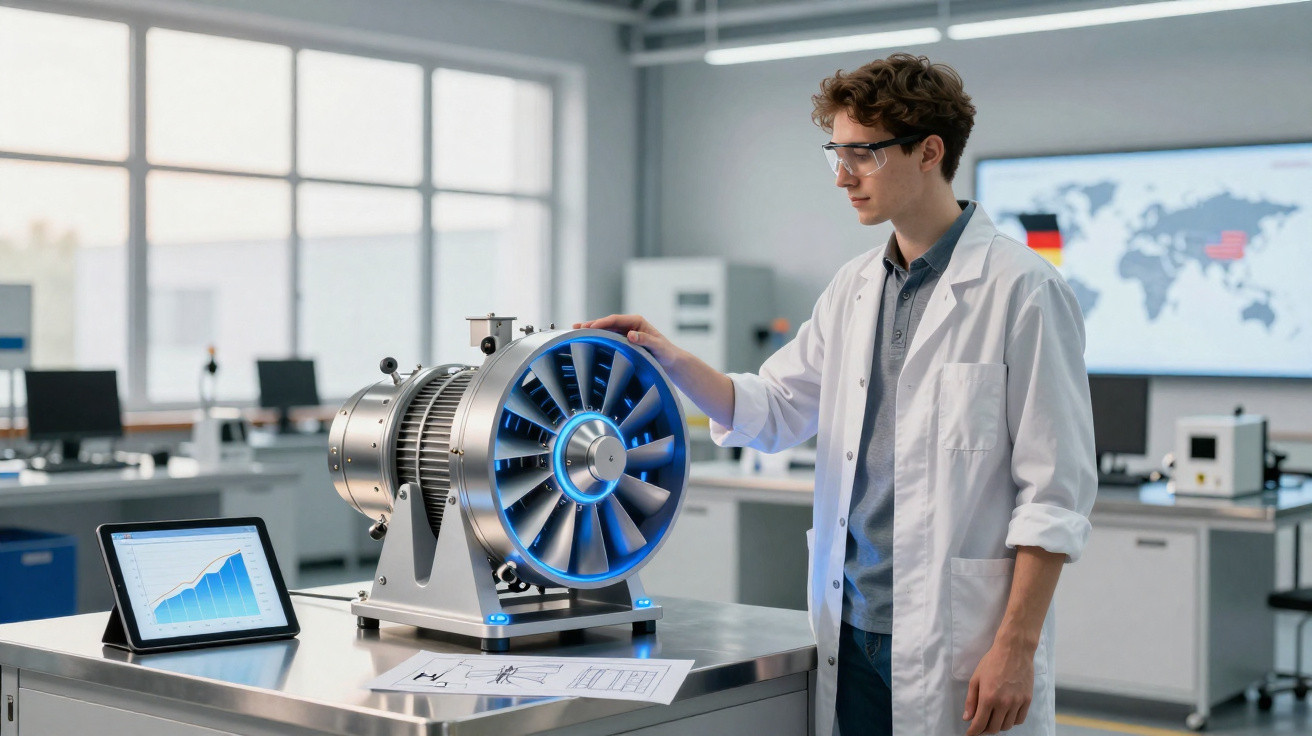
Away from launch pads and inside laboratory facilities, German engineers have demonstrated a hydrogen turbine milestone that is challenging US industry and even NASA, altering expectations for clean, high-output power systems.
Germany’s new hydrogen turbine record changes the race
Hydrogen turbines often receive less attention than batteries, solar panels and nuclear-fusion announcements. However, they occupy an important intersection: heavy industry, aviation and grid back-up all require power that is energy-dense, adaptable and low-carbon. Germany has now asserted itself in precisely this area.
Technical information released by the project team indicates that a German research consortium has taken a new hydrogen-fired turbine to operating-test performance levels not achieved previously. The unit delivered high electrical output using pure or almost pure hydrogen, while tightly managing both emissions and efficiency.
The German turbine achieved record performance using hydrogen as its main fuel, with efficiency and stability that outperform current US benchmark tests.
The result carries considerable symbolic weight. US laboratories and NASA-led programmes have long led hydrogen-combustion work for launch systems and experimental power equipment. On this occasion, Europe takes the spotlight.
How this hydrogen turbine sets a new benchmark
The advance centres on three areas: stable combustion, efficiency at useful scale and emissions control. Delivering all three simultaneously is exceptionally difficult.
Combustion without excessive emissions
Hydrogen burns rapidly and at high temperatures. Although this enables turbines to produce substantial power, it can also lead to severe rises in nitrogen oxides (NOx), pollutants associated with health and air-quality issues. The German engineers concentrated on sophisticated burner designs that combine hydrogen and air in carefully controlled patterns.
By keeping flame temperatures down while maintaining complete combustion, the team reports NOx levels comparable to or lower than modern natural gas turbines.
This matters greatly to investors and regulators. Low emissions can turn an eye-catching laboratory prototype into equipment that can be insured, licensed and connected to real energy markets.
Impressive efficiency at relevant scale
Numerous experimental hydrogen turbines operate at very small scale, making them useful for academic research but of little relevance to electricity grids or industrial sites. The German installation, by contrast, achieved megawatt-class output, a range genuinely used by utilities and heavy manufacturers.
Although the precise results depend on the operating mode, the engineers reported gross electrical efficiency that narrowly exceeds comparable US hydrogen trials and earlier NASA-backed auxiliary-power demonstration units. That improvement in efficiency means more electricity from each kilogram of hydrogen.
- Greater efficiency lowers fuel costs and hydrogen requirements
- Improved combustion stability reduces maintenance needs and downtime
- Reduced NOx emissions make environmental approvals easier to obtain
Why surpassing the US and NASA matters
NASA and US aerospace companies have been closely associated with hydrogen technology for decades. Liquid hydrogen has fuelled rocket engines from the Space Shuttle through to the current Space Launch System. Space engines, however, are designed for thrust rather than continuous electricity generation for a grid.
Germany’s latest record is more directly connected to commercial deployment. It concerns turbines capable of powering an industrial site, supporting a national grid during a still winter evening, or supplying data-centre back-up without using gas or diesel.
The symbolic victory over NASA is less about rockets and more about who will supply the next generation of clean, dispatchable power machines.
The political timing is significant too. While the US is investing heavily in hydrogen hubs, Europe is seeking to protect its industrial base and climate-leadership role. A prominent technical advantage for Germany reinforces the case that European engineering can continue to establish standards in strategically important clean-technology sectors.
Where this hydrogen turbine could be used
The record-setting trials remain within a research programme rather than a product range. Even so, the likely uses are already apparent.
| Sector | Potential role for hydrogen turbines |
|---|---|
| Power grids | Rapidly ramping back-up for solar and wind, replacing gas peaker plants |
| Heavy industry | On-site electricity and heat for steel, chemical or cement works using green hydrogen |
| Aviation | Airport ground-power units and testbeds for future hydrogen aircraft engines |
| Data centres | Low-carbon standby electricity instead of diesel generators |
These markets each have somewhat different requirements. Grid operators prioritise reliability and rapid response. Industrial users seek integration with heat processes. Data centres require almost instantaneous start-up and high availability. The German prototype was specifically tested for rapid load changes, suggesting that flexible operation remains a central design objective.
The hydrogen challenge: where will the fuel come from?
A record-setting turbine represents only one half of the equation. Hydrogen must still be made, transported and stored. Where the gas is produced from fossil fuels without carbon capture, its climate benefits are greatly reduced.
The big vision links high-efficiency hydrogen turbines with so-called green hydrogen made from renewable electricity, forming a closed low-carbon loop.
Germany is already planning large-scale hydrogen imports from areas rich in sun and wind, including North Africa and the North Sea. A turbine able to operate efficiently with changing hydrogen blends-from pure hydrogen to natural-gas mixtures-offers operators flexibility as the supply network expands.
How this compares with batteries and other clean technologies
Batteries attract more headlines and are essential for short-term grid balancing and electric vehicles. Their economics, however, shift when storage is required for several days or weeks rather than a few hours. Hydrogen turbines can address this need by storing energy chemically before converting it back into electricity when needed.
Other approaches sit alongside them, including pumped hydro storage, demand response and advanced nuclear power. The new German record does not render these options obsolete; it broadens the available toolkit instead.
In one future configuration, a grid dominated by renewables could work as follows: solar and wind meet most demand, batteries manage hour-to-hour variation, and hydrogen turbines step in through prolonged cloudy, windless periods or seasonal shortfalls.
Risks, limits and what could go wrong
This technology is not a universal solution. Hydrogen is difficult to manage: it leaks readily, can embrittle metals, and needs either high-pressure tanks or cryogenic temperatures. Careful safety engineering, strong regulation and public confidence are therefore essential.
Cost remains another issue. Producing green hydrogen is still costly, while hydrogen-capable turbines experience greater material stresses than gas-fired versions. Should supply chains for electrolysers, pipelines and storage fail to keep pace, the impressive turbine record could remain underused.
The record demonstrates what is technically possible; turning it into everyday infrastructure will depend on policy, investment and public acceptance.
Key concepts worth unpacking
As this competition gathers pace, two expressions will become increasingly common: “efficiency” and “capacity factor.” Efficiency measures the proportion of hydrogen’s energy that becomes electricity. Even an increase of only a few percentage points can save millions in fuel expenditure across a turbine’s working life.
Capacity factor measures how much time a turbine operates relative to its maximum possible running time. Hydrogen turbines may operate for fewer hours than conventional gas plants, coming online during supply shortages. Nevertheless, those hours could be extremely valuable if they avert blackouts or replace diesel back-up systems.
For those following climate and technology policy, the German record offers a clear message: hydrogen turbines are developing, rivalry is intensifying, and the established order between US, NASA and European laboratories is no longer certain. The next steps-large-scale demonstrations, commercial orders and cross-Atlantic partnerships-will show whether Germany’s ambitious lead becomes a durable advantage or an abrupt warning for its competitors.




Comments
No comments yet. Be the first to comment!
Leave a Comment