
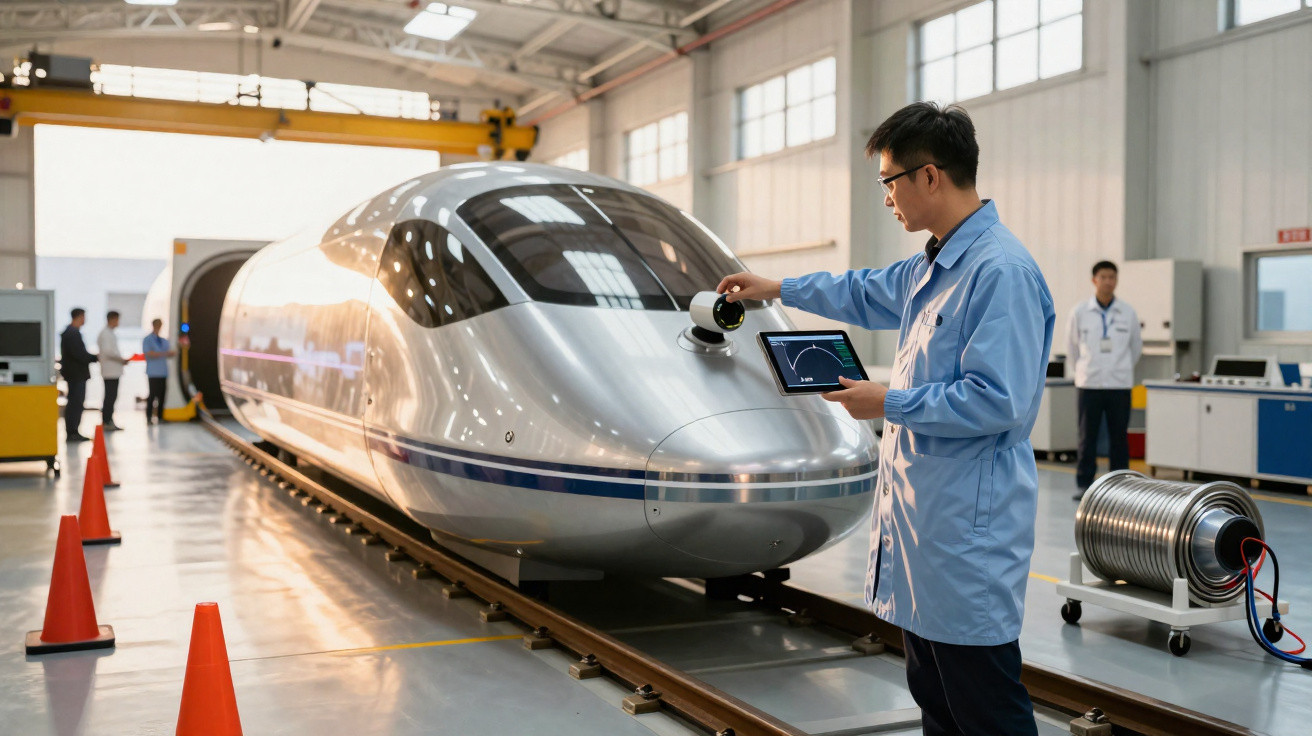
On a brief section of steel and concrete in China, a quiet machine offered a glimpse of how unfamiliar future travel may become.
Observers saw little more than a flash: a one-tonne test vehicle hovering above its guideway, accelerating from rest to jet-plane speed and stopping again in less time than a blink seems to last in recollection.
China’s 2-second dash that shook the hyperloop race
On a 400-metre test track, Chinese researchers accelerated a 1.1-tonne superconducting maglev chassis from 0 to 700 km/h in approximately two seconds, before stopping it without mechanical brakes. Conducted in vacuum conditions, the trial used infrastructure intended as a prototype for future hyperloop-style transport.
The work was carried out by a team at the National University of Defense Technology (NUDT), an important part of China’s high-speed rail and defence research landscape. The achievement is significant not only for its top speed, but also for the severe acceleration delivered over such a short distance, comparable with the forces involved in launching a fighter jet from an aircraft carrier.
From 0 to 700 km/h in about two seconds: China has just combined maglev and vacuum tube tech in a way no other country has publicly demonstrated.
Tests of this sort are important because hyperloop ideas require far more than raw speed. Engineers need to prove they can manage energy, stability, levitation and braking inside a sealed tube, where air acts differently, cooling presents difficulties and the safety margin is far tighter.
Maglev’s long road to the “train of the future”
Magnetic levitation is far from a new concept. During the 1960s, engineers in Germany and Japan began serious work on the technology, pursuing a straightforward principle: eliminating wheel-to-rail contact removes much of the friction that constrains a train’s speed and efficiency.
From Transrapid to Japanese SCMaglev
Germany created the Transrapid system, a technological landmark that exceeded 430 km/h on test routes. Japan went on to develop the SCMaglev, which uses superconducting magnets to achieve still greater speeds; in 2015, a crewed SCMaglev train reached 603 km/h on the Yamanashi test line.
However, neither Transrapid nor SCMaglev transformed rail transport worldwide. Transrapid failed to establish a viable long-term commercial case in Europe, ultimately resulting in one operational route in Shanghai. Japan’s superconducting maglev connection between Tokyo and Nagoya has faced cost pressures, environmental objections and local resistance, which have postponed full operation.
Hyperloop’s bold promise and harsh reality
The debate shifted around 2013, when Elon Musk brought hyperloop into the mainstream: a capsule travelling through a low-pressure tube at roughly 1,000 km/h or above, pairing maglev with sharply reduced aerodynamic drag.
Start-ups including Hyperloop One, later known as Virgin Hyperloop One, attempted to turn that vision into a commercial service. They constructed small test tracks and prototype vehicles, released illustrations of streamlined pods and pledged city-to-city travel measured in minutes. But they encountered formidable practical barriers: enormous infrastructure costs, difficult land purchases, safety approval requirements and the challenge of operating mass transport within a steel vacuum tube.
Most Western hyperloop companies have since reduced their ambitions or ceased operations. Even so, the underlying technologies-powerful linear motors, dependable levitation and vacuum engineering-continue to progress, especially in nations already making substantial investments in high-speed rail.
Hyperloop is shifting from startup dream to state-backed megaproject, and China’s new maglev record sits right at that crossroads.
Inside the 2-second sprint: physics you can feel
NUDT’s record-setting run concerns human physiology as much as magnets and vacuum pumps. Reaching 700 km/h in around two seconds exposes a vehicle-and, eventually, its passengers-to exceptionally high g-forces.
For context:
- A commercial airliner during take-off: about 0.4 g.
- A Formula 1 car under heavy braking: roughly 4–5 g.
- Fighter pilots in tight turns: up to 9 g with a special suit.
The Chinese test vehicle probably underwent forces near the upper limit of what people can endure without specialist preparation. In passenger systems, engineers will have to extend the acceleration and braking phases over greater distances to keep g-forces tolerable, even where the equipment itself is capable of far more.
Synchronising levitation, thrust and braking
To complete the run, the researchers needed to coordinate multiple subsystems to millisecond precision:
| Subsystem | Role during the record run |
|---|---|
| Superconducting magnets | Maintain stable levitation and guidance with minimal energy loss |
| Linear motor propulsion | Supplies the immense burst of power required for rapid acceleration |
| Vacuum tube | Cuts air resistance, increasing the impact of every kilowatt |
| Non-contact braking | Decelerates the vehicle through controlled electromagnetic forces |
Should levitation trail propulsion by even a small fraction of a second, the chassis may oscillate or graze the guideway. If braking begins too late or too aggressively, the vehicle may become unstable, particularly at several hundred kilometres per hour inside a low-pressure tube.
Why this record matters for future transport
China’s test does not mean people will be travelling in 700 km/h pods next year. Rather, it demonstrates that one essential element-precisely controlled maglev travel under vacuum at extreme acceleration-can now be achieved beyond a laboratory setting.
China already operates the world’s largest high-speed rail network, covering more than 40,000 kilometres, with trains regularly running at 300–350 km/h. That manufacturing and operational foundation provides an advantage in moving towards more experimental technologies, including superconducting maglev and tube-based routes.
Hyperloop-style projects need a blend of heavy industry, precision engineering and political will; China currently holds strong cards on all three.
From a strategic perspective, the achievement forms part of a broader contest over next-generation mobility. Countries are seeking to reduce emissions from domestic flights, cut logistics times and assert technological leadership. A working hyperloop corridor could shorten the effective distance between megacities in ways that conventional rail cannot equal.
What stands between prototypes and real passengers
Engineering and safety hurdles
Converting a 400-metre demonstration into a 400-kilometre route introduces serious challenges:
- Thermal management: Superconducting magnets need to remain at cryogenic temperatures throughout the entire route.
- Tube integrity: A leak in a vacuum tube produces abrupt shifts in pressure and airflow.
- Evacuation procedures: Designers need methods for rescuing passengers from sealed tubes running underground or elevated over long distances.
- Power resilience: Hyperloop systems require reliable, high-capacity electricity networks, alongside backup provision for critical sections.
Regulators also require evidence on the long-term effects of repeated high-g exposure on passengers, the behaviour of vibrations in extended tubes, and the system’s response to earthquakes, floods or sabotage.
Economic and social questions
Then there is the cost. Constructing vacuum tubes on viaducts or through tunnels, alongside maglev guideways and cryogenic equipment, is substantially more expensive than building conventional high-speed rail. Even states such as China, which can focus resources at scale, must still defend that expenditure against investment in schools, hospitals or improvements to existing railways.
The social consequences matter too. Hyperloop routes could alter migration patterns, property markets and regional economies, just as high-speed rail has done-but more quickly and abruptly. Planners will need to address who gains from ultra-fast links and who is left outside them.
Where hyperloop could realistically appear first
Most specialists anticipate that the first hyperloop-style services will not span continents. Instead, they are likely to serve constrained, high-demand corridors where existing rail or air travel is bottlenecked. Such routes could connect:
- Two megacities less than 1,000 km apart.
- An inland industrial centre with a major seaport.
- Airports and satellite cities where space for additional runways is limited.
China fits this pattern through dense city pairings such as Beijing–Tianjin and Guangzhou–Shenzhen. A short tube route dedicated to freight could even arrive before passenger services, enabling engineers to establish reliability without life-or-death consequences from the outset.
Key technical notions behind the record
Two fundamental ideas sit behind the headlines and explain what happened on that 400-metre track.
Superconductivity in plain language
In an ordinary wire, electrons collide with atoms and lose energy as heat. Once cooled below a critical temperature, a superconductor lets electrons travel with almost no resistance. This makes it possible to generate highly powerful, stable magnetic fields while wasting far less energy than standard electromagnets.
For maglev, that means a train can hover and remain centred through magnetic forces that do not significantly droop or vary, even at high speed. The compromise is cooling: maintaining magnets at cryogenic temperatures over long routes is technically complex and costly.
Why vacuum matters so much
At 700 km/h, air acts less like an invisible gas and more like a dense fluid. Drag increases broadly with the square of speed, meaning that doubling speed raises air resistance several times over. Removing most of the air from a tube dramatically reduces that drag, lowering the energy cost of every further increase in speed.
By taking place in a low-pressure tube, the Chinese record addresses this issue directly. It indicates that a large, heavy object can accelerate intensely while remaining under control in an environment whose aerodynamics differ from both open air and traditional wind tunnels.
What this could mean for everyday travel and risk
Should systems based on these trials eventually carry passengers, life around major cities could look different. For travellers able to pay the fares, commutes of 400 or 500 kilometres could fall to less than half an hour door-to-door. Business journeys currently requiring flights and overnight stays could potentially become single-day commitments.
The dangers would not disappear. A vacuum tube intensifies certain failure scenarios, including structural fractures, abrupt pressure surges, electricity failures and software mistakes in network control. To prevent individual failures from becoming disasters, designers will need multiple layers of protection, such as segmented tubes, emergency pressure valves and passive braking systems.
There are also clear prospective benefits from hyperloop-style lines: emissions lower than those of short-haul aviation, less noise than aircraft and the potential to move valuable, time-sensitive freight away from crowded roads. Carefully integrated with improved conventional rail, they could create a transport mix in which every mode serves the trip lengths and passenger volumes it handles most effectively.
China’s two-second sprint does not resolve all of these issues. What it does demonstrate is that the physics underpinning extreme maglev in a tube is no longer confined to concept papers. The divide between science-fiction drawings and rail’s next generation is becoming smaller, and this brief, fierce burst of speed is likely to shape future arguments over how far-both literally and politically-countries are willing to push their trains.



Comments
No comments yet. Be the first to comment!
Leave a Comment