
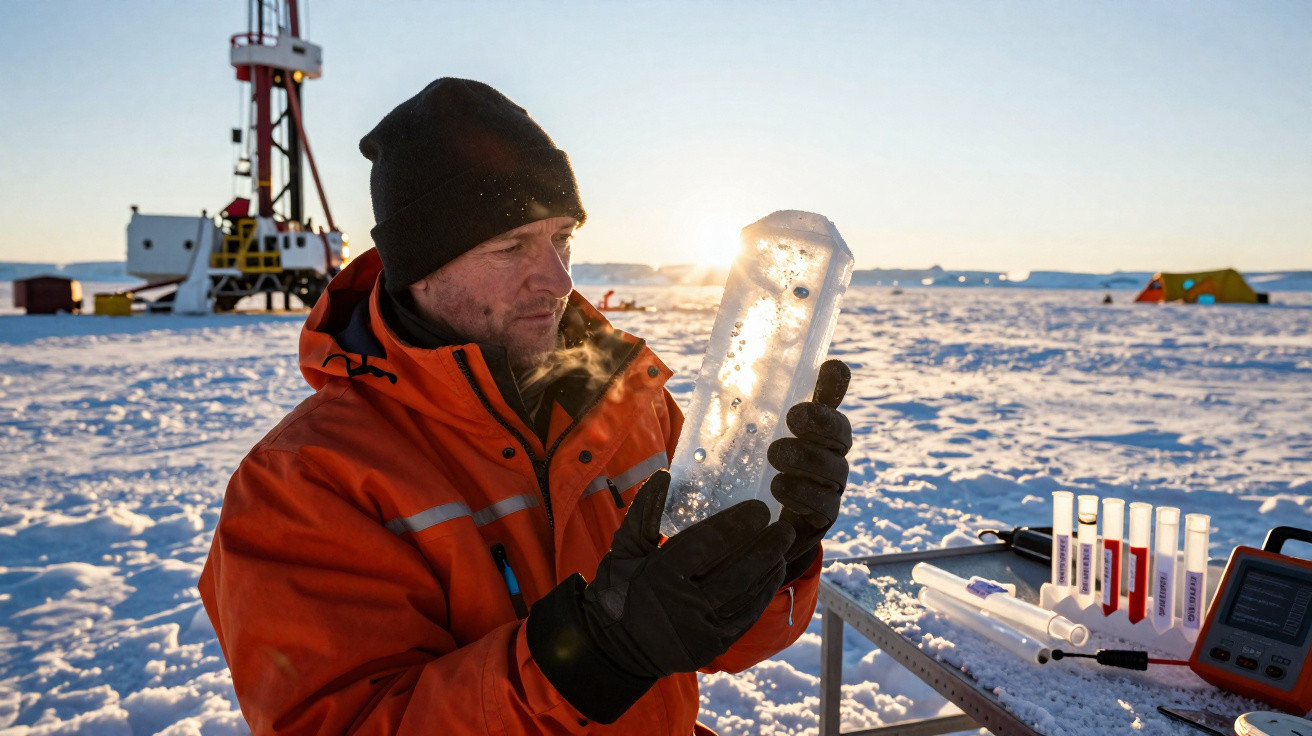
In East Antarctica’s unforgiving quiet, a drill has retrieved a frozen chronology reaching far beyond the span of human history.
Beneath layers of wind-blasted ice and age-old dust, researchers have extracted a record-breaking ice core extending back tens of millions of years. This latest core has drawn the attention of research teams around the world, offering unusual insight into how Earth’s climate functioned long before people existed.
What a 228-metre Antarctic core actually contains
At 228 metres long, the new Antarctic core holds roughly 23 million years of environmental history, based on preliminary age assessments. Every narrow section of ice contains imprisoned bubbles of ancient air, frozen particles and faint chemical signatures.
Together, these details make the core an uninterrupted record of earlier climates. Snow accumulated each year, was compressed and preserved traces of the air above it. Across millions of years, those deposits built into a frozen stratigraphic sequence that researchers can interpret as a documentary unfolding in slow motion.
Every metre of this core spans roughly 100,000 years of Earth’s climate story, compressing entire geological eras into a few centimetres of ice.
Research teams from multiple nations are likely to receive shared access, with the first studies examining greenhouse gases, volcanic activity and changes in ocean circulation. For scientists investigating long-term climate patterns, data of this kind is normally only imagined.
Why 23 million years is important to climate science
Most current Antarctic ice cores document the past 800,000 years, an interval shaped by ice-age cycles recurring approximately every 100,000 years. Reaching back 23 million years takes this new record into a fundamentally different climatic period.
Scientists anticipate that the oldest layers will record:
- Warmer intervals in which Antarctica’s ice sheet contracted substantially
- Sudden cooling episodes associated with changes in ocean gateways
- Natural carbon dioxide fluctuations well beyond those found in recent cores
- Dust and ash produced by ancient volcanic activity and desert conditions
The core covers periods when Antarctica was partly free of ice, sea levels stood higher and the planet was responding to changing continents and ocean basins. This background is relevant now because human activity is driving atmospheric greenhouse gas concentrations into levels unseen for millions of years.
By matching ancient CO₂ levels with temperatures and sea levels, researchers gain a reality check on how sensitive Earth’s climate system truly is.
Inside the frozen Antarctic archive: what scientists seek
Air bubbles trapped as time capsules
A major attraction is the air enclosed within the ice. Minute bubbles provide direct samples of former atmospheres. Scientists melt small core sections under vacuum, then use highly precise equipment to measure the gases that emerge.
Their attention will centre on:
- Carbon dioxide (CO₂)
- Methane (CH₄)
- Nitrous oxide (N₂O)
- Noble gases that help reveal ancient temperatures
By charting the rise and fall of these gases, researchers hope to establish how rapidly the planet reacted to natural changes in solar radiation, orbital variation and tectonic processes.
Chemical traces from ancient storms and oceans
The ice retains chemical evidence transported by winds and oceans as well. Salts, dust and isotopes preserved in the core can show how storm tracks shifted, along with the expansion and retreat of sea ice over time.
| Signal in the ice | What it tells scientists |
|---|---|
| Oxygen isotopes | Earlier temperatures and ice volume |
| Sea salt particles | The extent of sea ice and the strength of storms |
| Dust concentration | Continental aridity and wind intensity |
| Sulfates and ash | The timing and intensity of volcanic eruptions |
Taken together, these indicators allow scientists to reconstruct more than average conditions. They can also identify rapid-change events, including abrupt post-eruption cooling and sharp pulses of warming.
A record that may transform projections
Climate modellers are following the development closely. Simulations of future warming rely on checks of how accurately they can replicate earlier climate change. So far, those checks have largely drawn on the last 1 million years, which were comparatively cool against certain older epochs.
The new Antarctic core offers a test run of how the climate system behaved when CO₂ and global temperatures were closer to where humanity might be heading this century.
Should models reproduce the variations preserved in this core, confidence in projections for sea-level rise and heatwaves will increase. Should they not, research groups will revise the models, particularly the elements representing ice-sheet collapse and feedback loops involving clouds and oceans.
Lessons about sea-level rise
One issue is especially prominent: how fast can major ice sheets break apart as temperatures rise? Geological evidence indicates that sea levels were several metres higher in certain warm phases 10–20 million years ago.
Scientists intend to link those sea-level estimates with exact CO₂ measurements from the core to reduce the probable range of future change. For coastal planners from Florida to Bangladesh, such evidence contributes directly to longer-term risk evaluations.
How drilling took place in such an extreme setting
Drilling 228 metres into Antarctic ice is far from straightforward. The location probably lies on a stable East Antarctic plateau, selected to achieve maximum age while retaining undisturbed layers. Crews work in temperatures far below freezing and have only brief periods of workable weather.
Engineers employ a specialist drill that cuts clean cylinders while ensuring the ice remains as cold as possible. Each core section, commonly about one metre in length, is raised to the surface, recorded and placed in insulated containers.
The ice is then transported in refrigerated containers to laboratories that may be thousands of kilometres away. Strict handling procedures are essential because even minor temperature changes can crack the core or obscure its sensitive chemical gradients.
Key terms for understanding this climate record
Scientists repeatedly use several technical concepts when discussing ancient climate evidence. Two are particularly helpful.
Palaeoclimate: This describes climates that existed before direct measurements by humans. Scientists reconstruct them from natural records including ice cores, tree rings, lake sediments and corals. Every archive has particular advantages and limitations, which makes extensive records such as this new core especially valuable.
Climate feedbacks: Feedbacks are mechanisms that either intensify or lessen change. For example, warming decreases ice cover, exposing darker surfaces that take in more sunlight and create further warming. The new core can help reveal the strength of such feedbacks in the distant past, providing indications of how they could operate during contemporary warming.
What it means for daily life far beyond Antarctica
An ice core drilled in one of Earth’s most isolated regions may seem remote to someone in London, New York or Lagos. However, the evidence held in that ice relates directly to everyday issues, including food prices, flooding risks, heatwaves and energy systems.
When models include long-term records of this nature, they can more accurately assess the stability of monsoon patterns, potential movements in storm belts and the frequency with which destructive extremes may occur. Insurers, urban planners and farmers’ unions all use those assessments, whether directly or indirectly.
There is a psychological dimension, too. Evidence covering 23 million years puts current change within a wider narrative. It demonstrates that Earth’s climate has continually changed, while also showing that major transitions generally occurred over thousands of years rather than decades. The pace of present-day warming becomes especially clear, potentially intensifying discussion about how rapidly societies should adapt and reduce emissions.
The Antarctic core does not provide policy, but it offers a timeline against which human choices in this century will be judged by future scientists.
As initial findings from this record appear in journals and at conferences, they are likely to prompt further model revisions, updated sea-level estimates and new questions about thresholds that must not be exceeded. For the moment, the 228-metre cylinder remains in laboratory freezers, with its story only beginning to be examined.





Comments
No comments yet. Be the first to comment!
Leave a Comment