
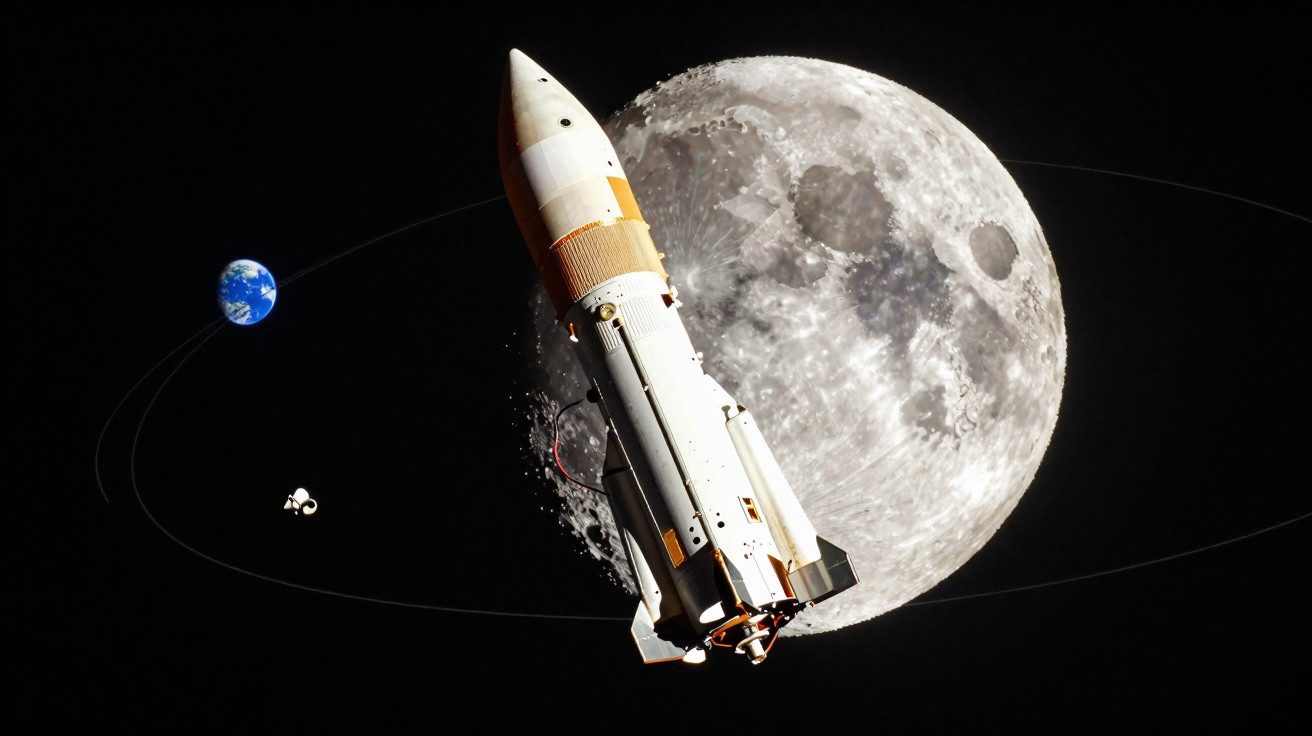
According to an astronomer, a SpaceX rocket upper stage - the non-recoverable section - is set to crash into the Moon on 5 August.
SpaceX is indeed heading to the Moon, though not intentionally. That, at least, is the forecast from astronomer Bill Gray. He believes the upper stage of a Falcon 9 rocket, the section that cannot be recovered, will strike the Moon on 5 August 2026. Roughly the size of a five-storey building, the object came from the SpaceX rocket launched in January 2025 to send the Blue Ghost and Hakuto-R lunar landers into space. Gray explains that the Falcon 9 upper stage, designated 2025-010D, remained in orbit around Earth rather than re-entering the atmosphere after the mission.
Falcon 9 upper stage predicted to hit the Moon
“It has passed close to both the Moon and Earth several times, but never close enough to raise concerns about an impact,” Bill Gray also explains. His orbit-calculation software now estimates that the object will ultimately collide with the Moon. Although the astronomer has confidence in his calculations, he acknowledges that he is not “completely certain” of the result. While a piece of debris can be tracked under the gravitational influence of the Moon, Earth, the Sun and the planets, the effect of solar radiation pressure cannot be forecast with the same degree of accuracy.
This would not be the first object to strike the Moon
In his post, Bill Gray also points out that the SpaceX upper stage would not be the first object to hit the Moon. In 2009, Nasa deliberately crashed a probe into the lunar surface to determine “whether water ice exists in a crater located in the permanently shadowed region of the lunar south pole.” Then, in 2022, an upper stage from China’s Chang’e-5 T1 mission also struck the Moon, creating two craters.
Gray believes the crater made by the SpaceX debris on the Moon should resemble those formed by that Chinese upper stage. “One of the craters is around 16 metres in diameter and the other around 18 metres,” the astronomer states. Unfortunately, the specialist says that even if the SpaceX upper stage crashes into the Moon, the impact is unlikely to be visible from Earth.
Growing concern over space debris
As rocket launches become more frequent and struggle to meet demand, Bill Gray is becoming increasingly concerned about space debris. In his view, the scientific value of this upper stage striking the Moon would be limited. Nor would it pose a danger to anyone.
Nevertheless, the astronomer says that “this highlights a degree of negligence in the way space debris is disposed of.”






Comments
No comments yet. Be the first to comment!
Leave a Comment