
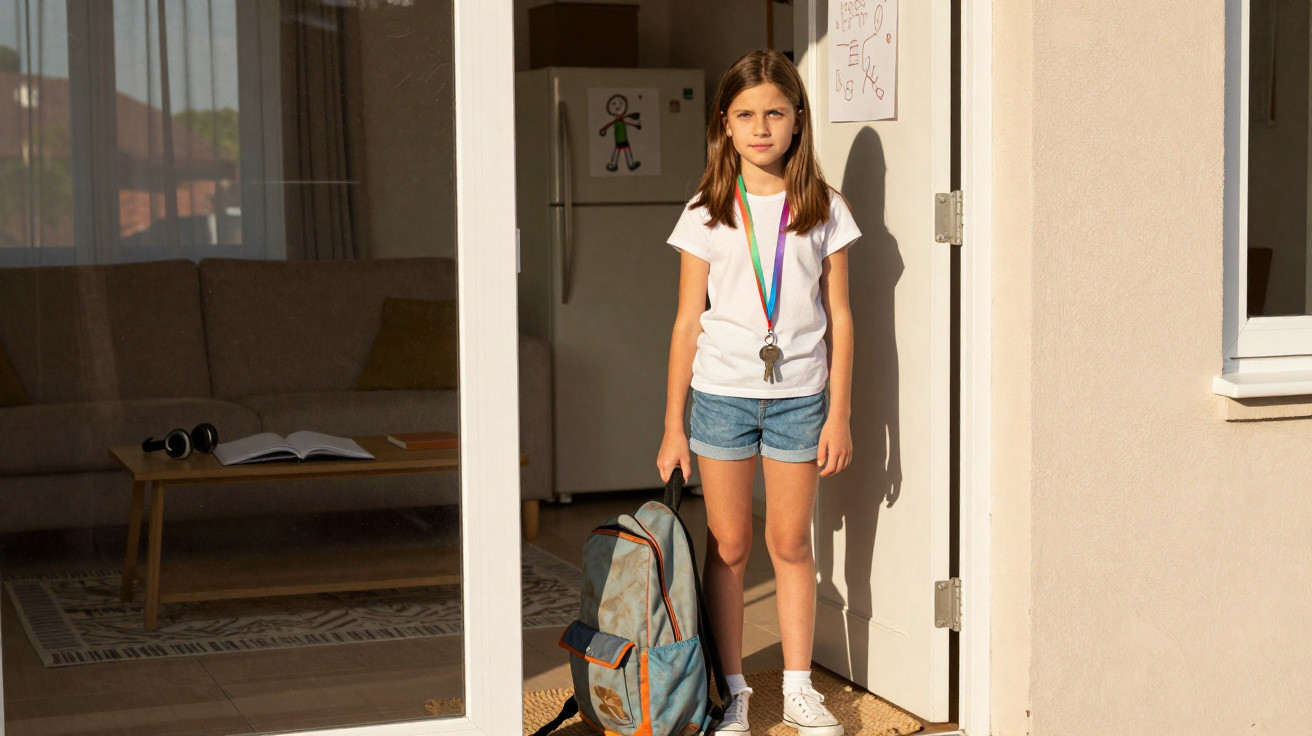
This childhood shaped millions of people, often more profoundly than they realise.
Anyone who grew up in the 1970s, 1980s or early 1990s will recognise the scene: school bag tossed into a corner, front door shut, and nobody home. No parent, no after-school club, no smartphone – just quiet, boredom and their own imagination. For a long time, these “latchkey children” were seen as a problem case. Psychology now presents a more nuanced picture: many children who were so often left to their own devices developed remarkable inner resilience.
The generation with a front-door key around its neck
From the 1970s onwards, it was no longer only one parent who worked in many families. Children returned from school to empty homes, carrying a key or finding the door unlocked. For hours, no one was directly looking after them.
At the time, it seemed ordinary: you made yourself a snack, switched on the television, lay on the carpet and stared at the ceiling. You did crafts, built silly things, called on friends in the neighbourhood or played football until dinner. There were no WhatsApp groups, no parental taxi service and no tightly scheduled programme of activities.
Millions of children therefore grew up with a great deal of freedom – and responsibility. They had to decide for themselves when to go out, when they should be back, and whether it was best not to touch the hob.
What looked like mere neglect at the time turned out, in many cases, to be practice in emotional independence.
Of course, it was not always idyllic. In unstable families or unsafe neighbourhoods, being alone could also mean fear and overwhelm. Studies show that context is crucial. Yet for children living in reasonably stable circumstances, these afternoons brought a psychological benefit that researchers can now describe more clearly.
What being alone really builds within us
The British psychoanalyst Donald Winnicott coined the term “capacity to be alone” in the late 1950s. To him, it was not a sign of coldness or withdrawal, but a central feature of emotional maturity.
Winnicott drew a clear distinction between painful loneliness and being content in one’s own company. His central idea was that someone who experiences a reliable caregiver from early childhood – even one who does not constantly intervene – develops an inner sense of security. That security can later be carried into empty rooms, quiet evenings and periods without distraction.
For latchkey children, the parent was not in the next room but at an office or factory. Even so, many knew that Mum or Dad would come back. That basic certainty was often enough to make solitude not a shock, but a place to practise.
A study in the Journal of Social Behavior and Personality surveyed 500 adults about how they cope with being alone. Its finding was that people who feel comfortable alone show fewer depressive symptoms, fewer physical signs of stress and greater life satisfaction. The ability to manage on one’s own therefore appears to be a genuine psychological resource, rather than an eccentric personality trait.
How boredom became a lesson in self-regulation
Children who were alone after school had no coach, no app and no parental commentary running in the background. Instead, they faced small everyday challenges that they had to handle themselves:
- Tolerating boredom and finding their own ways to overcome it
- Making sense of frightening noises and calming themselves down again
- Noticing hunger and sorting out something to eat
- Feeling lonely and realising that the feeling passes
Every one of these situations was a small lesson in self-regulation. There were no worksheets or online courses, just repetition in everyday life. Over time, these strategies became automatic: children learned to settle themselves, organise their time and occupy themselves without external direction.
Anyone who learns early on that they can ease inner tension themselves develops a solid sense of “I can handle this”.
In this context, US psychologist Peter Gray refers to an “internal locus of control”. Children who frequently make their own choices and experience the consequences are more likely to feel that they can influence their lives. Long-term surveys indicate that this internal locus of control has tended to decline among young people in recent decades – alongside the shrinking amount of truly free time without adults or digital distractions.
A major study published in 2023 in the Journal of Pediatrics links this trend to increasing rates of anxiety disorders and depression among young people. Put simply, those who have little opportunity to practise autonomy in childhood tend to have less confidence in themselves as teenagers and adults.
Why earlier and current generations were shaped differently
The generation before the classic latchkey-child years often grew up with mothers who stayed at home permanently. After school, a clear routine awaited them: food, homework and set times for play. That offered security, but left little room for the kind of productive solitude in which a child is genuinely thrown back on their own resources.
The generation that followed moved towards the other extreme: leisure time was meticulously organised through music lessons, sports clubs and tutoring, later supplemented by constant stimulation through smartphones. Even those sitting alone in their bedroom are rarely alone with their thoughts – messaging, games and social media fill every gap.
The latchkey generation sits between these two groups. Economic change meant both parents worked, while after-school provision and full-day schools were still scarcely developed, and there was no permanent digital distraction. Whether intended or not, this created a historically unique experiment: children had extensive unstructured, unsupervised time while, in many cases, still having emotional support at home.
When quiet becomes inner strength
Many adults from that era now say they can easily sit in a café for an hour, watch people and resist reaching for their phone. They do not experience silence as threatening, but as a luxury. Onlookers sometimes ask whether everything is all right, when in fact this is when they feel most at home with themselves.
That calm did not appear from nowhere. It grew out of hundreds of afternoons when nobody was at home to provide entertainment. It came from boredom so deep that it turned into creativity: drawing comics, recording mixtapes, building worlds with Lego bricks or inventing stories in their heads.
Those who have learned to make friends with silence often respond less panic-stricken to empty spaces in later life.
This does not mean that conditions at the time were ideal. Children in chaotic households suffered greatly from being left alone. Where a reliable bond was missing or the environment was unsafe, solitude could turn into neglect and fear. Studies make this clear: without secure emotional foundations, autonomy can quickly become overwhelm.
What today’s parents can take from the latchkey-child era
Few mothers and fathers today would want to leave their child alone for hours by current standards. Full-day schooling, after-school provision and legal requirements make that unlikely in any case. Nevertheless, there is something to learn from that period.
- Create deliberate spaces of freedom: Children need periods when nobody tells them what to do – and when no screen takes over that role.
- Allow boredom: Always responding to the frustration of “I’m so bored” with an activity removes opportunities for children to learn.
- Give them small responsibilities: A key to the home, small errands or walking independently to training – naturally in ways that are age-appropriate and safe.
- Avoid constant commentary: Children should be allowed to try things, fail and try again without adults judging every step.
In this way, part of that inner robustness can be encouraged without repeating the darker sides of the past. The point is not to leave children to fend for themselves, but to trust them to master certain situations on their own.
When solitude becomes the foundation of good relationships
Psychoanalysis offers an interesting point here: people who are comfortable with themselves often form deeper relationships. They cling less and do not seek contact merely because they fear emptiness, but from genuine interest.
Someone who does not panic at the prospect of a quiet evening alone finds it easier to say “no” to unhealthy friendships or relationships. The capacity to be alone is therefore not the opposite of connection – instead, it provides the basis for choosing relationships freely rather than needing them as an emotional crutch.
In a hyperconnected age, where every pause can be filled with scrolling, this ability can seem almost old-fashioned. Psychologically, it is highly modern: it protects against burnout, makes people more resilient to social pressure and supports conscious decisions – even when they go against the tide.
Anyone wondering today why so many people from the 1970s and 1980s generations are remarkably relaxed about being alone will often find the answer in seemingly ordinary scenes: a child, an empty living room, a sandwich – and hours in which nobody else provided distraction.






Comments
No comments yet. Be the first to comment!
Leave a Comment