
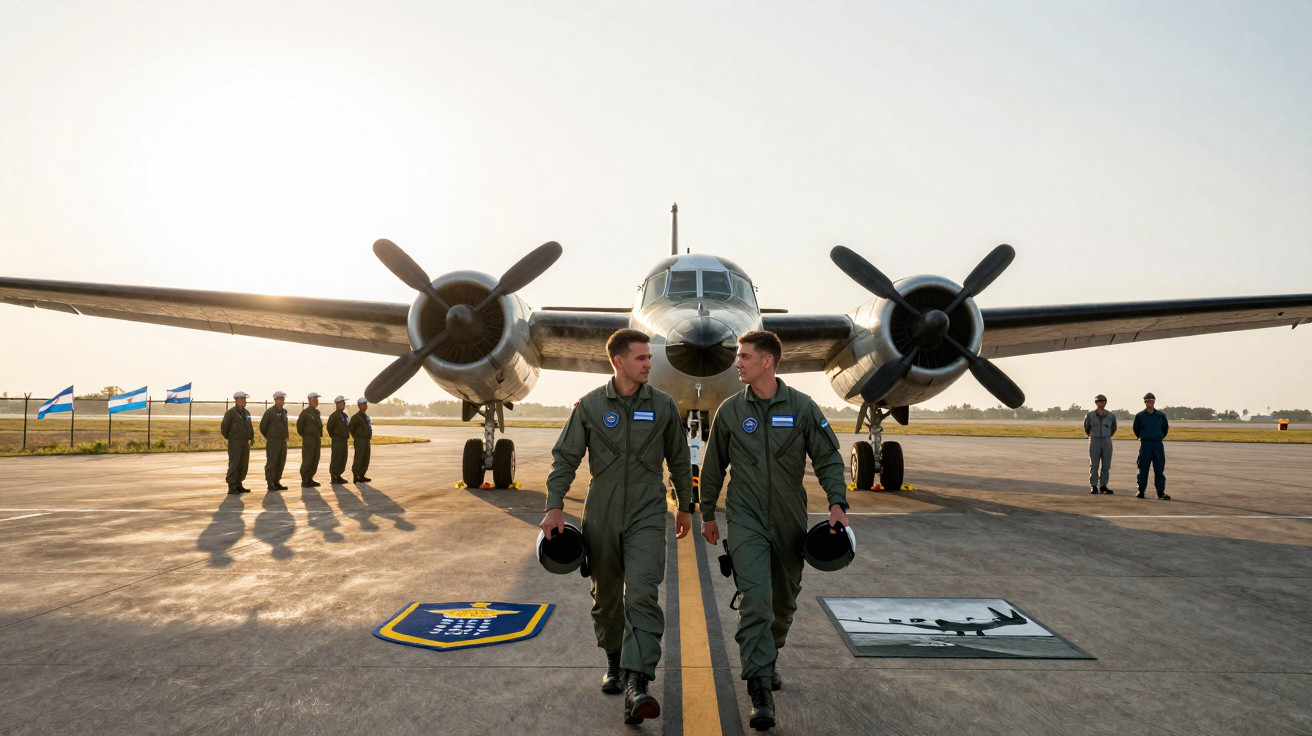
After more than six decades in exploration, maritime patrol and anti-submarine warfare roles, the Argentine Navy has formally retired its Grumman S-2T Turbo Tracker aircraft. The farewell ceremony was held at Comandante Espora Naval Air Base in Buenos Aires Province, Argentina, where aircraft 2-AS-23 completed its final operational sortie. Confirmed by Zona Militar last month, the retirement brings to an end a period that started in 1962, when the first Trackers reached the country.
Final flight of the Argentine Navy’s S-2T Turbo Tracker
On the afternoon of 2 December, 2-AS-23 flew over Bahía Blanca for the final time. Following its landing, the aircraft performed its distinctive wing-folding manoeuvre before the Navy’s senior leadership. The event was attended by the Chief of the Navy General Staff, Admiral Carlos María Allievi; Vice Admiral Marcelo Ricardo Flamini; Rear Admiral Gustavo Fabián Lioi Pombo; and Rear Admiral Román Enrique Olivero.
Veterans of the Malvinas War, military and civilian staff from Puerto Belgrano Naval Base, relatives, and former personnel from the Anti-Submarine Naval Squadron also attended. Together, they gave an emotional farewell to one of the most recognisable symbols of modern Argentine naval aviation.
The ceremony traced the service history of the Tracker generations operated by Argentina. The first six S-2A aircraft arrived aboard the aircraft carrier ARA Independencia on 31 May 1962, establishing the Anti-Submarine Naval Squadron. A further six S-2E aircraft joined the fleet in 1978, strengthening the Navy’s operational capabilities during a challenging geopolitical period, especially in the country’s south.
With their specialised ability to search for and detect submarines, the aircraft were deployed during operations in the Beagle Channel in December 1978. They were later employed in the South Atlantic Conflict in 1982.
Tracker operations during the Malvinas conflict
The Trackers fulfilled a crucial role during the 1982 Malvinas conflict. Initially embarked aboard the aircraft carrier ARA Veinticinco de Mayo, they carried out exploration and anti-submarine patrol missions across the South Atlantic. After the carrier withdrew, they continued flying from Río Grande and Río Gallegos.
Their task was to identify the presence of British submarines and support Fleet operations, again proving their worth under real combat conditions.
Lieutenant Junior Grade Soledad Ledesma, the ceremony officer, noted: “In the year 1993, an important generational technological leap would come for 2-AS-23 as it became the first of its class to be sent to Israel for its modification under the ‘TATA’ project (turbine conversion of the Argentine Tracker aircraft). Since then, the Turbo Tracker continued training crews, participating in joint and combined exercises, operating in support of Fleet units, conducting anti-submarine and surface exploration operations, maritime space control flights over the 200-mile zone, and SAR standby over national jurisdictional waters.”
Before being decommissioned, 2-AS-23 undertook an emotional farewell tour, including a visit to the Military Aviation School in Córdoba. Numerous aviation photographers documented the stop, underlining the enduring interest in the twin-engined anti-submarine aircraft, the last of its kind still in service in South America. A few days earlier, it had also appeared at the open day at Punta Indio Naval Air Base, allowing hundreds of visitors to see it at close range for the last time.
In his address, Corvette Captain Norberto Baumgartner, Commander of the Anti-Submarine Naval Squadron, stressed the significance of 2-AS-23 as a living record of Argentine naval aviation history. He also highlighted the presence of Malvinas War Veteran Retired Captain Juan José Membrana among the final crew. He stated: “To you, dear Grumman Tracker, in all your versions: this AS-23 represents our affection and respect for your nobility. Thank you for taking care of us and bringing us home.”
The subsequent folding of 2-AS-23’s wings represented the final closure of an outstanding chapter in Naval Aviation history. The S-2T Turbo Tracker leaves a legacy of service and dedication to the surveillance and control of the Argentine sea. Shaped by the roar of its turbines, the winds of the South Atlantic and the sacrifice of its crews, its story will remain in the memories of those who regarded it as more than an aircraft: a guardian of the sea and an emblem of the Argentine Navy.
Image credits: Gaceta Marinera – Argentine Navy.
Translation by Constanza Matteo
You may also like: Following President Milei’s Announcement, the Argentine Navy Moves Towards Restoring Its Submarine Force


Comments
No comments yet. Be the first to comment!
Leave a Comment