
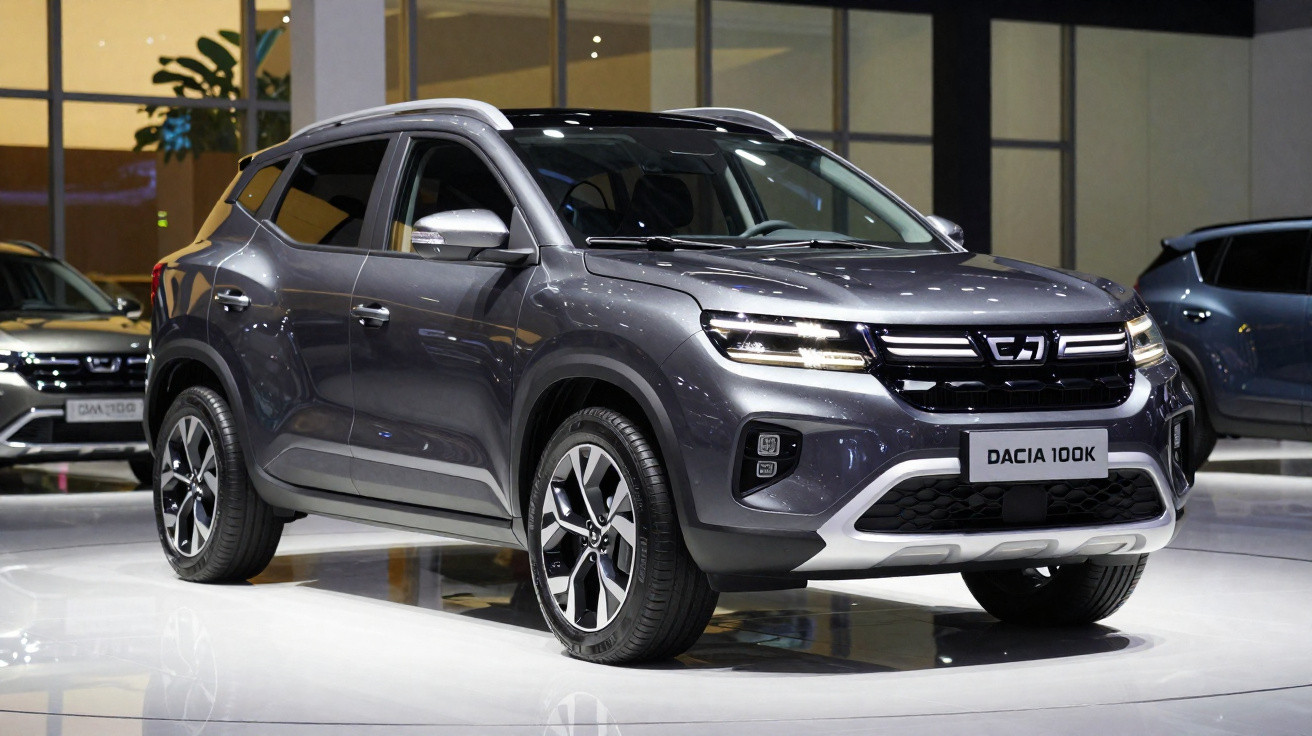
The Romanian budget brand discovered in 2025 that it could also launch-and sell in substantial numbers-larger SUVs, priced from a minimum of €25,000. Enough to cast a shadow over its earlier successes, the Duster and Jogger.
Dacia ended 2025 with growth of 3.1% and 697,000 sales within the Renault Group. Although this was a solid performance, it did not provide full reassurance: the brand’s French chief executive, Denis Le Vot, left the company during the summer, while competition from Chinese brands is becoming more intense.
Dacia Bigster production passes 100,000 units
At the start of 2026, the Bigster passed the milestone of 100,000 units built at the Mioveni plant in Romania. Production is running at a rate of 1,357 Bigsters a day-one every 55 seconds-which is a highly respectable figure for a vehicle of this size. It is both the most expensive model in the range and in the history of the budget brand.
Orders for the model opened at the beginning of 2025, following its unveiling at the 2024 Paris Motor Show. It reached the roads in spring with an appealing proposition: a price not vastly different from that of the Duster, yet with 22 cm more length and a 667-litre boot. Even before deliveries began, it had secured 13,000 sales.
More than 8 million Dacias have left the Mioveni factories since 1968. While the Bigster has not overtaken the brand’s other models, it has nevertheless “cannibalised” Dacia’s results. Some 67,500 Bigsters were sold in 2025, with a sharp increase in the second half of the year, when it became Europe’s best-selling compact SUV among private buyers. The Sandero remains Dacia’s top-selling model.
Dacia Bigster buyers choose the hybrid
Most buyers selected the Journey trim, the range-topping specification, which is available only from €28,600 with the 140 hp petrol engine featuring mild-hybrid technology. However, this was not the version chosen by the largest number of customers: they instead favoured the 155 hp non-plug-in hybrid, from €32,000 (65% of sales).
These sales have not all come from France. France is admittedly a major market, but it does not account for the largest share of Bigster sales. Since the model went on sale, the country has contributed 17,460 registrations. 95% of sales come from Western Europe, with the Bigster featuring among the best-selling cars in Germany, Portugal and Italy.
One platform for a market worth 3 million annual sales
Although the arrival of such a large SUV may have seemed surprising for a budget brand, Dacia had clear reasons for doing so: C-segment SUVs now account for a market of 3 million sales a year in Europe, and every rival costs considerably more. Examples include the Peugeot 3008, Renault Austral, Toyota RAV4 and Hyundai Tucson.
At 4.57 m long, the SUV is the biggest vehicle in the range and substantially longer than the Duster. Yet it is still similar in length to the Jogger (4.55 m), the brand’s adventurous estate car that can become a small camper van with its “Sleep Pack”. At the time, Denis Le Vot explained that using the Duster platform had cost Dacia nothing.
“As usual, we started from the bottom to create a large car. It is a B-segment platform that makes it possible to build a C-segment vehicle. With a width of 1.80 m for the Duster, we had room to lengthen the car without making it look like a dachshund,” he explained during the model’s press drives in April 2025.


Comments
No comments yet. Be the first to comment!
Leave a Comment