
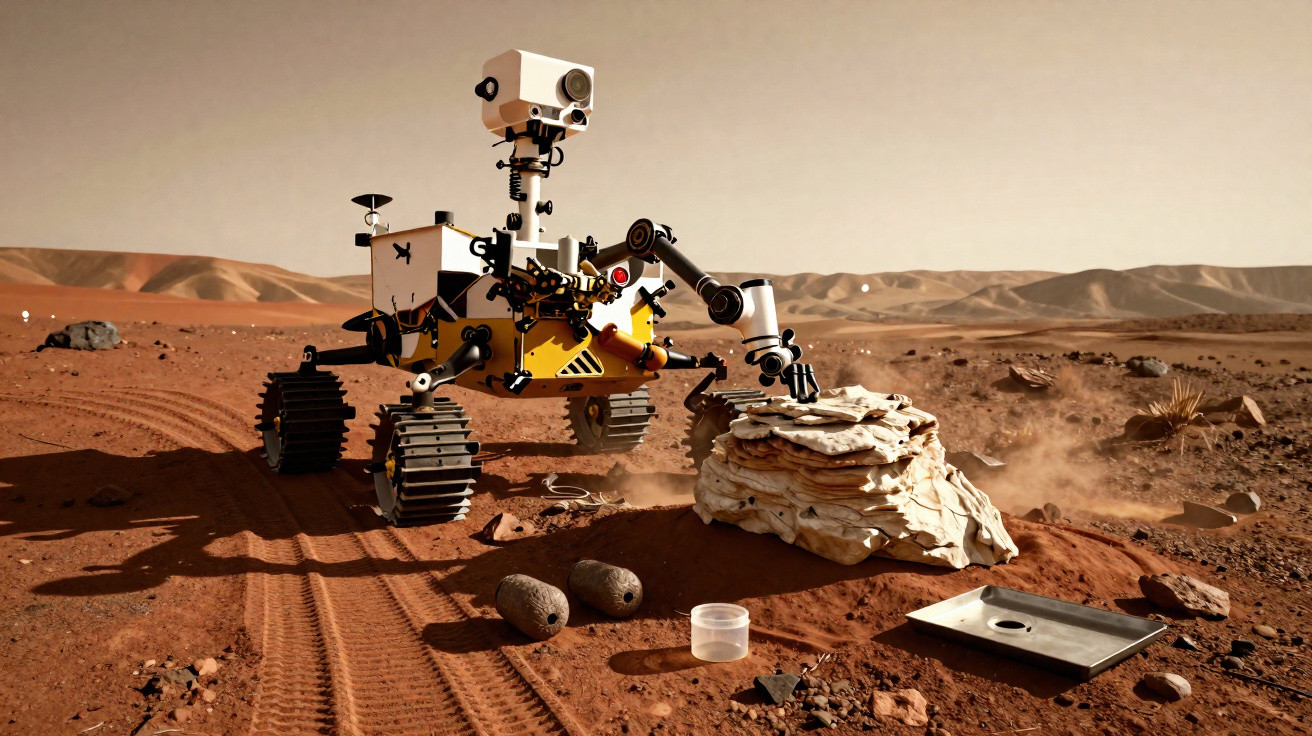
A small piece of Martian rock, drilled by a lone rover, has revived space exploration’s oldest question: was Mars ever alive?
A fresh assessment of Curiosity rover data, combined with laboratory simulations, has put scientists in a difficult position. The concentrations of organic compounds found in a Red Planet rock are so high that models based solely on chemistry, with no involvement from living organisms, no longer appear adequate.
The finding troubling scientists
In 2023, NASA’s Curiosity rover was examining sediments in Gale Crater, an ancient basin that once held a lake. In one sample of sedimentary rock, the robot’s instruments detected organic compounds with carbon chains containing up to 12 atoms.
That result stood out on a planet exposed for billions of years to harsh space radiation and protected by only a thin atmosphere. Organic compounds are widespread throughout the Universe, yet on Mars they are generally found only in modest traces. This time, the amount was too substantial to overlook.
“The volume of organic molecules preserved in this rock indicates that, in the distant past, Mars may have been far more ‘chemical’ - or far more ‘biological’ - than previously thought.”
The initial explanation considered at the time was the presence of substances resembling fatty acids, molecules closely associated with life on Earth. They are part of the fundamental structure of cell membranes, coat organisms and take part in countless metabolic reactions. However, Curiosity does not carry a fully equipped laboratory. It can effectively ‘smell’ and heat samples, break down molecules and identify fragments, but it does not offer the resolution available in terrestrial laboratories.
Ancient life or inventive chemistry?
The dilemma was immediate: were these molecules a biosignature, evidence of ancient Martian microorganisms, or could they have formed through physical and chemical processes alone, without life playing any role?
On Earth, fatty acids and similar organic chains commonly point to biological activity. Yet geologists and astrochemists know that rocks, heat, water and energy can also assemble complex molecules with no cells nearby. The team therefore set out to establish just how far chemistry ‘without life’ could go.
What the new research did differently
As the Martian rock could not be examined directly, researchers recreated the problem on Earth. Scientists associated with NASA and European laboratories used simulations involving rocks analogous to those on Mars, exposing them to radiation doses equivalent to roughly 80 million years on the Martian surface.
Their aim was straightforward: to determine how much organic material could survive after such prolonged bombardment by energetic particles and ultraviolet radiation. It was already known that organic molecules break apart readily under this kind of assault, particularly on a planet with such a sparse atmosphere as Mars.
“The models showed that, for Curiosity to detect so much carbon today, the rock would have needed to begin with enormous quantities of organic compounds in the distant past.”
The scientists then examined every principal non-biological source that might have supplied this original stock of molecules.
The ‘no-life’ explanations that fell away one by one
Several possible abiotic origins were assessed, including:
- A continual deposition of carbon-rich cosmic dust on the Martian surface;
- Meteorite impacts delivering complex organic matter;
- Atmospheric chemistry on an ancient Mars that was wetter and had a denser atmosphere;
- Substances generated inside the planet and brought to the surface by impacts.
Each scenario was quantified using models of material flows, meteorite fall rates and radiation-driven molecular destruction curves. The outcome surprised part of the scientific community: no abiotic model was able to reach the concentration observed in the rock drilled by Curiosity.
Meteorites and space dust do carry organic molecules, for instance. Yet even when accumulated over millions of years, they do not come close to the amount inferred for that particular sediment. The possibility of an ancient Martian atmosphere rich in carbon compounds faced a different constraint: it would require far more methane relative to carbon dioxide than climate models consider plausible.
The theory that compounds formed deep within Mars and were thrown to the surface by impacts also suffered a setback. Had this occurred, the rock’s mineral composition should have been different, displaying signs of intense heating or mixing with mantle material. That is not what was found at the site under study.
When the simplest explanation becomes unsettling
After these tests, one point remained: every entirely chemical explanation appeared weak. This does not mean that life on Mars has been ‘proved’, but it changes the relative weight of the hypotheses. If the abiotic option becomes too complicated to account for the evidence, the biological hypothesis stops being a remote fantasy and becomes a serious contender.
“The data do not compel us to accept that life once existed on Mars, but they push science towards a crossroads where biology again becomes a concrete possibility.”
The study’s authors, whose research was published in the journal Astrobiology, remain cautious. A decisive signature is still missing: isotopic patterns, fossilised cellular structures or organic chains arranged in configurations typical of metabolism. None of these can be detected using Curiosity’s current instruments.
The role of future rovers and the sample-return mission
To resolve this deadlock, the space science community is relying on two approaches. The first involves rovers able to drill deeper, such as the European ExoMars mission, which is still awaiting launch. A few metres below the surface, radiation levels are much lower and molecules may be better preserved.
The second approach is more ambitious: returning Martian rocks for examination in laboratories on Earth. The Mars Sample Return mission, conceived as a NASA–ESA partnership, plans to collect sealed tubes that the Perseverance rover is already depositing in Jezero Crater and return them using a rocket launched from the Martian surface itself.
| Stage | Objective |
|---|---|
| Collection by rovers | Select sedimentary rocks that may have preserved evidence of water and organic matter. |
| Storage in tubes | Isolate samples from the Martian environment to prevent subsequent contamination. |
| Launch from Mars | Send a capsule containing the tubes into orbit and then onwards to Earth. |
| Laboratory analysis | Use high-resolution techniques that cannot be carried aboard a rover. |
Only a laboratory on Earth will make it possible to measure precisely, for example, the proportion of carbon isotopes in the detected molecules. On Earth, life forms tend to ‘prefer’ certain isotopes, leaving a subtle signature in organic matter. Finding something similar in Martian rocks would be a watershed moment.
Concepts that help explain the controversy
Two terms recur constantly in these discussions: ‘organic compounds’ and ‘biosignature’. They are not synonymous. Organic compounds are carbon-based molecules, often containing hydrogen, oxygen, nitrogen or sulphur. They can arise both in living cells and through entirely physical or chemical reactions.
A biosignature goes a step further: it is any trace that indicates, with a good degree of probability, the direct or indirect action of living organisms. It may be a specific molecule, a chemical pattern, a texture in rock or even an atmospheric gas at an unusual concentration. The Gale Crater rock lies squarely on the boundary between these two categories: it goes beyond simple ‘generic organics’, but has not yet definitively crossed into ‘confirmed biosignature’ territory.
Possible scenarios for Mars’s past
Current evidence opens up several working scenarios for researchers. One envisages an ancient Mars with permanent lakes, moderate volcanism and hydrothermal sources beneath those lake beds. In this setting, organic molecules could have formed in large quantities, perhaps with the help of iron- and sulphur-rich minerals, without life being involved.
A second scenario is bolder: microorganisms may have emerged in these lakes, produced and altered organic matter, and then disappeared as the Martian climate changed. What Curiosity detects today would be highly degraded remnants of that short but intense biological period. For now, both possibilities remain open.
These discussions also help determine where to drill, which rocks to prioritise and what instruments should be sent on forthcoming missions. Locations combining still water, fine sediments and partial protection from radiation receive greater priority. Every new piece of evidence may strengthen or weaken the hypotheses, refining the history scientists are trying to reconstruct for Mars.






Comments
No comments yet. Be the first to comment!
Leave a Comment