
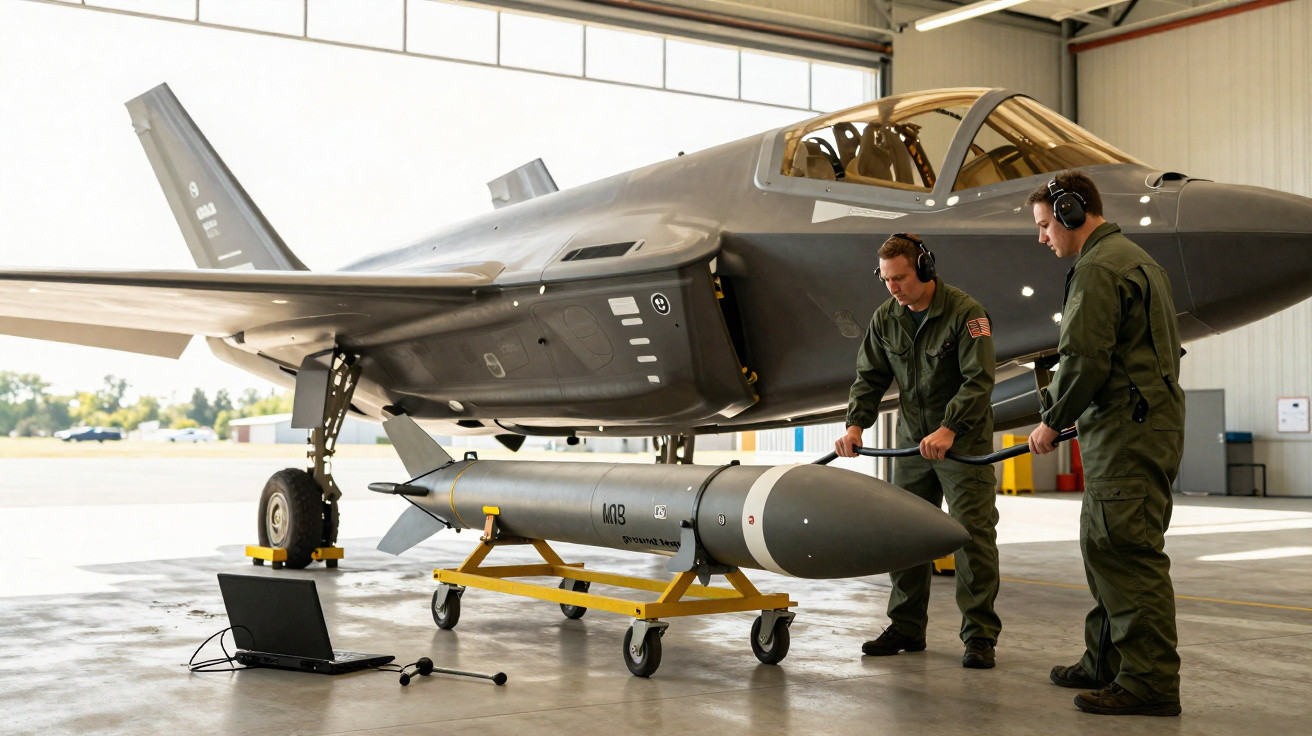
Fresh trials in California have brought the F-35A a step nearer to firing Meteor, the long-range European missile built to engage hostile aircraft well before pilots can see them. The development links US-made stealth aircraft more closely to Europe’s defence plans, while also highlighting delays and strains within the weapons programmes behind the headlines.
Ground tests mark a critical step for F-35A and Meteor
Engineers at Edwards Air Force Base in California have recently completed a set of ground trials combining the F-35A with MBDA’s Meteor beyond-visual-range air-to-air missile.
The work centred on two essential assessments: ground-vibration trials and checks of the missile’s “fit” within the F-35A’s internal weapons bay.
Engineers confirmed that Meteor can be safely stored and released from the F-35A’s internal bay without compromising the jet’s stealth profile.
Test data was reviewed to establish how the airframe and missile equipment performed together. This included the response of mounting points during vibration, along with the operation of bay doors and launcher mechanisms.
Lockheed Martin’s F-35 industry team has stated that just one final ground test is required before the programme can proceed to full airborne firing trials using the F-35A.
Why Meteor on the F-35 matters for Europe
Meteor is not a conventional missile within the US inventory. Designed in Europe, it is already carried by aircraft including the Eurofighter Typhoon, Rafale and Gripen. Its integration with the F-35 is chiefly intended for European customers seeking to retain a common missile across several combat-aircraft fleets.
A ramjet motor powers the missile, enabling it to retain high speed and energy until it reaches its target instead of coasting during the final stage, as many traditional air-to-air missiles do.
Combining a stealthy F-35 with a ramjet-powered Meteor extends the distance at which pilots can threaten enemy aircraft, often before they are detected.
MBDA calls Meteor a “network-enabled” weapon. In practice, it has a two-way data link through which the missile and aircraft can exchange targeting information in flight. On a fifth-generation fighter such as the F-35, this network allows the aircraft to provide the missile with updated target data as an engagement develops.
This creates a flexible engagement envelope. An F-35 can fire at a hostile aircraft from long range before using its own sensors and linked information from other platforms to alter the missile’s course while it remains airborne.
Who is leading the integration work?
European nations have divided responsibility for integrating Meteor across the F-35 variants:
- Italy is sponsoring Meteor integration for the conventional take-off and landing F-35A.
- The UK is leading Meteor integration for the F-35B short take-off and vertical landing (STOVL) variant.
In March, a US Marine Corps F-35B started early Meteor flight trials at Naval Air Station Patuxent River. The aircraft is part of a UK–US industry-backed collaboration. The programme is aimed at Royal Air Force and Royal Navy F-35B fleets, as well as possible demand from other F-35B operators.
Delays push Meteor in-service date into the 2030s
Although progress has recently been made, the Meteor–F-35 programme has slipped beyond earlier schedules. In a June statement to Parliament, Maria Eagle, then the UK defence procurement minister, said Meteor is now anticipated to enter service on UK F-35s in the “early 2030s.” The previous target was approximately 2027.
No detailed public reason was offered for the delay. However, later government reports indicated a combination of supplier problems, Meteor’s low priority within the wider global F-35 programme, and difficult commercial negotiations.
For the Royal Air Force, this postponement means the UK F-35B fleet will continue relying on its existing air-to-air weapons for several more years before receiving a genuinely long-range, Meteor-class capability carried within the aircraft’s stealthy bays.
UK officials say Meteor will significantly lift the F-35’s air combat reach, but acknowledge that capability is now several years later than planned.
The UK’s parallel headache: no long-range strike missile yet
London also faces a separate but connected issue: F-35s still lack a standoff, long-range weapon for attacking ground targets. A parliamentary report published last October called the absence of this weapon the Ministry of Defence’s “biggest concern” for the wider F-35 fleet.
The intended answer is a further MBDA weapon, the Spear 3 precision strike missile. Spear 3 is designed to be carried in quantity inside the F-35’s internal bays, providing long-range attacks against air-defence systems, vehicles and other important targets while preserving the aircraft’s low observability.
However, Spear 3 has also been delayed. The UK’s National Audit Office said both Spear 3 and Meteor had slipped because of “poor supplier performance,” commercial arrangements that did not prioritise schedules, and Meteor’s limited priority within the global F-35 programme.
| Capability | Missile | Role | Planned UK F-35 timeframe |
|---|---|---|---|
| Air-to-air, long range | Meteor | Engage enemy aircraft beyond visual range | Early 2030s |
| Air-to-ground, standoff | Spear 3 | Strike defended land and maritime targets | Early 2030s |
Until both missiles enter service, UK F-35s will carry a narrower weapons mix than originally planned, restricting how far they can remain from advanced surface-to-air missile systems.
F-35 numbers grow as weapons lag behind
The UK has pledged to procure 138 F-35s, all in the F-35B STOVL version. Contracts have so far been placed for 48 aircraft, with further orders expected during the 2030s.
As aircraft reach front-line service more quickly than their next-generation missiles, the expanding fleet increases pressure to address this “weapons gap”.
For European F-35A users including Italy, Norway, Denmark and others, Meteor provides a means of aligning missile inventories with existing Typhoon or Gripen fleets. Common weapons simplify logistics and allow air forces to transfer missiles between aircraft types during a crisis.
Aligning weapons across multiple platforms lets European air forces mix and match F-35s, Typhoons and other fighters while relying on the same high-end missile.
What Meteor brings to an F-35 fight
In theory, combining Meteor with the F-35 alters the geometry of air combat. The F-35’s sensors and stealth enable it to locate and track hostile aircraft without being easily detected, while Meteor supplies the range and terminal-phase energy needed to exploit those early detections.
Under a typical scenario, an F-35 patrols at high altitude while discreetly gathering radar and electronic-emissions data. After identifying a hostile aircraft, its pilot can launch a Meteor at long range and remain beyond the effective reach of many enemy weapons.
The ramjet maintains high speed far into the engagement, making it more difficult for a target to evade the missile by turning away or diving. Its data link permits either the F-35 or other friendly platforms to improve the intercept if the target manoeuvres or fresh information emerges during flight.
Key terms worth unpacking
The story rests on two core technical concepts: “beyond-visual-range” and “internal weapons bay.”
Beyond-visual-range, or BVR, refers to air combat at distances where opposing aircraft cannot be seen by pilots with the naked eye. At such ranges, radar capability, data links and missile kinematics determine the outcome more than dogfighting skill alone.
An internal weapons bay is a compartment within an aircraft fuselage used to carry weapons. Internal carriage is essential for stealth aircraft, because weapons suspended beneath wings create radar reflections that are easier to detect. Meteor’s bay integration means F-35 pilots need not choose between low observability and long-range striking power.
Risks, trade-offs and future scenarios
Meteor–F-35 integration offers clear advantages but carries risks as well. Reliance on one European supplier for both Meteor and Spear 3 leaves the UK and other customers vulnerable to industrial or political disruption.
There is also a balance to strike between cost and speed. Faster integration could require additional funding, more test flights and greater technical risk, at a time when defence budgets face rival demands from land warfare, naval programmes and replenishing stocks for Ukraine.
In a high-tension situation over the Baltic or eastern Mediterranean, mixed groups of Meteor-equipped F-35s and older fighter types could provide NATO with layered air defence. Typhoons could patrol farther back carrying large missile loads, while F-35s operate forward and discreetly supply targets to Meteors launched by several aircraft. This form of networked, cooperative engagement is precisely what the current integration work seeks to make possible.
As final ground tests conclude and flight trials accelerate, the central question changes from “will Meteor fit the F-35?” to “how quickly can this combination reach front-line units?” For European fleets already operating the Lightning, the answer will influence not only future air combat, but also budget arguments and industrial choices for years to come.






Comments
No comments yet. Be the first to comment!
Leave a Comment