
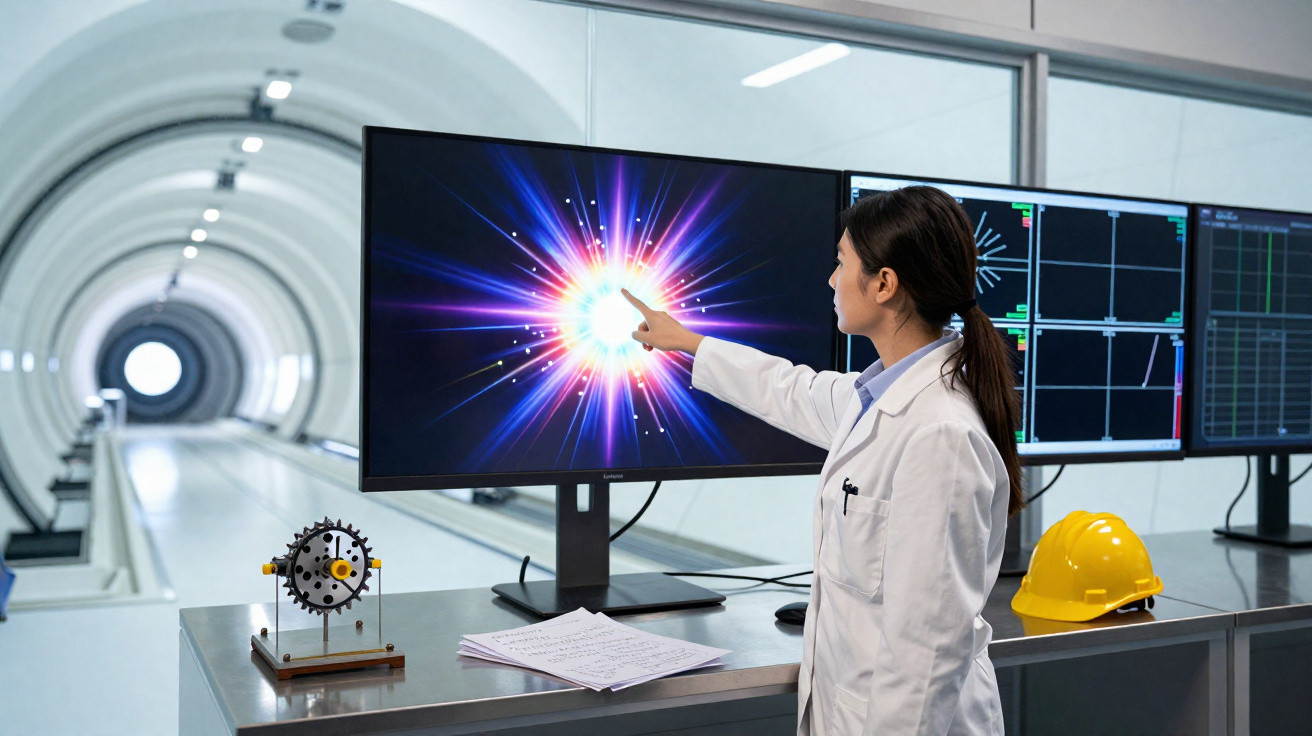
The traces are fleeting, jagged and-if they prove genuine-strange enough to lift eyebrows and quicken pulses in the control room.
During the night shift at the Large Hadron Collider, dim lighting gives the consoles a subdued, drowsy glow. A technician, rubbing tired eyes as their coffee goes cold, watches a bank of screens draw neon hieroglyphs against black. Behind a line of chairs, I see someone lean in and press a key, pausing the event display just as a calorimeter cell flares like a match struck in rain.
Nobody gasps in this environment; they narrow their eyes, speak quietly and verify the data. Yet the rhythm shifts when a pattern declines to resemble anything routine. The burst is slight but persistent, failing to match the usual candidates-muons, jets, photons or the constant trickle of background noise. The room falls quiet, as though everyone is holding their breath.
Then the spike appeared.
A Glitch, A Ghost, Or Something New?
LHC teams have logged what they call unknown energy signatures: brief, abrupt spikes emerging in data following proton-proton collisions. They are not the spectacular displays associated with a Higgs-like event, but resemble camera flashes cutting through fog. Their unusual shape and timing are the concern, as neither fits the catalogue of established particle tracks.
During one recent period of operation, analysts identified a group of rapid, highly localised energy deposits in the calorimeters without the normal signs of particles entering or leaving. There were no extended, clean tracks and no distinctive jets spreading outward-only compact packets of energy arriving within a narrow time interval. The trigger team marked the pattern, reconstruction was run again, and the blips remained, like fingerprints left on glass.
Before anyone so much as suggests a “discovery”, there is a hierarchy of explanations to test. At the first level are detector effects: inactive channels, electronic noise or timing offsets between sub-detectors. Next come rare Standard Model processes capable of masquerading as something unfamiliar. Only after that do exotic possibilities enter the discussion, including dark photons and axion-like particles that might deposit energy where models do not predict it. In physics, “unknown” means “not yet matched to a dependable template”. It is a warning, but also an invitation.
How Scientists Will Try To Break The Mystery
The opening approach is deliberately ruthless: attempt to eliminate the effect. Analysts will process the same runs again using alternative calibrations, before dividing the data by time, luminosity and detector region to determine whether the burst pattern shifts. They will synchronise timestamps between systems to nanosecond precision, compare results with zero-bias triggers and follow bunch crossings to exclude out-of-time pileup.
Afterwards comes the search for confirmation. If ATLAS observes it, can CMS observe it as well? Does its timing correspond with the muon spectrometer? Does the spike trace back towards the interaction point, or does it resemble a cosmic-ray shower cutting through the roof? We have all had an unexpected blip disrupt a familiar routine. The excitement is genuine-but it requires a demanding filter.
Readers of media coverage often make the familiar error of becoming attached to anomalies before the background has been thoroughly subdued. Frankly, nobody manages that every day. The process is slow and repetitive because nature conceals surprises among the weeds, and those weeds closely resemble wiring oddities, beam-gas interactions and statistical illusions. Being boring prevents you from being wrong.
“Extraordinary events are where discovery begins-and where mistakes go to hide,” a veteran collider physicist told me. “Our job is to flush out both.”
- Verify the result across several detectors and subsystems.
- Reproduce the effect in fresh runs under different beam conditions.
- Begin a blinded analysis to prevent selection bias.
- Publish a preliminary note that makes background systematics fully visible.
- Ask external theorists to pressure-test possible interpretations.
What The Burst Shapes Could Be Saying
When physicists discuss short bursts, they are interpreting the grammar of energy: its arrival speed, its spread and its direction. A burst appearing in electromagnetic calorimeters without a corresponding track could point to a neutral particle decaying in an unusual manner. One delayed by a fraction of a moment may indicate a long-lived particle travelling some distance before it decays. A burst correlated across subsystems but lacking a clear origin may instead be a timing artefact-and that is precisely the danger.
Topology is the understated key. Does the energy form a cluster like a photon shower, or spread out like a hadronic jet? Does a narrow angle recur more often than random chance would allow? Does the event display resemble one fragment, or two symmetrical flashes suggesting a decay into a pair? Such patterns matter because they provide context in whispers. One isolated burst offers a one-line story; a repeating form can develop into a language.
Background effects remain the most stubborn adversary. Beam halo can imitate signals that appear to originate from nowhere. Neutrons ricocheting around the cavern can create ghost events. Even the cadence of the electronics may produce a pattern which, initially, resembles physics. New physics rarely announces itself loudly; it taps, tap-tap-taps, until the knocking reveals itself as a code nobody knew to interpret. And sometimes, of course, the sound is coming from inside your own house.
How To Follow This Without Getting Lost
Begin with the most straightforward test: consistency. Seek independent confirmation from more than one detector, alongside public analysis notes that measure backgrounds through several methods. Confidence rises incrementally when the same pattern persists with modified triggers and after recalibration passes. A PhD is not necessary to follow the story; patience and a preference for patterns over headlines are enough.
It is also useful to follow the timeline. Genuine signals endure over seasons. They return when the collider operates again under comparable conditions, while becoming clearer as calibrations improve. If the effect diminishes or wanders as analysts tighten their checks, it was probably a mirage. If it remains stable despite those tighter checks, there is good reason for curiosity.
Allow yourself to pose apparently simple questions, too. What is the control region? How was the background modelled? Did both ATLAS and CMS observe the effect, and did LHCb detect any sign of it? Major experiments depend on sceptical curiosity. That is not negativity; it is how positive news proves it deserves attention.
“We learn more by trying to break our own results than by celebrating them,” said a data-quality convener in Geneva. “If an effect survives the gauntlet, then it gets our full attention.”
- Watch for internal notes becoming public preprints.
- Look for joint statements issued by several collaborations.
- Follow dedicated runs aimed at the burst timing window.
- Check whether new calibration reduces background estimates.
- Look for conference presentations comparing topologies between detectors.
What It Could Mean-And Why It Matters
Perhaps these bursts simply teach humility, reminding us that machines of such complexity produce harmonics we do not always detect. Or perhaps they are a quiet signal from a branch of physics that rarely interacts with us, arriving as small revisions to a script we believed we understood. Scientists are right to proceed carefully, and everyone else is right to remain curious.
Should the signatures disappear under scrutiny, rigour has succeeded. Should they endure, they may develop into evidence of a new mediator, a long-lived particle or a discrepancy worth exploring through further runs and improved triggers. In either case, the pursuit matters. Discovery is a shifting frontier approached with equal measures of nerves and poise, in the hope that firm ground appears beneath your feet.
Share the mystery, but remain committed to the method. Science is not an inbox alert; it is an extended conversation. Its next line is being written now in tunnels beneath the French-Swiss border, by people who regard surprise as a guest that must be welcomed and scrutinised.
| Key point | Detail | Why it matters to the reader |
|---|---|---|
| What “unknown energy signatures” means | Bursts that do not correspond to standard detector templates for known particles or backgrounds | Provides a clear, low-jargon definition for following developments sensibly |
| How validation works | Cross-detector checks, reprocessing with new calibrations, blinded analyses and replication | Sets out the checklist that distinguishes hype from genuine progress |
| What to watch next | Public notes, consistent signals in fresh runs and decreasing background uncertainties | Helps you follow the story without becoming lost in speculation |
FAQ:
- Are these bursts proof of new physics? No. They are interesting patterns that must pass several layers of testing before anyone treats new physics as a serious possibility.
- Could this be a detector glitch? Yes. It is the first explanation scientists seek to confirm or exclude through timing checks and calibration scans.
- What experiments are involved? ATLAS and CMS are the principal general-purpose detectors at the LHC; LHCb and ALICE could provide context depending on the topology.
- How long until we know more? Careful internal studies can take weeks to months, and sometimes longer when dedicated new runs are required.
- What might cause such bursts if they’re real? Potential explanations include rare Standard Model processes or candidates such as dark photons and axion-like particles, all dependent on robust evidence.






Comments
No comments yet. Be the first to comment!
Leave a Comment