
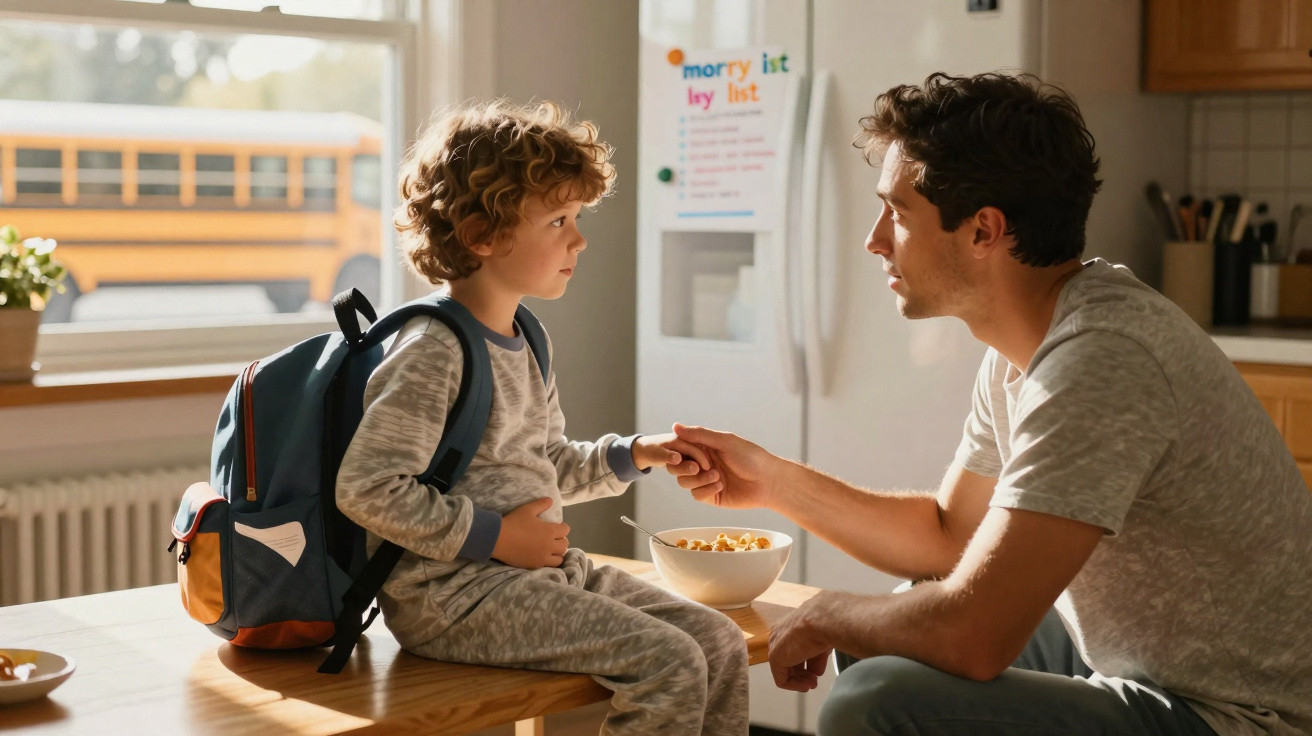
The earliest sign was how much heavier the kettle seemed on Monday mornings.
After that came the little hand on her tummy, the creased forehead and the hushed “I don’t feel well.” We would hover by the back door with shoes only partly on and a lunchbox damp with condensation on the worktop. Toast scented the kitchen as she folded over, pushing against the pain with bright, watery eyes. It felt like Groundhog Day in a school uniform. I started with my soothing voice, moved on to a practical one and, when the clock began to pressure us, occasionally offered a chocolate biscuit as a bribe. None of it made a difference. The GP said she was healthy as a horse, which felt reassuring and baffling in equal measure. On one wet Tuesday, between fastening her coat and hearing her shoes squeak, I finally understood. What if her stomach was not ill at all?
Mornings that seemed to stretch for ever
There is a particular quietness that comes when a child is holding back tears before school. The radio chatters about traffic, the cat circles everyone’s feet and your thoughts start negotiating with the time. We would inch towards the door before she suddenly bent double, her hands tucked beneath her school jumper as though she were trying to keep something from falling apart. I rubbed her back in slow circles while my thoughts went round and round too, asking whether we had overlooked something clear, something physical.
Most of us have had the moment when we almost wish it were a bug, because bugs come with treatment and a finish line. What we had instead was a routine: stomach pain before school, easing by mid-morning when she managed to get there, no symptoms over the weekend apart from a flutter on Sunday evening. She was not pretending. Her winces were real, and she looked pale at the edges. Yet every test was normal, and the pain disappeared on teacher-training days as quickly as sunshine clears mist.
Some days I coped well; on others, I did not. I used reason, delivered a PowerPoint’s worth of encouragement and even said “think of fun things at school”-which, looking back, is rather like telling a storm to search for rainbows. What she needed was for me to notice, properly notice. The pain was not an unexplained illness. It was communication.
Naming the real cause of school anxiety
The change began in the most ordinary way. At the park, a friend mentioned her son’s “worry tummy” as casually as she might have mentioned hay fever. She explained that children’s bodies can speak loudly while their vocabulary for feelings is still small, and that anxiety often takes hold in the mornings, when the day feels vast, unfinished and unknown. That thought stayed with me. I began observing, scientist-style, minus the lab coat.
I saw that the pain settled the moment we reached the school gate, even while she was still sniffling. I saw that it did not flare up on art day, but did on PE day, and that it was at its loudest whenever there was a supply teacher. I also noticed how my own fast, shallow breathing had become tangled up with hers. Once we gave it a name, it felt as though the whole house released its breath.
This wasn’t a mystery virus; it was anxiety dressed up as a bellyache. I explained that brains sometimes issue “danger” signals even when we are safe, and that they often send them straight to the stomach because that is where the body pays attention. Her face did not relax immediately. Still, something in the atmosphere changed. We had a name for it, something we could hold without being hurt by it.
What was really behind the fear
When I asked what felt hardest about school, she did not give me one big answer. It was several small worries tangled together like socks in a tumble dryer. She was anxious about the reading circle in case she stumbled over a word and felt her cheeks burn. The toilets worried her because the hand dryer sounded like a jet engine and someone had once thumped the door. The dining hall was simply too crowded, too loud, too much of everything.
She said that adults sometimes forget how long the corridor feels and how much the ceiling lights hum. She feared getting told off for a tiny mistake. She disliked the new PE teacher’s loud whistle, and losing at dodgeball upset her because the sting on her arm made her cry in front of other people. There was no single huge monster. It was more like a swarm of gnats: irritating, persistent and everywhere.
The worries beneath the stomach pain
We created a list, and it was far from tidy. There were margin doodles and a fingerprint in tomato sauce. We were not trying to find one answer for every line. We wanted her to see that fear becomes smaller when it leaves your head and reaches the page, a bit like putting a spider in a jam jar. She drew circles around the three worries that felt most uncomfortable, then added a small star beside one of them: reading aloud.
Honestly, nobody manages this every day. Families are not miniature therapy practices. On some evenings we were too exhausted to talk, and the list remained beneath spelling homework and a soggy permission slip. Even so, plotting out her worries made the ache feel like something we could inspect, move around and prepare for. Anxiety does not like a plan.
Gently reshaping the mornings
We did not transform our household overnight. We made gradual adjustments. I stopped telling her “There’s nothing to worry about,” because that is emotionally much like telling someone standing in a thunderstorm that the sun exists somewhere. Instead, we made the morning smaller: shoes waiting at the door, uniform prepared the night before, only one breakfast choice and a five-minute “worry window” after toast. In that time, she could tell me every terrible thing her mind had suggested. I did not contradict her; I simply nodded and wrote down a sentence.
We also practised a deliberately silly breathing exercise: smell the hot chocolate, blow out the birthday candles. We used a mug of peppermint tea as a prop, although we did not always drink it, because the smell helped her body remember the pace of the breath. We called her anxiety “The Wobble”, which meant we could discuss it without making her feel that she was the problem. “The Wobble is loud today,” she might say, and I could reply, “We can carry it together.”
We stopped arguing with the fear and started walking with it. That was an enormous change. Debating with anxiety seemed to feed it, whereas moving alongside it left it bored. The pain still appeared on some mornings, because bodies retain patterns, but it stopped running the whole day. We would step into a light English drizzle with the ache beside us, like a disgruntled passenger.
Bringing school in without a fuss
I sent her teacher an email, the sort you write while pasta is boiling. It was not alarmed, only: “This is what we’re seeing; here’s what helps.” The school were wonderful in the small but meaningful ways: a calm greeting at the door, the opportunity to arrive five minutes early and avoid the crowd, and the choice to replace reading circle with reading to the class bear on difficult days. The SENCO recommended a “safe person” card: a small laminated pass she could show to leave for a minute without drawing attention to herself.
We mentioned the hand dryer and learned that it could be turned off during the Year 3 break without anybody noticing. That week, the PE teacher replaced the whistle with a clap to begin activities. Not every adjustment could happen, and we were not asking for a day wrapped in cotton wool. We wanted to reduce the load enough for her to manage the unavoidable knocks. It turned out that many of her worries could be eased through small kindnesses.
What was unhelpful, and what quietly worked
I would love to claim that I never pleaded or bribed, but I did both, because I am human and sometimes needed to get to work. The thing that repeatedly failed was becoming a symptom detective at the doorstep. “Exactly where does it hurt? Describe the pain.” That only made us both more worried. Asking every five minutes whether it had stopped ensured that the pain remained at the centre of the room.
What helped was being slightly dull. We kept the same goodbye at the gate: a wave, a deep breath and then my walk to the corner shop, where I did not sit on the kerb and cry, however much I might have wanted to. On PE days, I put a note in her lunchbox saying “I’ll bring the peppermints after school” because peppermint had become our shorthand for “you did a hard thing.”
Progress looked boring from the outside, and that was the magic. One Tuesday, she picked up her bag without being reminded. On Friday, she told the cat, “No Wobble today,” then rolled her eyes at herself, which is more or less a Year 3 triumph. The tummy aches did not disappear in one cinematic scene. They slowly faded, like a bruise you forget is there until you knock it again.
Relapses, rainclouds and keeping going
Tests made the pain return. So did the first week after half-term and any day that involved a supply teacher. We held to the same plan and shortened parts of the day whenever possible. At first, she attended two lessons, then came home for lunch before returning for art. On mornings when everything felt especially sharp, we agreed on “10 minutes, then decide”, which outwitted the fear by making the horizon smaller.
I also had to pay attention to my face. Children read us like books that have been thumbed through many times. If I looked frightened, she saw twice the danger. I practised a calmness that was not pretend, but borrowed from a future in which we were all right. There were still mornings when I got it wrong and talked far too much. The next day, we would begin again with toast, peppermint steam and the walk past the neighbour’s lilac, which smells like old perfume.
If your child is holding their stomach before school
If you are reading this with a small child pressed against you, I understand that mix of love and frustration, and the knot in your throat when you look at the clock. You are not the only parent studying a Year 4 timetable as though it were a weather forecast. First, rule out anything that needs to be ruled out. Our GP was gentle and never made us feel foolish for returning. Once medical causes have been checked, give anxiety a name and a role: it is trying to protect them, but sometimes it works too hard.
Your child is not being dramatic; their body is doing its best to keep them safe. Ask where at school the ache becomes loudest. Do not ask “why”; ask “when and where.” Write one sentence to send their teacher, allowing the school to make a small adjustment without creating a production. If the school gate is the difficult point, suggest a safe person or an earlier arrival time. They are little hinges that can open very large doors.
A straightforward script that rescued our mornings
This is what I say at the door when the ache appears: “I can see the Wobble is loud. That means your body is trying to protect you. We’re going to do hot chocolate breathing. Then we’ll take the first ten minutes together with your teacher knowing. After that, I’ll be at the corner shop and then at my desk. If you need your card, you’ve got it. Your tummy might still ache and you can still do brave things.” It is not lyrical, but it is our lighthouse.
We also made a small bravery chart that rewarded effort rather than attendance with stickers. She received a star for using her card, attempting the breathing exercise in class or reading to the bear. On difficult days, a star was awarded simply for walking through the door. Fear dislikes kind measurement because it depends on absolutes. Our chart was specific, messy and forgiving.
The day we became aware of the quiet
There was no one grand victory. Instead, there was a Wednesday when the kettle seemed light, she spread her toast with too much butter and the cat stole a corner. We were halfway to school when she said, “Oh, I forgot my Wobble,” and smiled as if she had grown out of a jumper. That afternoon, she told me that the hand dryer was still loud and that she still disliked it, but it was “just a noise now.” We both slept soundly that night.
I keep the worry list in a drawer. It is untidy and precious: a map of somewhere we travelled through slowly. The ache still returns when life becomes stretched-at the start of a new term, after a change of seating, or with a supply teacher whose voice carries too loudly. We do not panic. We take out the mug, breathe, send the email and make the day smaller. Anxiety pushes buttons. We are learning where its off switch is.
How recognising anxiety changed everything
Understanding the ache as anxiety did more than make mornings easier; it altered how we speak about difficult things. My daughter discovered that a brave day can still be a shaky one, and that courage exists within the shaking. She learned to notice her body and ask whether the alarm was in the room or only in her mind. I learned to start with calm, follow through with action and treat school as a partner rather than a battleground.
There is something both ordinary and heroic about going to school with a churning stomach and doing maths regardless. It is not the kind of story social media tends to celebrate. It is the sort that puts a person back together, one tiny stitch at a time. It started when we recognised the ache for what it was: a message that needed a name, a quiet voice asking for a plan and a parent prepared to listen, even when the kettle felt heavy and the rain was unkind.






Comments
No comments yet. Be the first to comment!
Leave a Comment