
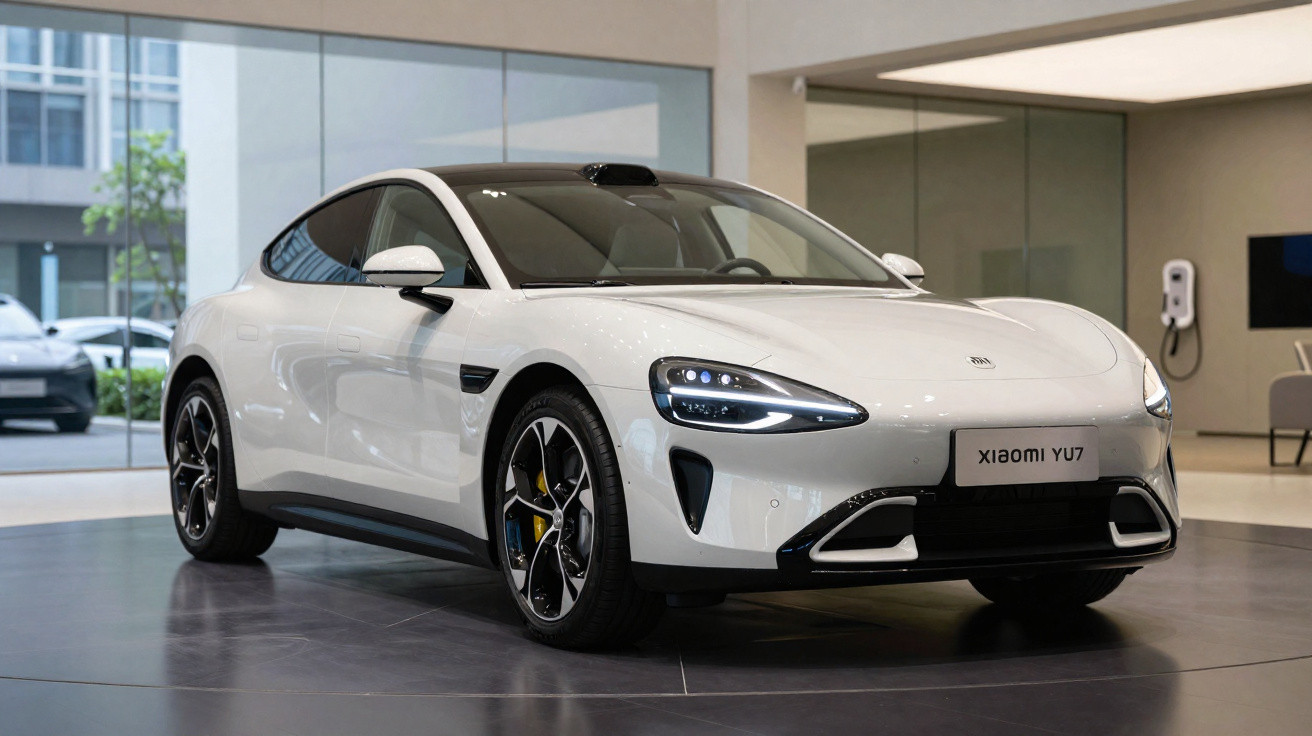
Following the success of the SU7 saloon, Xiaomi has now given its first electric SUV its global debut: the YU7. It is set to give Tesla serious competition, at least in the Chinese market, where it will initially go on sale.
The Chinese manufacturer is aiming to reproduce its saloon’s success with this new SUV. That helps explain its clear resemblance to the SU7, from its sleek, contemporary styling to its 0.245 Cx drag coefficient.
Its more modern touches include flush-fitting door handles and an LED lighting arrangement featuring a continuous light bar across the rear.
“V6”... electric
The Xiaomi YU7 will be offered in three trims: Standard, Pro and Max. Their principal differences lie in battery capacity and driving range.
Continuing the “sense of humour” already displayed with the SU7, Xiaomi has fitted the SUV with its HyperEngine V6s electric motor - yes, V6, as though it were an internal-combustion engine. Its real standout feature, however, is the speed at which it can spin, reaching a maximum of 21,000 rpm.
The entry-level YU7 Standard uses a 235 kW (320 hp) rear-mounted motor, allowing it to accelerate from 0 to 100 km/h in 5.88 seconds. Its 96.3 kWh LFP battery delivers a claimed maximum range of 835 km, although this figure is measured under the CLTC (China Light-Duty Vehicle Test Cycle), which is considerably less demanding than Europe’s WLTP procedure.
The YU7 Pro gains a second motor on the front axle, producing 130 kW (177 hp), for a combined maximum output of 365 kW (496 hp). Range falls to 770 km (CLTC), while the 0-100 km/h sprint takes 4.27 seconds.
At the top of the range, the YU7 Max employs two motors: a 220 kW (299 hp) unit at the front and a 288 kW (392 hp) motor at the rear, producing a combined 508 kW (691 hp).
This version features a 101.7 kWh NMC battery, which has a higher energy density and enables Xiaomi to claim a maximum range of 760 km, again under the CLTC cycle.
Performance is strongest in the Max, where 0-100 km/h takes only 3.2 seconds and top speed exceeds 253 km/h. The other versions are “limited” to 240 km/h.
With its 800 V architecture, the YU7 supports ultra-rapid charging capable of adding around 620 km of range in just 15 minutes. Xiaomi’s SUV can also charge from 10% to 80% in only 12 minutes.
Xiaomi YU7: no shortage of screens
The cabin is centred around the Xiaomi HyperVision Panoramic Display: a 1.1-metre-wide panel incorporating three mini-LED screens along the top of the dashboard. It is joined by a 16.1-inch central 3K display and a 6.68-inch screen in the second row, used to control various functions and the infotainment system.
The Xiaomi YU7’s electrical system includes five driving modes, seven distinct interior lighting settings and the AI-powered XiaoAI voice assistant. For driver assistance, the standard-fit LiDAR system is a particular highlight, offering a range of up to 200 metres.
Although the centre console has lost some physical controls, Xiaomi counters this with an ecosystem of magnetic accessories that includes shortcut buttons. These can be customised to operate different features, such as opening the glovebox or switching on the rear camera. There are nine magnetic mounting points throughout the cabin.
With a 678-litre boot and one of the largest frunks in its class - 141 litres, compared with the Tesla Model Y’s 116 litres - the YU7 provides ample luggage room. Folding down the rear seats increases capacity to 1718 litres.
When will it arrive?
The Xiaomi YU7 will launch in China as early as next month, with prices in its home market starting at €30,000 (253,500 Renminbi). That puts it well below the Model Y, the “target to beat”.
Orders are already open, and the 300,000-unit mark was passed within just a few minutes.
An expansion into international markets has not been ruled out, with further news potentially arriving in 2027. Could it make its way to Portugal?





Comments
No comments yet. Be the first to comment!
Leave a Comment