
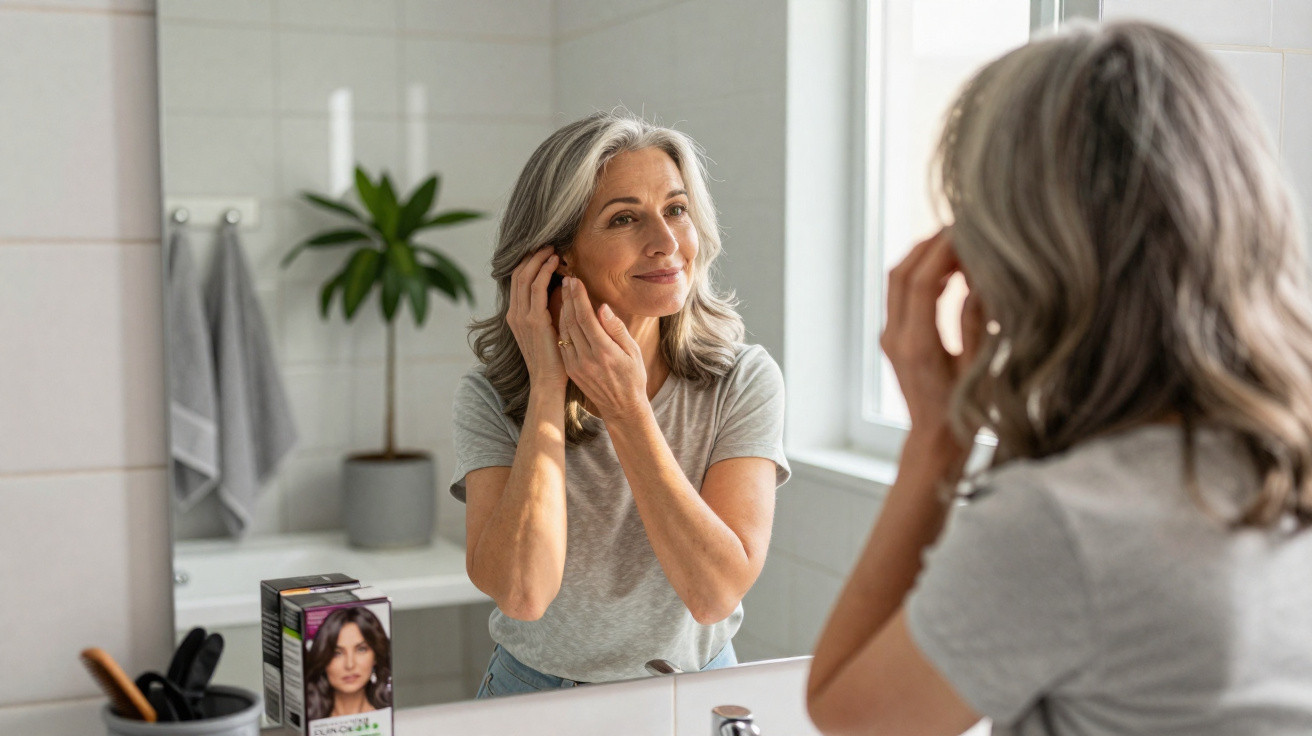
Her hairdresser labels it “maintenance”. Her diary sees it as a two-hour slot every four weeks. Her banking app has a rather different name for it. She angles her head, separates the roots with two fingers and has a thought that is frightening and exhilarating in equal measure: What if I just… stopped? It seems both defiant and unexpectedly calming. No more covering up. No more inspecting the white line in the car’s sun-visor mirror. No more acting as though time is standing still. She takes a photograph, sends it to her closest friend and types: “I think I’m done.” Then, with her heart pounding, she waits for an answer.
The hidden burden of concealing your roots
Watching silver roots gradually reappear brings its own particular strain. It is not quite a fear of ageing; it is more like a quiet anxiety that runs beneath everyday life. Every morning, the gaze goes straight to the parting. It is not to see whether the hair looks good, but whether it still appears “acceptable”. That small habit can shape the emotional atmosphere of the whole day. Rather than appreciating your appearance, you are searching for proof that you have failed.
Eventually, this affects a woman’s relationship with herself. The underlying message is subtle yet unrelenting: your “real” hair needs fixing. Your natural growth pattern is something to disguise. The mental burden is not simply the colour treatment itself, but the constant bargaining with the person in the mirror. Deep down, you know it is not only about hair. It concerns who is permitted to visibly age in public.
When Sara, 52, from Manchester, eventually allowed her roots to grow out, she had not expected an internal change. She assumed it would be purely visual, perhaps also a decision that would save money. Yet six months later, while standing in a supermarket, she realised she had not thought about her hair once all day. The quietness of that discovery felt enormous. “It was like getting back mental bandwidth I didn’t know I’d lost,” she says. “I suddenly had room in my head for other things.”
Accounts like Sara’s are becoming increasingly common. A 2021 survey conducted by a US salon chain found that, among women moving to natural grey, 72% reported feeling “more authentic” and almost 60% said their overall stress levels had fallen. Beauty was not the first thing most participants mentioned. Instead, they spoke about relief: no longer living by a four-week root-touch-up timetable, and finally recognising themselves in shop windows.
Psychologists describe this shift as moving towards “self-congruence” - a state in which outward appearance matches your feelings and understanding of who you are. Colouring roots is not inherently a rejection of that, of course. For some women, hair colour is simply fun, creative and joyful. The emotional conflict starts when dyeing becomes compulsory: an unquestionable duty intended to prevent social judgement. That is when shame slips in under the label of “maintenance”.
Allowing the silver to show can disrupt that cycle. It communicates something clear and visible: I am no longer arranging my life around a battle I cannot win. There is a reason so many women report a psychological lift after the uncomfortable growing-out period. They have shifted from concealing a recurring “problem” to claiming a consistent identity. This can restore a sense of agency, even while openly acknowledging ageing. Ironically, accepting the thing you were taught to fear can make it far less frightening.
Making the grey transition empowering rather than exposing
Women who describe a real emotional boost tend to have one thing in common: they did not merely stop colouring their hair and hope everything would work out. They planned their departure. A frequently recommended practical option is a “soft landing”. Rather than stopping all at once, they ask a colourist for extremely fine highlights or lowlights that reflect their own natural silver pattern. This softens a stark root line and makes the growing-out process appear intentional rather than neglected.
Others choose to wear their hair shorter for a period, not as a punishment but as a practical tactic. A crisp bob, shag cut or soft fringe can make emerging grey look like a feature. Many women say changing their cut at the same time creates a psychological “reset”: it feels as though they are introducing a slightly new version of themselves, rather than gradually changing from brunette to someone who is “letting herself go”. That interpretation has a significant effect on what the brain sees in the mirror.
One major emotional trap is assuming you will feel courageous and glowing throughout every day of the transition. You will not. Some mornings, two-tone hair can resemble a neon sign declaring “UNFINISHED”. This is where simple, dependable rituals can be useful. Some women refresh their skincare routine, earrings or lipstick, not from vanity but to redirect attention from monitoring their roots towards their overall look. At three months of root growth, a strong lip colour can do more for confidence than the finest salon toner.
The language used in your own thoughts matters as well. Rather than telling themselves, “I look old”, women who manage the process more easily are likely to think, “This is a phase, and I’m in the middle of a project.” That small change in perspective shifts you from passive victim to active participant. Let’s be honest: nobody truly does this every day, but having one kind phrase to return to when you catch sight of your reflection can alter the emotional direction of a bad hair day.
Stylist and “silver coach” Marisol Gomez, who has helped dozens of women through the process, explains it this way:
“Grey hair isn’t the problem. The problem is the story you’ve been sold about what grey means. Once you rewrite that story for yourself, the hair is just hair again – and it stops running your life.”
Some women create that new narrative in highly practical ways. They adjust their Instagram feeds to feature more visible silver-haired role models. They stop following accounts that make them feel inadequate. They join private Facebook groups, where members share awkward grow-out selfies and encourage one another. This online setting can act as protection from raised eyebrows at work or from an aunt quietly asking, “Are you sure about this?”
- Save a favourite photograph of yourself with coloured hair on your phone - not as a warning, but as evidence that you have looked good in more than one version of yourself.
- Experiment with temporary glosses or purple shampoos if the shade concerns you; feeling in charge of the process is helpful.
- Set a firm “check-in date”, such as six or nine months, before deciding whether to return to dyeing.
The quiet natural grey hair revolution in bathroom mirrors
At first glance, the story is straightforward: a woman stops colouring her roots and allows her natural silver pattern to emerge. Beneath that simple act, however, a deeper change can unfold. Many women report a gentle but lasting change in how they engage with the world. They become less apologetic. They contribute a little more readily in meetings. They notice that they no longer automatically smooth their hair before voicing an opinion. Choosing grey externally can spread into other parts of life as a quiet, steady refusal to make themselves smaller.
Some liken it to other major life changes that required them to redefine their boundaries: divorce, illness or motherhood. The difference is that this trigger remains constantly visible, like a banner worn on the head. That visibility becomes a kind of filter. Those who interpret it as “letting go” or “giving up” often reveal their own unease about ageing. Those who see it as brave can become unexpectedly supportive. Within that cycle of social feedback, many women discover a fresh kind of inner strength.
There is a generational effect, too. Daughters who see their mothers confidently wearing silver from the age of 45 onwards receive a different message about what midlife can be. Colleagues begin to reassess who is allowed to be stylish, visible or even sexy at 50 or 60. One woman who went grey in her early forties said her 13-year-old son told her, “You look like a superhero now.” He did not mean “old”. He meant distinct. That is the psychological reversal: the thing you have been taught to fear may be precisely what makes you look unmistakably like yourself.
| Key point | Detail | Why it matters to the reader |
|---|---|---|
| The mental burden of roots | Constant monitoring, quiet shame and a sense of obligation | Names a vague discomfort and helps normalise the feeling |
| The psychological boost of acceptance | Greater authenticity, reduced stress and a more stable self-image | Shows what can genuinely be gained by embracing grey |
| A strategic transition | “Soft landing” techniques, new rituals and social support | Offers practical ways to manage the transition without hiding |
FAQ:
- Will going grey make me look older overnight? Most women say they look “different”, rather than immediately older. Your haircut, shine and styling have a much greater effect on whether you look fresh or tired than the colour itself.
- How long does it take to fully grow out my natural silver? Based on your hair length, it can take from 6 months with a short cut to 18–24 months with long hair. Many people choose a midway chop to reduce that timescale.
- What if I regret my decision and want to go back to dye? You can always colour it again. Many women experimenting with grey find that simply knowing this option exists makes the change feel less scary and more playful.
- How do I handle negative comments about my grey hair? A simple, composed response is effective: “I actually love it this way.” Then move the conversation on. Repeating this response teaches both you and others to view the grey as a self-assured choice.
- Can embracing my natural silver really affect my mental health? For some people, yes. Giving up constant root maintenance may lower day-to-day stress, strengthen self-acceptance and release energy once spent concealing and worrying.






Comments
No comments yet. Be the first to comment!
Leave a Comment