
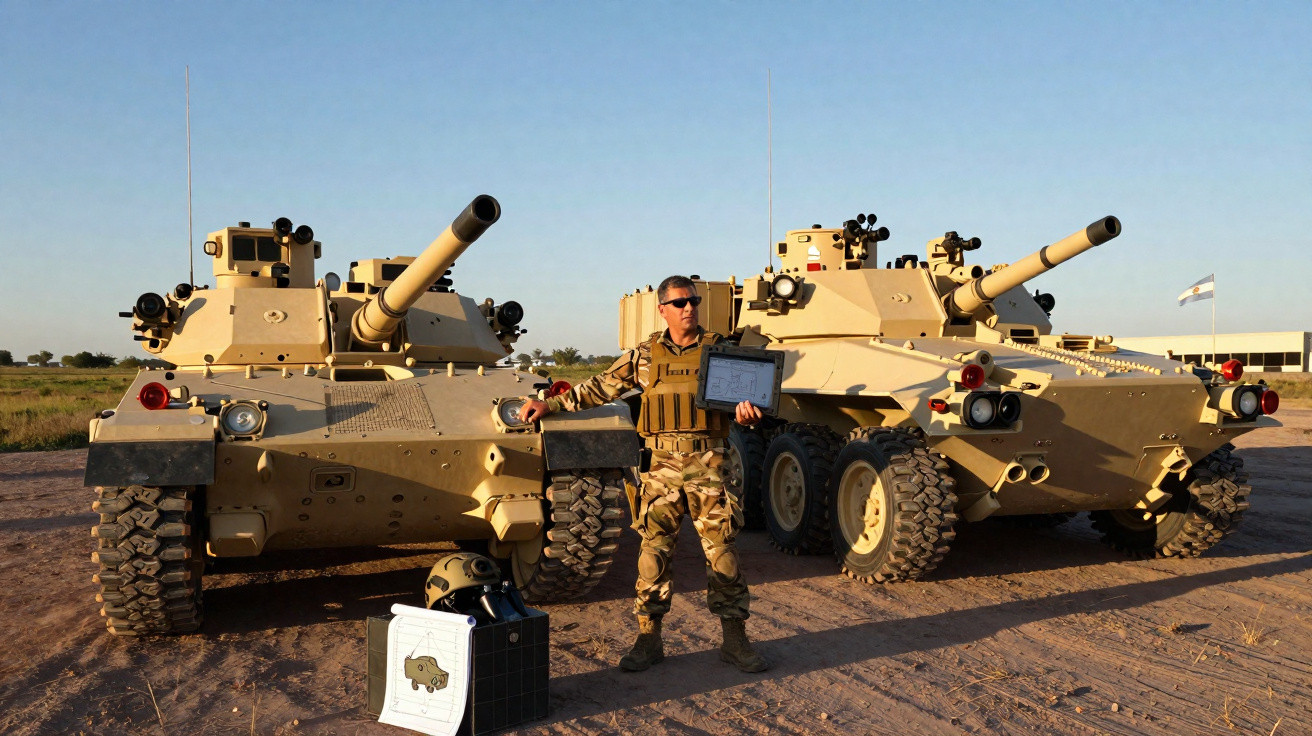
As one of the Argentine Army’s (EA) most significant challenges during the first quarter-century that has just ended, the upgrade of TAM Combat Vehicles to the 2C-A2 standard has reached a decisive stage. Throughout 2025, despite driver training, crew instruction and operational activities involving vehicles already in service, no further upgraded units were delivered. This represented a notable halt in a programme intended to keep the armoured cavalry current and enhance its capabilities.
The Force has kept the programme under wraps. Even so, the absence of visible progress over the past year raises questions over both the pace of implementation and the continued momentum of the modernisation plan. Completing it is essential if the intended fleet of at least 74 TAM 2C-A2 vehicles is to be achieved, from an inventory of 231 units recorded in the latest edition of the National Defence White Paper (2023). Meeting that target would support the creation of a standardised fleet that is fully operational.
The TAM 2C-A2 upgrade fundamentally reshapes the tank’s capabilities. Replacing the hydraulic system with an electric one improves turret precision and safety, while a new digital fire-control and aiming system, together with thermal sights for the gunner, commander and driver, enables effective operation in all conditions. Further additions include the E-LAWS laser-warning system with full 360° coverage, an auxiliary power unit (APU) for silent watch, and an automatic fire detection and suppression system, substantially increasing vehicle protection.
Together, these enhancements deliver a technological leap intended not only to update the TAM, but also to extend its service life and retain its relevance against emerging battlefield threats. Comprehensive work on the hulls, undertaken by the 602 Arsenal Battalion, is a vital element of the process: it ensures the equipment is structurally and mechanically restored before being reassigned to operational units. Tank Cavalry Regiment 8 “General Necochea Hunters” was the first unit to receive upgraded vehicles.
The enduring armoured vehicle family concept
The TAM was conceived as an integrated concept: a vehicle family sharing a chassis, components and a common logistical philosophy. Alongside the medium tank (VC TAM), versions were developed including the Personnel Carrier Combat Vehicle (VCTP), Mortar Carrier Combat Vehicle (VCTM) and Command Post Combat Vehicle (VCPC), as well as support variants such as the Fire-Control Command and Control Vehicle (VCCDT), Ammunition Vehicle (VC AMUN) and Tank Recovery Vehicle (VCRT). Some of these variants were not completed in the quantities originally envisaged, yet all followed the same principle: efficiency in production, maintenance and training, ensuring a coherent, flexible, domestically produced mechanised force.
Today, progress on the TAM 2C-A2 programme has revived debate over the future of tracked armoured vehicles in the Argentine Army. Beyond the main tank, the question is how support, transport and command capabilities will be integrated into a modernised structure. In contrast, the VCBR Stryker programme, which has included a complete family of specialised vehicles from its inception, highlights the need to restore a comprehensive vision akin to that which originally underpinned the TAM.
The distinction between the two programmes also illustrates the doctrinal development of armoured planning. Whereas the TAM project was founded on the idea of a full family that was never realised in every version, the Stryker programme has progressed from the outset under a defined framework designed to cover every mission required by mechanised units. This planning, which provides for multiple variants on one platform, is a sound move towards the standardisation and specialisation of equipment-a combination anticipated by the original TAM concept decades earlier.
Stryker: the commitment to an 8×8 wheeled armoured combat vehicle family
The VCBR 8×8 Stryker programme is the Argentine Army’s other major commitment in armoured mobility. Following receipt of the first four M1126 vehicles in 2025, and the planned arrival of a second batch of the same number during the first quarter of the current year, the ultimate aim is to establish a fleet of more than 200 vehicles derived from this platform.
Under the original plan, the future Stryker family would comprise around 120 Armoured Personnel Carriers (APCs) fitted with 12.7 mm M2 machine guns; 27 Infantry Fighting Vehicles (IFVs) armed with 30 mm automatic cannons; 14 Tank Destroyers; 12 Mortar Carriers; 9 Command Posts; 9 armoured ambulances; 8 recovery vehicles; 6 bridge-laying vehicles; and 4 breach-opening vehicles. This range of variants demonstrates a systemic approach intended to equip brigades with complementary assets on a shared platform, simplifying logistics and maintenance.
From a doctrinal perspective, the Stryker’s arrival represents the consolidation of a force with high strategic mobility, able to deploy rapidly over long distances. Its introduction, however, should be viewed as complementary to rather than a replacement for the traditional armoured component. The two systems-wheeled Strykers and tracked TAMs-serve different environments and missions, and together will form a modern, balanced structure.
Tradition and adaptation
The Argentine Army has a long-standing tradition of tracked armoured equipment. Before the Second World War, it acquired its first light Vickers tanks, based on British designs, marking the beginning of national mechanisation. The Nahuel DL-43 medium tank, a domestic development, was produced in 1943 and, although limited in number, demonstrated the country’s industrial capability. In the post-war period, M4 Shermans in several versions were added, forming the core of armoured forces throughout the 1940s and 1950s.
Later, during the 1960s, French AMX-13s and their AMX-VCI infantry fighting variants arrived, increasing the mobility and firepower of mechanised units. For infantry unit mechanisation, Universal Carriers were extensively used from the 1940s, followed subsequently by the US M113 family-including M577 command, M106 mortar-carrier and M548 cargo-transport versions-which became the backbone of Argentine mechanised units. Finally, the development and production of the Tanque Argentino Mediano (TAM) established a domestic platform during the 1980s, tailored to the country’s terrain and operational requirements.
This record shows how tracked propulsion has historically underpinned armoured cavalry, providing a blend of mobility, protection and firepower that remains an irreplaceable doctrinal pillar. In this respect, continuing the TAM 2C-A2 programme not only safeguards a legacy, but also reinforces the importance of retaining a tracked armoured component within the Force’s structure.
Recent operational exercises have also highlighted the need to adapt to emerging battlefield threats. The proliferation of drones and loitering munitions has encouraged the adoption of passive protection measures, such as anti-drone cages or grilles, reflecting personnel’s ability to respond to an increasingly complex environment. These lessons will need to inform future TAM improvements, incorporating sensors, modular armour, and active warning and defence systems.
Continuity and challenges of the TAM 2C-A2 programme
The TAM 2C-A2 upgrade offers a tangible opportunity to strengthen the backbone of the EA’s armoured units. Its true strategic value, however, will not be measured solely by the number of vehicles delivered, but by the ability to establish a long-term vision for the Army’s tracked assets. Rather than an end point, the TAM 2C-A2 should be seen as the starting point for a new phase of technological integration, industrial planning and operational projection.
Its continuation will help sustain the Army’s combat capabilities and preserve the strengths in engineering, maintenance and production that Argentina has developed. The question is clear, even if the answer is less so: what direction will the EA choose for the future of its tracked armoured vehicles? This does not necessarily mean reviving the original TAM programme, but it does require recognising the importance of redefining the role these assets will play within a modern, balanced and sustainable doctrine.
Images used for illustrative purposes.




Comments
No comments yet. Be the first to comment!
Leave a Comment