
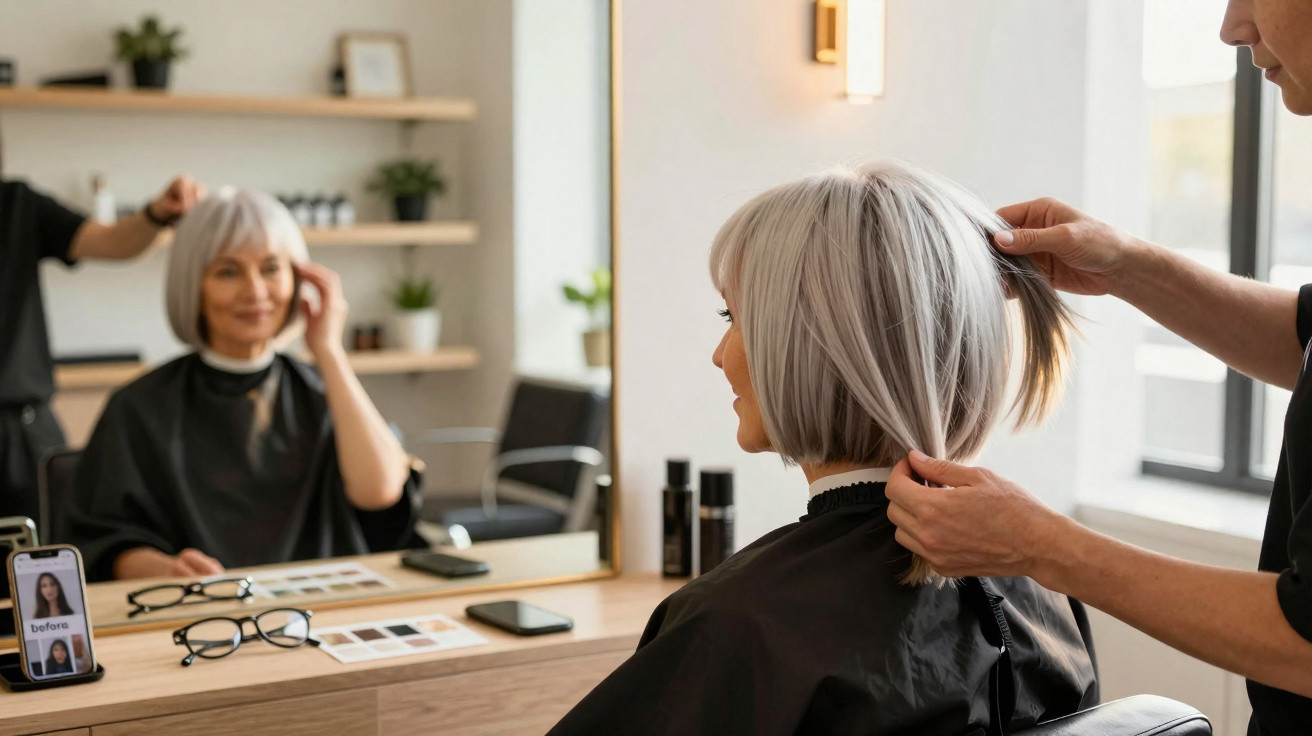
On a wet Tuesday afternoon, when the salon light had taken on an almost silvery cast, a woman in her late sixties settled into the chair before the mirror. She had a grey bob, a blunt fringe and the very same photograph she said she had brought along “since the nineties.” Her stylist gave a courteous smile, though her expression suggested a small degree of regret. The haircut was not unattractive; it was simply trapped in time.
Elsewhere in the salon, women of a similar age left with soft fringes, weightless layers and shapes that skimmed their cheekbones, seeming to soften time’s harsher lines. She observed them closely before gripping her old photograph a little more firmly.
The scissors paused above her ends.
Change was within reach.
Why stylists say the “classic cut” can age you overnight
Ask three seasoned hairstylists which habit most ages women over 60, and many will offer the same answer: holding on to precisely the haircut worn at 40. It is not the concept of a classic cut that causes the issue, but recreating it rigidly, time after time.
Hair responds differently on a mature face. Its texture can alter, density may reduce and the jawline often becomes softer. A bob that once felt effortlessly French-chic can begin to make features appear harder. A helmet-like short style may flatten the profile. The hair itself is not wrong; the face has simply changed.
Stylists encounter this disconnect daily: hair remaining in the past while the face exists in the present.
A London stylist told me about Anne, a 67-year-old retired solicitor and regular client. For years, Anne demanded the same sharply cut, chin-length bob, coloured with the same box black dye. “This is my signature,” she would say, almost as a warning. In the 1990s, other clients had copied the look.
After a family wedding, however, Anne arrived with a different view. “I hate the photos,” she admitted. “I look strict. Tired. Like my own headmistress.” What had once projected authority now appeared severe beside softer skin and deep-set lines.
Nobody shaved her head or turned her platinum blonde. Instead, the stylist raised the line to just beneath the cheekbones, changed the black to a cool chocolate shade and introduced a wispy side fringe. Her eyes appeared greener, and her jawline looked lighter. Later, her daughter sent the stylist a message: “She looks like herself again.”
Before professional hairstylists discuss age, they often discuss “visual weight”. Strong, straight lines place heaviness in the areas where it is least welcome: along the jawline, at the neck and beneath the chin. Those are often the places where time becomes most visible.
When women over 60 retain a classic cut without adapting it, its old geometry can work against their new contours. For example, a crisp bob paired with a fuller neck may resemble a horizontal line that draws attention to sagging instead of skimming over it.
A style that once framed the face can eventually seem to enclose it. This is the quiet mistake stylists identify: it is not about disliking classic cuts, but about keeping them frozen while everything else gradually changes.
The smarter way to update a classic cut without losing yourself
Stylists are not telling women over 60 to discard their identity. The most thoughtful professionals recommend small adjustments rather than complete transformations. It is more like changing the lighting around a favourite painting than repainting the canvas.
For someone who has always chosen a bob, a contemporary update could mean a softer, slightly shattered shape. It might involve a subtle graduation at the back, a few nearly invisible layers to create movement around the cheeks, or a fringe that interrupts the forehead rather than cutting it in two.
Many professionals use a straightforward approach: they ask what you love about your current cut, then experiment only with the parts you do not mention.
The greatest pitfall is requesting “just a trim” for a decade without interruption. Often, that phrase really means, “I’m scared, don’t touch my comfort zone.” That feeling is valid. Hair can hold identity, memories, relationship history, grief and glory all at once.
Yet trimming an outdated shape only maintains the problem. It tidies the edges of a style that no longer flatters your features. We’ve all been there, that moment when you walk out of the salon looking exactly like you walked in, only slightly shorter and slightly more disappointed.
In truth, nobody necessarily does this every day, but arranging a proper “restyle” appointment once a year can transform the outcome. It allows for a longer consultation, a fresh perspective and more meaningful decisions. That is when stylists may suggest the one centimetre that truly makes a difference.
“I don’t want my clients over 60 to look younger,” says Paris-based hairstylist Clara M. “I want them to look awake. A classic cut kept too rigidly is like makeup that never smudges: it stops looking like a face and starts looking like a mask.”
Soften the edges
Request broken lines rather than severe ones: gentle face-framing layers, a feathered fringe or a tapered nape. Such small details reduce harshness without altering your overall length.Reduce heaviness, rather than necessarily changing the colour
Going blonde is not essential. You may simply benefit from finer highlights around the hairline or less bulk at the back. This creates lift and movement without announcing a “new look”.Make the cut suit your lifestyle
Be clear if you never style your hair. Your stylist can create a shape that settles naturally when air-dried instead of one requiring round-brush boot camp each morning.Reconsider your parting
A centre parting worn for decades can pull the face downwards. Even moving it slightly off-centre may alter how facial lines and features are perceived.Arrange a “shape check” twice yearly
Make it more than a trim: have a conversation about the shape. Ask plainly: “Is this cut still working with my face, or am I stuck in a past version of me?” Then allow a pause. That is often when honest advice emerges.
Growing older, not smaller, in the mirror
At the centre of this discussion is not really hair, but a broader question: how much can you change before it feels like betraying yourself? Many women over 60 grew up with an idea of respectability closely tied to tidy, controlled hair. No disorder, no risk.
But look at women who enter a room at 65 or 70 and quietly command it. Their hair nearly always has an easy quality: softness, and the sense that they have stopped fighting their reflection and begun working alongside it.
Sometimes the true revolution lies in exchanging a stiff classic cut for a looser, slightly imperfect style that has as much room to breathe as the face does.
| Key point | Detail | Value for the reader |
|---|---|---|
| Update the shape, not your identity | Retain the essence of your classic cut while adapting its lines, layers and fringe to your current facial features. | You still feel like “you”, only fresher and more in harmony with age. |
| Avoid the “eternal trim” trap | Arrange an annual restyle consultation rather than requesting only minor maintenance cuts. | It creates opportunities for subtle yet powerful adjustments that genuinely rejuvenate. |
| Work with texture, not against it | Embrace changing hair behaviour - thinner, coarser or curlier - and make the cut work around it. | Less daily effort, more natural movement and hair that suits your real life. |
FAQ:
Should all women over 60 avoid classic bobs or pixie cuts?
Not at all. The issue is not a bob or pixie cut itself, but an inflexible, dated interpretation of it. A modern bob with softness at the ends and lightness around the face can be exceptionally flattering at 60, 70 or 80.Do I need to go shorter as I get older?
No rule requires it. Some women look striking with long, layered hair in their seventies. What matters is whether the length drags down your features or overwhelms your frame.What if I’m terrified of changing my hair?
Begin very gradually. Ask your stylist for one modest adjustment: a softer fringe, a slightly angled front or some weight removed from the back. Live with that change, then build on it when you are ready.Is grey hair mandatory for a modern look after 60?
Absolutely not. Grey can look beautiful, yet rich browns, warm blondes and soft caramel shades can feel equally current. The real concern is flat, block colour without dimension.How do I find a stylist who understands women over 60?
Review salon Instagram feeds and see whom they feature. Read reviews that mention mature clients. When calling, ask directly: “Who in your team loves working with women over 60?” That single question filters out a great deal.





Comments
No comments yet. Be the first to comment!
Leave a Comment