
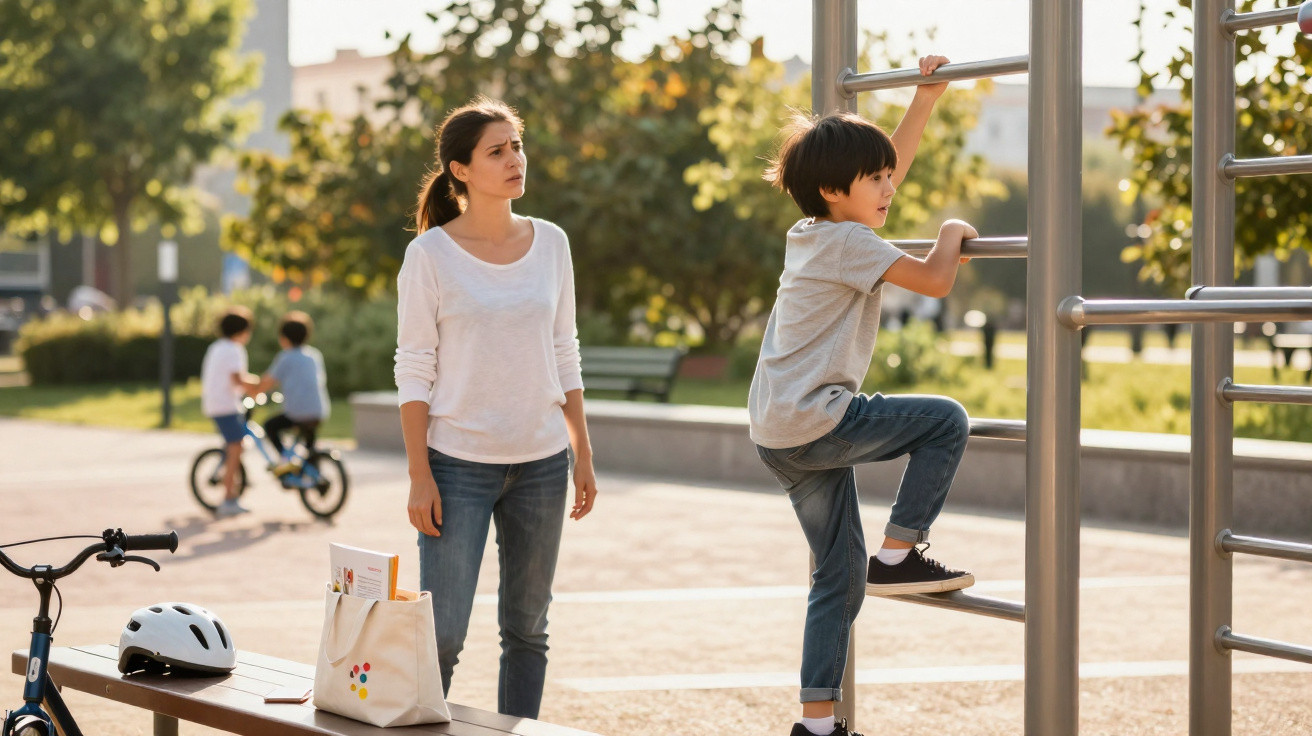
A healthy, bright ten-year-old stands rooted to the spot at a pavement. His mother holds an arm across his chest like the restraint on a roller coaster, despite the empty road and red traffic light. With her phone in one hand and anxiety in the other, she checks the road twice, then a third time. The boy silently rolls his eyes. He knows the familiar script: don’t run, don’t climb, don’t speak to strangers, don’t, don’t, don’t.
Nearby, other parents perform the same peculiar ritual. They grip rucksacks, keep tracking apps open and murmur warnings as if they are prayers. We reassure ourselves that it all comes from love.
And yet the children seem more weary than safe.
There is something about this picture that simply does not add up.
When protection becomes a soft cage
Spend time at any playground and the atmosphere is unmistakable. Children are not merely playing; they are monitored like junior staff in a hazardous workplace. Parents wait beneath the slide, follow their child around the climbing frame and leap in after a stumble before any tears have even appeared.
The outcome is an odd combination of security and suffocation. Children absorb the message: the world is dangerous, you are delicate and you cannot cope without me. We may call this gentle parenting or conscious parenting, but an increasing number of psychologists quietly use another term: overcontrol. Once it takes hold, it lasts.
In the 1980s, most children in Europe and North America walked to school alone by the age of nine. Now, many parents would not allow even a twelve-year-old to cross a quiet road without an adult. One UK survey found that children’s “roaming radius” - the distance they are permitted to travel from home - has reduced by almost 90% across only four generations.
Meanwhile, childhood anxiety, sleep problems and stress are all increasing. Ironically, helmets, filters and parental controls have become widespread during the same period in which children appear more mentally overwhelmed than ever. It is an uncomfortable correlation, so we seldom examine it.
The simple reality is this: children do not learn bravery while covered in bubble wrap.
If we intervene at every moment of discomfort, our children’s nervous systems never have the opportunity to learn, “Oh, I can handle this.” Their brains remain in a state of “somebody will save me”. In the moment, this can feel kind, but over time it quietly weakens resilience. A child who never hears their own inner “I did it” voice grows into a teenager who doubts that voice even exists.
We believe we are keeping fear away. At times, we are actually teaching it.
Teaching real safety rather than living on red alert
There is a different route, one that does not mean leaving children to fend for themselves in chaos. It begins by moving away from constant control and towards shared responsibility. Rather than only telling children to “be careful”, we show them what being careful truly involves.
At a street corner, instead of automatically taking their arm, pause and guide them: “What can you see? Has the car stopped? Where will you look before crossing?” Walk the journey together a number of times. Then, one day, observe from a distance as they cross alone - with your heart racing, but without stepping in. That is not neglect; it is training.
Many parents privately worry that relaxing their grip will make others see them as “a bad parent”. They respond by adding more rules, warnings and tracking technology. They prohibit sleepovers, monitor every minute online and timetable every afternoon, before collapsing on the sofa and wondering why everybody feels exhausted and tense.
Most of us recognise the moment when we hear ourselves say “Be careful” for the 15th time in an hour, without even being sure what we are warning about any longer. The motive is loving. Yet, over time, the effect is that children come to see the world as somewhere they are not prepared to manage.
“Real safety isn’t about removing all risk,” says child psychiatrist Dr. Lauren Knoll. “It’s about giving children enough practice with small risks that they’re not destroyed by the big ones.”
Begin with micro-risks
Allow your child to pour their own juice, use a blunt knife or climb a little higher than you find comfortable. These small moments are practice grounds for sound judgement.Use “If–then” coaching
Rather than saying, “Don’t run,” try: “If you want to run, then check first: is the ground clear, are people around you, are you wearing good shoes?” This develops internal rules instead of simple external obedience.Talk through frightening moments
Following a fall or disagreement, discuss what happened and what they handled well, rather than focusing solely on mistakes. That is how experience becomes wisdom instead of unfiltered fear.Ease one rule at a time
Pick one area - screen time, outdoor play or homework - and slowly pass some control to your child. See what happens, make adjustments and repeat.
Letting children feel life so they can live it
Modern parenting frequently seeks to shield children from every rough edge: boredom, frustration, conflict and even small disappointments. We hurry to offer solutions, distractions or negotiations before the emotion has time to settle. As a result, children miss the chance to learn that sadness passes, anger subsides and boredom can lead to creativity.
A more sustainable response can look almost dull to outsiders. You sit beside a crying child rather than immediately solving the issue. You say, “I’m here. This is hard,” rather than “It’s okay, don’t cry.” You allow siblings to argue for a few minutes before intervening. You let a teacher be slightly unfair without instantly emailing the school.
This is not about allowing children to be overwhelmed by distress or ignoring genuine danger. It is about choosing tolerable discomfort over permanent dependence. If your teenager forgets their sports kit, you do not drive across town as their personal assistant; you allow them to face the coach and the consequence. If your eight-year-old spends their pocket money on rubbish and regrets it, you resist reimbursing them.
Let’s be honest: no one manages this every day. But whenever we do, we communicate something powerful - you are able to deal with what life brings, and I trust you to do so.
Often, the most difficult part is not the child’s response, but our own. Their tears stir our guilt. Their anger bruises our ego. Their boredom sparks fears that we are “not doing enough”. Many contemporary parenting rules amplify those insecurities rather than settling them: endless guidance on perfect routines, ultra-healthy snacks, zero risk and continual stimulation.
Gradually, candid parents begin to ask a quiet question: what if children do not need us to be flawless protectors of their comfort, but dependable witnesses to their development? What if the greatest gift is not a world with no knocks, but a secure home base where they can fall, reflect and try again - without us hurrying in to rewrite the script?
| Key point | Detail | Value for the reader |
|---|---|---|
| Protection vs overcontrol | Shows how continual supervision and rules based on fear can undermine children’s confidence and resilience. | Helps parents recognise when care has quietly become control and make changes before anxiety takes hold. |
| Teaching real safety | Sets out practical methods for sharing responsibility with children through micro-risks and coaching. | Provides practical tools for raising children who can judge danger and behave wisely without continual adult presence. |
| Allowing tolerable discomfort | Supports allowing children to experience boredom, frustration and natural consequences with appropriate support. | Develops emotional strength and independence, reducing stress for both parents and children over time. |
FAQ:
Question 1: How do I know if I’m being overprotective or just responsible?
Consider the patterns: if you routinely stop your child doing things you did at their age, or if fear makes you say “no” before you have assessed the actual risk, you may be moving towards overprotection.Question 2: Won’t giving more freedom expose my child to real dangers?
The aim is not unrestricted freedom, but guided freedom. Begin with small steps, remain close at first, discuss possible situations and widen their independence as they demonstrate judgement and reliability.Question 3: My child is already very anxious. Is it too late to change our approach?
No. Start with very small steps, such as allowing them to order their own food, speak with a shop assistant or try a new activity while you watch from slightly further away.Question 4: What if other parents judge me for being “too relaxed”?
You are raising your child, not managing the neighbourhood’s opinion. Being informed about real risks and deliberate in your choices matters more than matching another person’s level of worry.Question 5: How can I manage my own fear while giving my child more space?
Identify the fear - “I’m scared something will happen” - take a breath before responding, and set rules when you are calm rather than panicked. Some parents also find it useful to speak with a therapist or trusted friend to distinguish genuine risks from imagined ones.




Comments
No comments yet. Be the first to comment!
Leave a Comment