
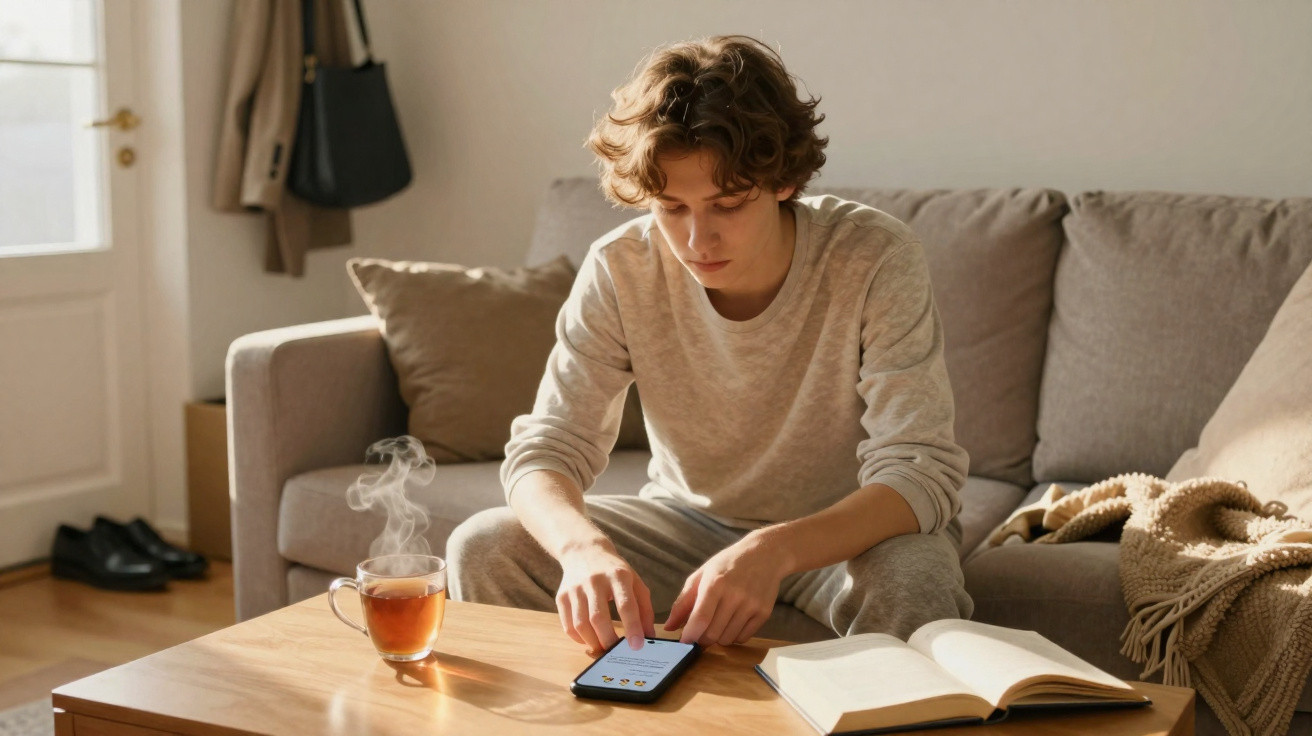
On Friday evening, your phone lights up with the familiar message: “We’re at the bar, you coming?”
You read it, look at the screen for a moment, then lock your phone and return to the sofa. Netflix murmurs in the background, the kettle clicks off, and your blanket feels like armour. Out there, people are laughing loudly in busy rooms. Glasses are clinking and stories are being swapped. You are at home, in a quietness that feels reassuring and faintly guilt-inducing.
You tell yourself that you are only tired, and that you will put in more effort next week. Yet your thumbs keep writing the same reply: “Sorry, not tonight.”
What if this pattern is not simply laziness or being “anti-social”?
What if your brain is quietly choosing home – and signalling something you have been overlooking?
Why your sofa wins against your friends
Your chest feels slightly tight, your shoulders drop, and getting ready, travelling, smiling, talking and listening all seem like hard work. The plan is not necessarily terrible; the energy needed to get there is.
Your nervous system performs an unseen cost-benefit calculation. A night out is noisy, uncertain and socially demanding. Home is familiar, safe and requires little effort. When your day has already depleted your “social battery”, your brain will nearly always choose the lower-risk option. The no you send to friends is therefore often a yes to an overburdened system.
A 2023 survey of young adults in the US found that nearly 60% would rather stay at home on most evenings, even when they liked the people asking them out. This is not merely a case of “people getting boring”. It suggests that socialising now has to compete with relentless digital stimulation, lengthy workdays and financial pressure. Going out is no longer the default escape; staying in is.
Consider Mia, 29, who called her weekends a “negotiation” with herself. Her friends appeared to be constantly out on Instagram: brunches, rooftop bars and concerts. In reality, she said yes to one invitation in five. For the rest of the time, she stayed in bed scrolling, partly envious and partly relieved. When she eventually pushed herself to attend birthday drinks after an exhausting week, she needed an entire day alone afterwards to feel like herself again.
Psychologists refer to this as “social fatigue”. Your brain has finite resources for self-control, making decisions and regulating emotions. Social environments require all three: you interpret body language, manage your responses and decide what to reveal. Following a whole day of doing this at work or online, your mind can quietly demand time to switch off.
Introversion matters, but it does not explain everything. Extroverts can also burn out when their system has been “on” for too long. Anxiety can slip in too: worrying about awkwardness, not being “fun enough”, or saying something odd. Avoidance may be a coping strategy rather than a personal failing. The crucial question is whether that strategy safeguards you or gradually cuts you off from others. That narrow boundary is where the psychology becomes especially compelling.
What your avoidance is really protecting
Enjoying your own company is different from using it as somewhere to hide. Psychologists commonly identify three forces behind the “I’d rather stay home” response: regulation, fear and identity. Regulation means home allows your system to settle. Fear means you stay in to avoid discomfort or possible rejection. Identity means that being at home matches who you think you are.
If your childhood home was chaotic, home may now represent safety and control. There are no surprises and no emotional ambushes. Your brain may associate social spaces with risk and unpredictability. So, when you decline drinks, you may really be rejecting uncertainty; the bar is simply its symbol.
Your personal narrative also matters in subtler ways. If you have spent years saying “I’m the quiet one”, staying in supports that familiar role. Stepping outside the pattern can feel strangely dangerous, even if you are lonely. One therapist I spoke with described a client who repeatedly missed group dinners, then spent the evening picturing everyone becoming closer without her. Loneliness was painful, but the prospect of being noticed and judged felt even worse.
At times, avoidance is your body holding on to the impact of previous experiences: a painful fallout with a friend, being ridiculed at school, or a partner who criticised your behaviour in public. You may not consciously dwell on those memories, but your nervous system does. It can begin using pre-emptive isolation as protection. You are not turning away from friends; in an unusual way, you are attempting to shield yourself from pain before it has even occurred.
How to choose home… without disappearing
A straightforward technique therapists often recommend is the “micro-yes”. Rather than asking, “Do I go out or stay home?”, divide the evening into stages and commit only to the next one. Get dressed: that is one yes. Walk out of the front door: another yes. Reach the bus stop, then decide once more.
This approach stops your nervous system from feeling cornered by one overwhelming social commitment. You are free to turn back after showering, or after ten minutes at the party. Oddly, knowing you are able to leave can make you more willing to attend – and to remain for longer. It turns socialising from an intimidating stretch of hours into several manageable choices.
It can also be useful to create gentler social plans that do not overwhelm your bandwidth. Choose coffee over clubbing, a walk over a crowded dinner, or two people rather than eight. When social time is matched to your real energy levels rather than your idealised self, the impulse to cancel becomes less intense. You are no longer pressuring Future You into an evening they secretly fear.
All-or-nothing thinking is another trap. People may feel they must either become the highly social version of themselves they see on TikTok or withdraw completely. Life is more complicated than that. You can care deeply about friends while restricting how frequently you meet them. You can stay home three nights out of four without becoming “a bad friend”.
Another frequent error is being dishonest about why you cannot come. Repeatedly claiming that you are “busy” teaches your brain that honest needs are shameful. Instead, try a gently truthful message: “I’m low on energy tonight, can we do something quieter soon?” It may feel awkward at first, but eventually it can feel respectful – towards both you and them.
Your friends will not necessarily understand every time. Some may take it personally. That can hurt, but it can also show who can accept your actual capacity and who prefers the performative version of you. There’s a quiet relief in realising you don’t have to audition for your own friendships.
“Loneliness is not just being alone; it’s being unable to show up as yourself around others.” – Clinical psychologist, London
To put this into practice, many people find it helpful to create a simple weekly “connection menu”:
- One brief, low-pressure meet-up (a walk, coffee or short call)
- One more meaningful conversation with someone safe
- One entirely home-based evening with no social commitments
It is not a set of rules, but a tool for finding balance. Let’s be honest: nobody really does this every day. Life becomes untidy, plans fall through and moods change. Perfection is not the aim; the point is recognising when “I like my own company” gradually becomes “I don’t know how to be around people any more.” That shift is easier to spot once you have identified what healthy solitude looks like for you.
Rethinking what it means to be “social”
Staying at home does not always mean you are avoiding life. Sometimes, it means you are finally living according to your own terms. The cultural idea that “more social equals better” emerged before permanent group chats, side hustles and round-the-clock stress. Your nervous system was simply not designed for endless exposure.
There is a quiet shift in acknowledging this. Friends are choosing book clubs over pub crawls. People watch films “together” while messaging from separate sofas. Much of the enjoyment of a night out may now sit in the memes shared the following day, rather than in the bar itself. Connection is taking new forms.
On a deeper level, preferring home may tell you something about the relationships themselves. Do you feel understood, or merely present? Do you come away from meet-ups feeling restored, or vaguely depleted? When somebody says, “You never come out anymore”, do they miss you – or the part you played in their group dynamic?
The psychology of avoidance is not solely about fear; it also involves discernment. Choosing home can be an act of self-respect when the room you are invited into demands too much masking, too many unspoken words and too many jokes made at your expense. The risk appears when every room begins to feel this way, and isolation becomes your usual climate rather than a safe refuge.
On a peaceful evening, when you are tempted to cancel yet again, try asking a kinder question than “What’s wrong with me?” Instead ask: “What am I trying to protect, and is there a gentler way to protect it?” The response may be a shorter meet-up, another friend or a more honest text. Or it may be exactly what you had planned all along: staying home, making tea and breathing out.
What changes is the narrative: not “I’m failing at friendship”, but “Tonight I’m choosing recovery so that, on another night, I can choose connection.” This small reframing moves you from being controlled by avoidance to actively participating in your social life, even when you are in your living room.
| Key point | Detail | Why it matters to the reader |
|---|---|---|
| The brain quietly makes the decision | Before each choice, your nervous system weighs up social costs against the comfort of home | It shows that your choice is not simply laziness, but an internal mechanism |
| Protective versus isolating avoidance | Wanting to stay at home can offer protection… or slowly sever connection | It helps you notice when a refuge is becoming an invisible prison |
| Micro-yes and tailored connection | Break outings into small stages and adapt social formats to your energy | It provides practical ways to see loved ones without overloading yourself |
FAQ:
- How do I know if I’m just introverted or actually avoiding people? You are probably introverted if time alone leaves you feeling recharged and you still enjoy some contact. If you often want connection but feel held back by fear, guilt or dread, that is more like avoidance.
- Is it unhealthy to prefer staying home most of the time? Not necessarily. It becomes concerning when you feel isolated, trapped in repetitive routines, or anxious at the thought of any social contact whatsoever.
- What if my friends say I’ve “changed” because I go out less? People often respond strongly when familiar roles change. You can acknowledge their feelings while still changing your availability to reflect your true capacity.
- Can therapy really help with social avoidance? Yes. Many evidence-based methods, including CBT, can help you question fearful predictions and develop gradual exposure to safer, more authentic social experiences.
- How can I explain my need for alone time without hurting people? Use “I” statements and combine honesty with care: “I value you a lot, and I also need more quiet evenings lately. I’d still love a coffee next week if you’re free.”






Comments
No comments yet. Be the first to comment!
Leave a Comment