
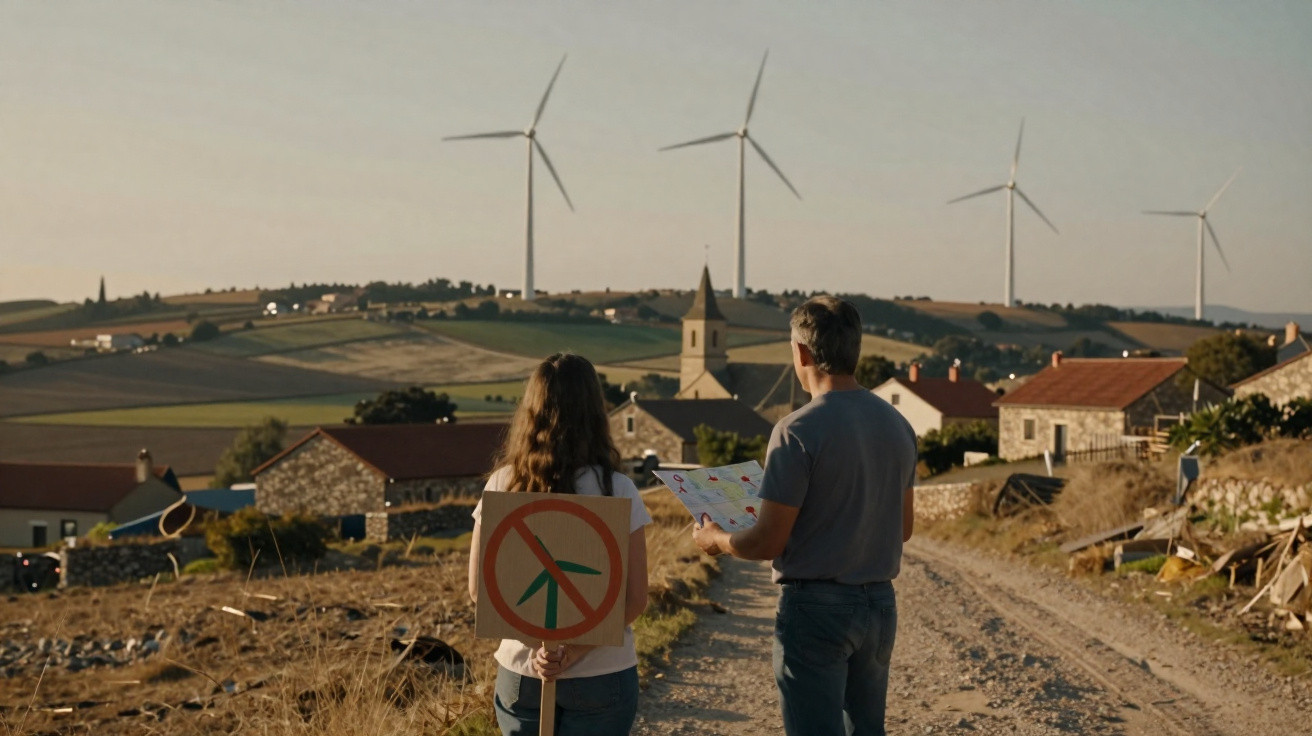
The first thing you register is not the sound, but the altered sky. White blades now cut across the horizon above barley fields and grazing cattle, rotating slowly-almost languidly-on a hill once marked by an unbroken line of hedges and oaks.
On a Tuesday evening in the village hall, farmers, teachers and shopkeepers pack beneath buzzing neon lights, folding chairs scraping across the floor. At the front, a printed visualisation depicts their valley scattered with turbines as high as skyscrapers. A few people bend forward with interest; others fold their arms, their expressions fixed.
Outside, beyond the misted windows, red lights flash from the tops of the first finished towers.
They seem as though they belong to another world.
When the valley skyline rises above the church
On a bright morning, the turbines come into sight well before the village sign. The road falls and climbs between hedgerows, before three, five, then ten narrow towers rise up, their blades turning over the mist like vast metronomes.
For generations, the church spire had been the highest point for miles around, a calm landmark visible in every direction. Beside these new giants, it now appears almost modest. Some residents see an unfamiliar beauty in the machines, a sign that the future has arrived. Others put it less kindly: “like living under a row of giant whisks.”
The land itself has not shifted by a single inch. Yet many people feel as though the ground beneath them has moved.
Further down the lane from the substation, Tom and Sarah operate a 120-year-old mixed farm. They had never expected to become campaigners. Their lives once followed the routine of milking, feed deliveries and fighting weeds in the potato field.
Everything changed when the first planning notice was taped to the bus stop: a proposal for 18 turbines, each more than 200 metres high. The consultation period was buried in barely noticeable small print. Tom carried the notice in his pocket for a week before raising it at the pub. Within a month, a WhatsApp group had become a fully fledged campaign, involving late-night map studies and hurried lessons in planning law.
Their barn now contains hay, calves and piles of protest banners. The farm has turned into the unofficial base for the opposition.
What is unfolding in this valley is not a straightforward story of being “for or against wind power”. It is a clash of climate urgency, corporate momentum and local memory.
On paper, the wind farm offers low-carbon electricity for tens of thousands of homes. The developer promotes green jobs, community funds and a clean-energy future. For national governments rushing to meet emissions targets, schemes of this kind are hard to resist.
For those waking beneath the blades, the balance looks different. They consider carbon reductions alongside shadow flicker in the kitchen, house prices alongside nights disturbed by low-frequency hums, and worldwide ambitions alongside the unsettling feeling that a known world is disappearing without their approval.
This is not merely an energy scheme. It is an argument about who has the right to redraw the map of “home”.
How a small village takes on a billion-dollar energy plan
The first meaningful shift happens not at a demonstration, but around a kitchen table. Four neighbours lay planning papers between mugs of tea and partly eaten biscuits, attempting to interpret traffic studies, noise forecasts and bird surveys written in dense, cautious language.
A retired civil servant among them begins marking passages with a red pen. “They say the visual impact is ‘moderate’ from this road,” she says quietly. “That’s the road to the primary school.” Another person reaches for a highlighter and starts identifying deadlines: objection dates, appeal periods and consultation windows that feel offensively brief.
That untidy evening produces a simple approach: divide up the documents, learn one section each, then return and explain it in everyday language.
It is painstaking, unglamorous work. But this is how resistance begins to find its feet.
The village soon learns that challenging a wind farm involves far more than holding banners aloft on a blustery Saturday. It requires spreadsheets, petitions and uncomfortable discussions with neighbours who hold different views.
One week, the group concentrates on noise, gathering accounts from other places living near turbines. The following week, members record local wildlife, noting bat flight paths and buzzard nests in an effort to show planners that this is not an empty “zone”, but a place alive with activity. They fundraise through bake sales and a quiz night to hire an independent consultant, having lost faith in glossy brochures with selectively framed viewpoints.
Relationships fray. Longstanding friends stop talking for a time.
Nobody, honestly, enjoys reading 600 pages of environmental impact assessments. But gradually, this hamlet of fewer than a thousand residents begins using the same technical, complicated language as the corporation seeking to alter its view.
For many people, the greatest difficulty is the doubt that arrives late at night. Are we simply NIMBYs? Are we blocking the climate transition our children urgently need?
“We’re not against wind,” says Maria, a local teacher who now spends her evenings drafting letters to councillors. “We’re against being treated like an empty field on a map. We live here. We bury our dead here. That has to count for something.”
The group starts passing around an informal guide, a boxed list shared from one house to another:
- Request visual simulations from genuine viewpoints, including school gates, kitchen windows and the churchyard.
- Seek independent noise and wildlife assessments rather than relying solely on company-commissioned reports.
- Arrange calm public meetings where every side can speak without shouting.
- Record everyday life with photographs, short videos and notes showing how the landscape is truly used.
- Explore alternatives, such as smaller schemes, alternative sites and community-owned models.
Its style remains resolutely practical, even gentle. Beneath that is a fierce collective belief: local people are not “obstacles”, but part of the climate solution.
Between spinning blades and deep roots
Weeks become months, and the valley gradually learns to exist in uncertainty. On some mornings, the turbines appear almost harmless, their blades moving slowly against a peach-coloured sunrise. On others, low heavy cloud makes the structures seem dark and industrial, like cranes that lost their way to a dockyard.
We know that feeling: a place you care about suddenly seems a little unfamiliar, as though somebody has rearranged the furniture in your own home. For this community, the sensation does not pass. It grows with every new concrete foundation and every lorry thundering through roads never built to carry such loads.
From a government office, the energy transition appears as neat coloured charts. From a farmhouse window, it is three red lights flashing through the bedroom curtains at 3 a.m.
| Key point | Detail | Value for the reader |
|---|---|---|
| Local knowledge matters | Residents observe wildlife routes, soil patterns and everyday activity that maps fail to capture | Helps you make the case for better placement rather than simple blanket opposition |
| Process is power | Understanding deadlines, rights and jargon returns some control to the community | Gives you the means to participate in, influence or reshape a project |
| Nuance beats slogans | Being “for renewables, against this design” creates more opportunities than rejecting everything | Makes it harder to dismiss your voice as selfish or uninformed |
FAQ:
- Question 1 Are rural communities always against wind farms?
- Question 2 Can local protests genuinely stop or alter a project?
- Question 3 What concerns are most commonly raised about large turbines?
- Question 4 Can people support clean energy without sacrificing the landscape?
- Question 5 What should a village do when the first planning notice arrives?





Comments
No comments yet. Be the first to comment!
Leave a Comment