
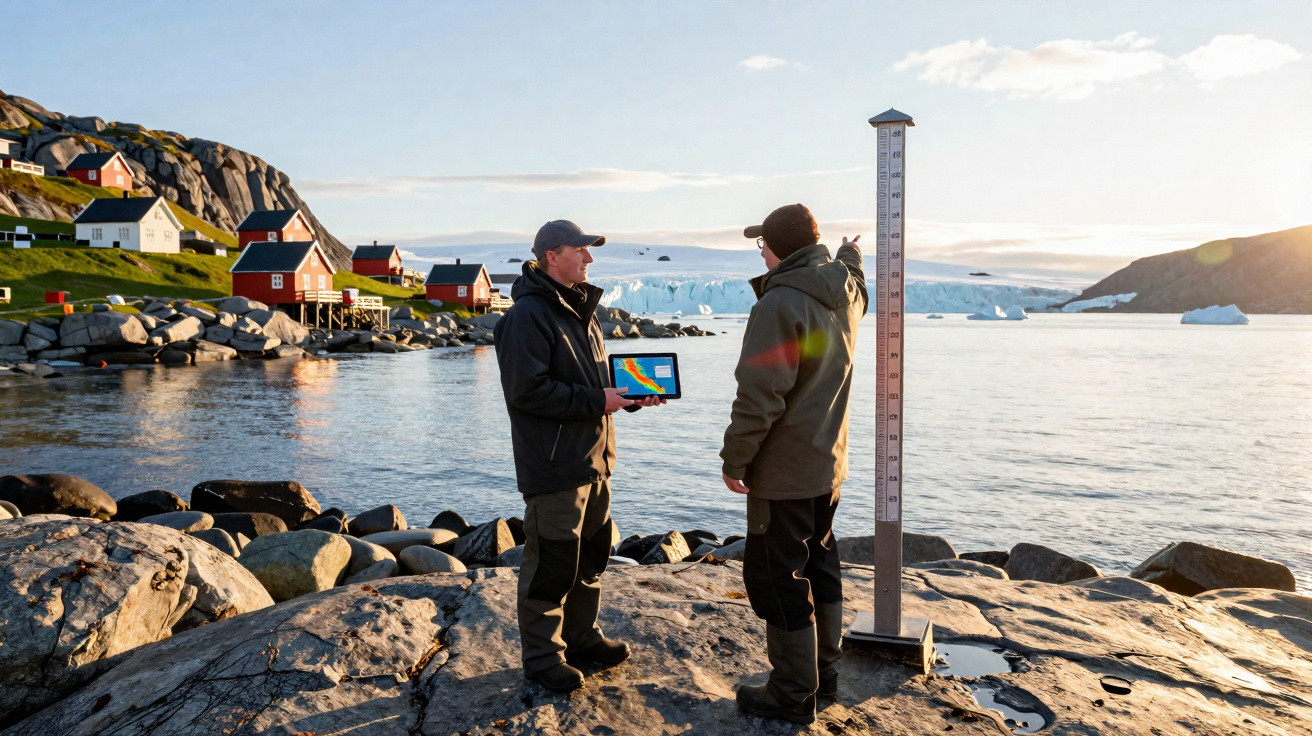
Around the globe, sea levels are increasing. Yet Greenland is an unusual exception: relative sea level there is expected to decline over the coming decades.
Greenland sea levels this century
A new study, led by Columbia University geophysicist Lauren Lewright, combines observations from the real world with computer modelling to project relative sea-level change around Greenland during this century.
"The Greenland coastline is going to experience quite a different outcome," says Lewright.
Rising sea levels are driven by higher concentrations of greenhouse gases in the atmosphere. These gases retain heat that would otherwise be reflected into space.
The oceans take up much of this heat, causing seawater to expand. Known as thermal expansion, this process is projected to make the largest contribution to future global sea-level rise.
Ice loss, land uplift and falling sea levels
However, researchers say that melting ice sheets will have a major influence on Greenland's future sea levels, which are expected to fall rather than increase.
Greenland is a distinctive case because its land is currently pressed down by a roughly 1.6-km-thick layer of glacial ice covering about 80 percent of the island.
That ice is presently disappearing at a rate of around 200 billion tonnes annually. As this immense weight is removed, the ground beneath it rises as well.
Under the most favourable scenario, in which greenhouse-gas emissions are restricted, the autonomous territory is projected to gain approximately 0.9 metres (around 3 feet) of exposed land as sea levels fall by the end of the 21st century.
If greenhouse-gas emissions are not reduced, Greenland will emerge by a full 2.5 metres (8.2 feet) from the ocean.
Lewright and her colleagues in the US, UK and Canada produced these estimates by matching observed historical changes in sea level and land elevation with a model that forecasts ground movement after land is uncovered by retreating glaciers.
Gravity also contributes significantly to Greenland's increasing elevation.
"When the ice sheet is very large, it has a lot of mass. The sea surface is pulled toward the ice sheet because of that gravitational pull," Lewright says.
"As the ice sheet loses mass, its gravitational pull on the sea surface decreases. That translates into sea level fall."
Effects on Greenland's coastal population
Lower sea levels will influence Greenland's economy, nearshore infrastructure and food security, particularly for its largely coastal population.
The research was published in Nature Communications.





Comments
No comments yet. Be the first to comment!
Leave a Comment