
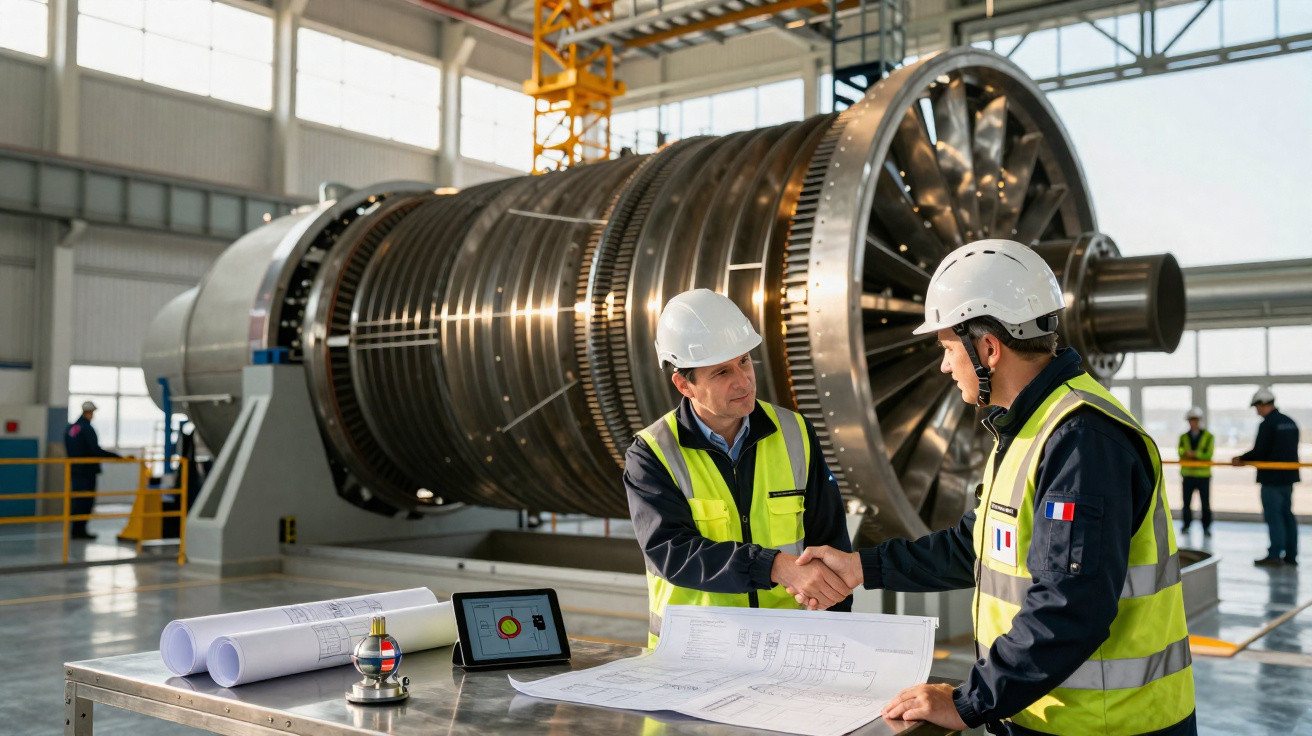
As Warsaw at last moves away from coal and commits to its first nuclear power plant, a factory in eastern France has returned to the heart of Europe’s energy landscape. It has secured a contract valued at well above €1bn and an opportunity to demonstrate that the continent’s nuclear supply chain remains alive.
From coal powerhouse to nuclear newcomer
Poland’s electricity system depended on coal and lignite for decades. In 2022, burning these fuels generated more than 70% of the country’s electricity. By mid-2025, that proportion had fallen below 50% for the first time, driven by gas, renewables and increasing carbon costs.
The country is now making a more decisive shift. In early January 2026, the Polish government confirmed that its first commercial nuclear power plant would be built at Lubiatowo on the Baltic coast. The facility will contain three US-designed AP1000 reactors provided by Westinghouse.
American nuclear technology will anchor the project, but the machines that actually turn heat into electricity will be French‑built.
Poland has chosen Arabelle Solutions, headquartered in Belfort in eastern France, to supply the station’s steam turbines. Located on the “conventional” side of a nuclear power station, after the reactor, these vast rotating machines transform steam first into mechanical energy and then into electrical power.
A €1–2bn contract centred on three giant turbines
The agreement includes three Arabelle steam turbines, each with an electrical output rating of around 1,200 megawatts. Once all three units are operating, currently expected from 2033 onwards, they will collectively provide electricity equivalent to the consumption of several million homes.
No formal contract value has been disclosed. Drawing on recent comparable projects, industry analysts estimate that the complete turbine “island” package is worth between €1bn and €2bn, with roughly €1.5bn seen as the central estimate.
Each turbine island for a large reactor now likely costs between €400m and €600m, reflecting tighter safety rules and higher engineering demands.
The scope extends beyond the turbines alone. Arabelle will provide the complete steam turbine island, including condensers, generators, auxiliary equipment and the complicated mechanical interfaces connecting the plant’s conventional side with its nuclear island.
What Belfort will actually build
- Design and manufacture of three 1,200 MW Arabelle steam turbines
- Production of generators and condensers for each unit
- Integration of auxiliary systems and control interfaces
- Engineering support and supervision during installation and commissioning
Everything will be designed, machined and assembled in Belfort before being transported to the Baltic coast. Engineers at the site will collaborate closely with Westinghouse to adapt French turbine technology to the US AP1000 reactor design.
The turbulent history of a French nuclear champion
The turbines marketed today as “Arabelle” have an industrial heritage spanning more than a century. Their origins lie with Société Rateau, established in 1903, which became an important supplier during France’s nuclear expansion from the 1970s onwards. By the close of the 20th century, Rateau’s successors had fitted large steam turbines across the entire French nuclear fleet.
Developed in Belfort, the Arabelle name became linked with exceptionally high output and long operating lives. Many of these machines continue to run after decades of near-continuous service.
That course changed in 2014, when Alstom sold its power operations, including the Arabelle range, to General Electric. Although the French state approved the transaction, it prompted intense debate about industrial sovereignty. A vital component of France’s electricity system had moved under US corporate ownership, despite certain state protections.
The direction reversed in 2024. EDF, France’s state-backed utility, acquired the steam turbine business for around €175m and renamed it Arabelle Solutions. The purchase returned the technology to public control and made it a clear part of the national nuclear strategy.
The Polish deal is the first major export contract for Arabelle Solutions since its return to the EDF fold, and a key test of its renewed ambitions.
The company now employs approximately 3,300 people, operates in about 16 countries and manufactures the Arabelle-1700 in Belfort, one of the most powerful nuclear steam turbines ever built.
Belfort’s industrial revival and the jobs involved
The Lubiatowo agreement is expected to support nearly 1,000 direct and indirect jobs in Belfort and its surrounding area over several years. The work will cover advanced engineering, welding, heavy machining, automation, quality assurance and logistics.
The region has experienced the energy sector’s fluctuations through restructuring, uncertainty and concerns about de-industrialisation. A nuclear order covering several reactors alters that picture. Order books gain volume, apprenticeships become viable again, and smaller subcontractors across Bourgogne-Franche-Comté receive greater certainty about future work.
Recent key projects involving Arabelle turbines
| Country | Project | Role | Main equipment | Timeline |
|---|---|---|---|---|
| Poland | Lubiatowo (AP1000) | New build supplier | 3 × 1,200 MW steam turbines | 2026–2035 |
| UK | Hinkley Point C (EPR) | Engineering & commissioning | Arabelle turbines for twin EPRs | 2024–2030 |
| France | Existing 56-reactor fleet | Major maintenance and upgrades | Turbogenerators, replacements | 2024–2040 |
| China | Taishan 1 & 2 (EPR) | Long-term technical support | Arabelle EPR turbines | Ongoing |
This range of work is significant for Belfort. Combining export orders with domestic maintenance contracts smooths out the cycle and helps retain highly specialised skills over the long term.
A message for Europe’s nuclear industry
The Polish order has implications reaching far beyond Belfort and Warsaw. It delivers a clear signal in a European market where new nuclear schemes frequently drift towards Korean or Chinese rivals.
In this case, a US reactor design is combined with a French turbine at a Polish location. The project indicates that a transatlantic-European partnership can still secure competitive tenders when it provides financeable technology and a dependable supply chain.
Without exporting a single reactor, France is exporting the hardware that makes nuclear electricity saleable: the high‑efficiency turbine at the heart of the power block.
For Poland, selecting a US reactor alongside a French turbine has a further advantage. It distributes political and industrial interests among several allies, potentially helping to protect the project from future geopolitical tensions or changes in government.
What a steam turbine island actually does
The reactor attracts most of the attention for many people. However, a nuclear power plant only generates income through its conventional island, where heat is converted into electricity.
Put simply, the Lubiatowo project will work as follows:
- The reactor core heats water, producing high-pressure steam.
- Steam passes through the blades of the Arabelle turbine, causing a huge shaft to rotate at high speed.
- That shaft drives an alternator, which produces electricity for the grid.
- The steam leaves the turbine and enters a condenser, where it is cooled and converted back into water.
- Pumps return the water to the reactor circuit, restarting the cycle.
The turbine island must extract every possible kilowatt-hour from each kilogram of steam while operating almost continuously for 40 to 60 years. Even small improvements in efficiency produce substantial revenue over a reactor’s working life.
Risks, benefits and what could go wrong
Poland’s choice offers genuine advantages. Large nuclear units can supply low-carbon baseload electricity, support a grid with a growing share of renewables and cut dependence on imported gas. For a coal-reliant country seeking to meet EU climate targets, this combination is appealing.
There are still risks. European experience shows that major nuclear projects often face cost overruns and timetable delays. Bringing together an American reactor supplier, a French turbine manufacturer and Polish contractors will challenge project management, domestic skills and political patience.
Moving oversized equipment from Belfort to the Baltic coast creates further logistical difficulties, requiring specialist transport, restrictive clearances and planning years in advance. A delay anywhere in the supply chain could affect the entire programme.
From an industrial perspective, however, the deal gives all parties powerful reasons to deliver. Jobs in Belfort, EDF’s strategy and Poland’s climate credibility all depend on the three turbines turning on schedule in the early 2030s.



Comments
No comments yet. Be the first to comment!
Leave a Comment