
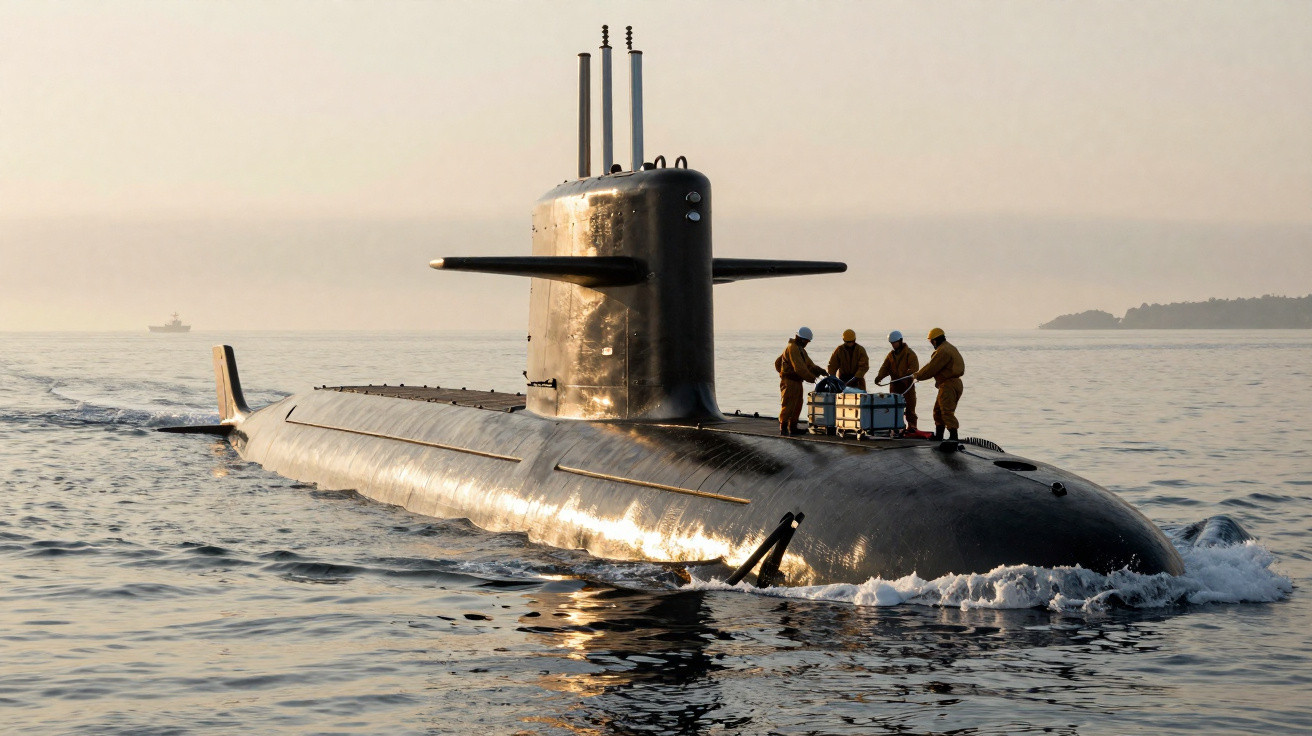
In recent weeks, the US Navy has made a significant move in a contest that seldom reaches the evening headlines: dominance of the deep ocean. By conducting the first sea trials of its newest nuclear attack submarine, Massachusetts (SSN-798), Washington is delivering a clear signal to Beijing and Moscow.
A 10,200-ton warning shot beneath the waves
Massachusetts is the latest Virginia-class Block V vessel, among the most sophisticated nuclear attack submarines ever deployed by the United States. Constructed jointly by General Dynamics Electric Boat and Huntington Ingalls’ Newport News Shipbuilding, the submarine left the yard for the Atlantic, where it began a demanding programme of high-speed manoeuvres, deep dives and simulated combat operations.
On sonar screens along the US East Coast, the Massachusetts appeared as little more than a ghost: hard to find, harder to follow.
US Navy statements and industry reporting indicate that the submarine performed as expected in stealth, speed and responsiveness. These initial tests concentrated on propulsion, acoustic discretion, and the vessel’s capacity to deploy and retrieve systems while under pressure.
Its basic specifications are intended to catch the attention of potential rivals:
- Displacement (submerged): 10,200 tonnes
- Length: 140.5 metres
- Beam: 10.3 metres
- Top submerged speed: over 46 km/h
- Crew: around 145 sailors and officers
- Endurance: virtually unlimited, limited mainly by food supplies
At the core of Massachusetts is a nuclear reactor fuelled by enriched uranium. This enables the submarine to stay underwater for months, travel thousands of miles from any US base, and still reach its destination prepared for combat.
A Swiss Army knife for modern undersea warfare
More than just a missile platform
Rather than being built for one purpose, the Virginia-class was conceived as a multi-role asset. Massachusetts can fire land-attack cruise missiles, pursue hostile submarines, accompany carrier groups and assist special forces missions in hostile waters.
From striking targets deep inland to quietly dropping off commandos on a hostile coast, one hull now covers missions that once required several different platforms.
In operational terms, the submarine is able to:
- Fire up to 40 Tomahawk cruise missiles against land targets
- Hunt and destroy enemy submarines with heavyweight torpedoes
- Lay naval mines to block key straits or harbours
- Deploy and recover unmanned underwater vehicles (UUVs) for reconnaissance
- Insert and support special operations forces using lock-out chambers and dedicated spaces
The principle is straightforward: wherever US policymakers wish to exert discreet pressure - whether in the South China Sea, Baltic, Barents Sea or Persian Gulf - a Virginia-class vessel can arrive undetected and disrupt an adversary’s planning.
Modular design aimed at future conflicts
Every design “block” has introduced further technology since USS Virginia (SSN-774), the first boat in the class, entered service in 2004. The early submarines concentrated on sonar and enhanced combat systems. Block III brought in a large-aperture sonar array and redesigned bow tubes capable of firing several weapons simultaneously.
Massachusetts is part of Block V, an extended version roughly 25 metres longer than the original model. Its defining feature is the Virginia Payload Module (VPM), a substantial hull section that functions as a versatile launch bay.
The VPM turns the submarine into a high-capacity launcher: cruise missiles today, underwater drones or new hypersonic weapons tomorrow.
Officially, the VPM provides room for 28 additional Tomahawks, beyond the existing torpedo room and vertical launch cells. However, the module can also be configured for:
- Unmanned underwater vehicles for long-range scouting
- Special forces gear and mini-submersibles
- Experimental payloads or new generations of strike weapons
This modular strategy allows the US Navy to incorporate new capabilities without having to redesign the complete submarine. As technologies develop, they may be fitted to future Virginia-class boats or installed during refits.
Keeping ahead of Russia, closing the door on China
A tightening race beneath contested seas
Although Massachusetts is not due to enter active service until late 2025 or early 2026, its sea trials provide a well-timed message. China is enlarging its navy at extraordinary speed, while Russia continues to spend heavily on formidable but noisy submarines including the Yasen-M class.
Washington believes that the contest over the coming decades will be settled not just on the surface, but across three crucial areas: Arctic routes, Pacific chokepoints and the North Atlantic. Submarines such as Massachusetts are designed for precisely these theatres.
| Country | Class | Approx. displacement (submerged) | Main role | Notable feature |
|---|---|---|---|---|
| United States | Virginia Block V | 10,200 tonnes | Multi-mission attack | Payload module with up to 40 Tomahawks |
| Russia | Yasen-M | 13,800 tonnes | Heavy strike and anti-ship | Very heavy missile armament |
| China | Type 093B | ~7,000 tonnes | Regional deterrence | Growing numbers, improving design |
| France | Barracuda | 5,300 tonnes | Attack and land strike | High acoustic discretion in compact hull |
| United Kingdom | Astute | 7,800 tonnes | Attack and escort | Very low noise signature |
Russia continues to operate some of the world’s most heavily armed submarines, although Western analysts regularly identify weaknesses in maintenance and noise levels. China is constructing vessels rapidly and gaining expertise, but its nuclear propulsion and sonar capabilities are commonly assessed as trailing US and British standards.
By comparison, the United States pairs advanced design with scale. As additional Virginia-class Block V submarines leave the production line, the US Navy will possess an attack-submarine fleet that can rotate between the Pacific and Atlantic with minimal time out of service.
Life aboard a “ghost” of the deep
145 people in a steel tube
Behind the polished diagrams and political signalling lies a human reality: roughly 145 men and women confined in a sealed steel tube for months at a time. Only a minority aboard Massachusetts are officers. The majority are extensively trained technicians, sonar operators, electricians, weapons specialists and nuclear engineers.
Days merge together. There is no daylight, only fluorescent lighting. The crew follows a demanding cycle of watches, training, drills and maintenance work. Sleep is limited and private space is scarce. Even so, decisions must remain exceptionally precise, especially in busy waters where collision with another submarine, a fishing trawler or the seabed itself is a continual hazard.
Every few seconds, the crew makes choices based on echoes and data that would mean nothing to an untrained ear – a faint noise might be a whale, or it might be a Chinese attack boat.
Stealth and patience are central to submarine warfare. A Virginia-class boat will commonly spend extended periods in “quiet” mode, travelling slowly to prevent its location being revealed. It can accelerate and strike swiftly when instructed, but its normal stance is observant rather than aggressive.
What “nuclear attack submarine” actually means
The phrase can cause confusion. A nuclear attack submarine such as Massachusetts uses a nuclear reactor for propulsion, but it does not automatically carry nuclear-armed missiles. Its main role is to track ships and submarines and, in the US context, to fire conventional Tomahawk cruise missiles at land-based targets.
This separates it from ballistic missile submarines, which carry nuclear warheads and underpin long-range nuclear deterrence. Both categories are nuclear-powered, yet they perform different strategic functions.
The distinction is important during a crisis. A Virginia-class submarine nearing a disputed coastline may carry conventional cruise missiles intended for radar facilities or command bunkers rather than nuclear payloads. Such uncertainty can increase the risk of miscalculation, particularly in tense areas such as the South China Sea.
Scenarios: how the Massachusetts pressures China and Russia
Defence planners frequently use scenarios to assess whether projects such as Massachusetts justify their expense. Two are particularly prominent.
The first is a Taiwan crisis. In that situation, US attack submarines could be directed to track Chinese surface groups, follow their submarines and, if ordered, engage vital naval units. A stealthy vessel capable of remaining in the Philippine Sea or South China Sea for months without resupply presents Beijing with a serious problem.
The second is a North Atlantic confrontation with Russia. The mission in this case would involve observing Russian submarines departing bases on the Kola Peninsula, safeguarding maritime routes to Europe, and protecting NATO reinforcement convoys from undersea strikes. With its advanced sonar suite and substantial weapons load, Massachusetts is well suited to this task.
In either scenario, simply knowing that an unseen US submarine could be nearby obliges adversaries to alter their behaviour: travel with greater caution, allocate additional resources to anti-submarine warfare, and accept that their own movements may be under surveillance.
Risks, costs and what comes next
Submarines such as Massachusetts cost several billion dollars apiece and depend on decades of industrial and technical development. They also entail risks: nuclear propulsion requires rigorous safety standards, while any major incident at sea would carry political and environmental consequences.
There is a wider strategic issue as well. As undersea warfare becomes increasingly crowded with sensors, drones and advanced underwater networks, the longstanding belief that nuclear submarines are almost impossible to detect could weaken. The Virginia-class design seeks to counter that possibility by placing greater emphasis on quieting technology and flexible payload capacity for emerging tools.
For the moment, however, Massachusetts gives Washington something direct and potent: another exceptionally quiet, highly capable 10,200-ton reason to avoid a confrontation with the US Navy. For China and Russia, it introduces one more factor into an already complicated undersea chessboard.



Comments
No comments yet. Be the first to comment!
Leave a Comment