
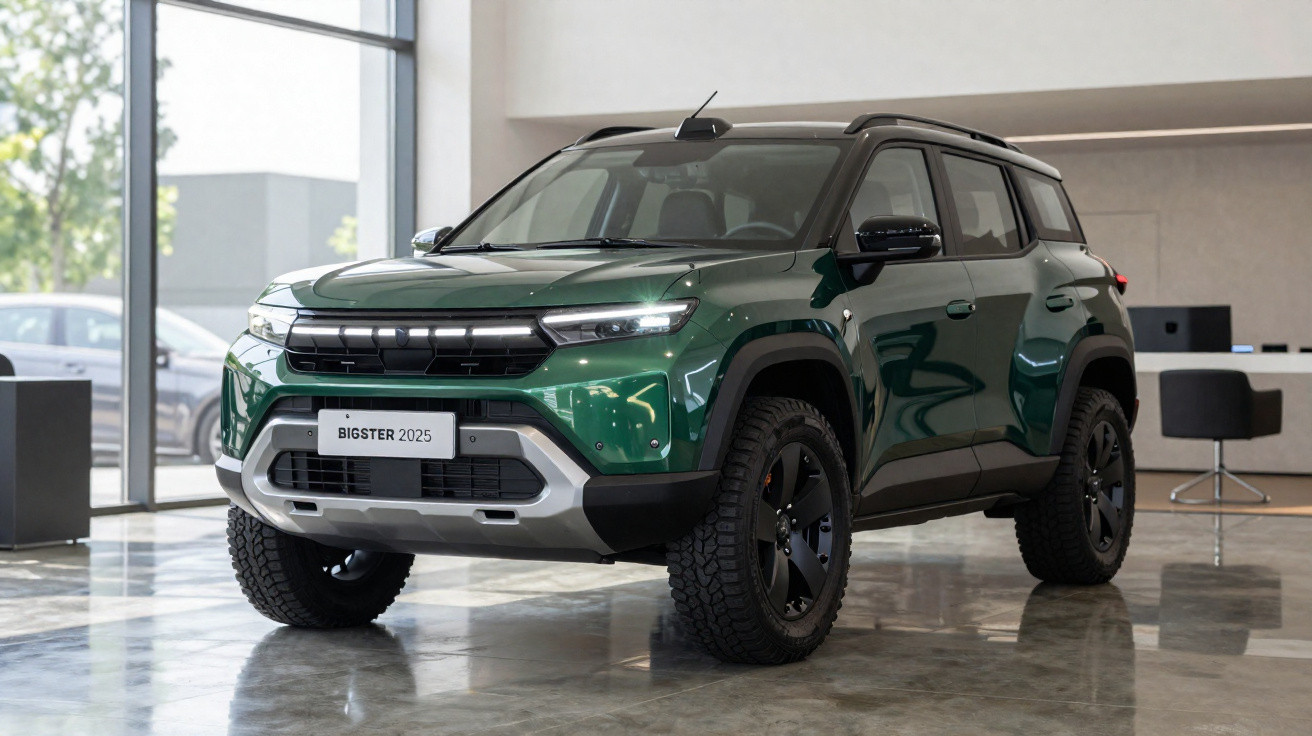
Dacia’s presentation of its first-half results produced two particularly clear messages. First, the brand is maintaining a strong pace of growth; second, Dacia’s immediate future will be packed with new developments.
Looking back, it has been less than three months since we had our first opportunity to get acquainted with the new Dacia Duster, and the overall verdict was very positive.
We have also just added the updated Dacia Spring to the list of cars we have driven. It is easy to see that both models represent a significant step forward compared with their predecessors.
Dacia is far from stopping there, however. Its next major launch will be the Dacia Bigster, effectively a larger sibling to the Duster, with a bigger body and potentially up to seven seats.
We will see it before the end of the year, and it should help drive the brand’s expected rise in global sales in 2025. According to Dacia vice-president Xavier Martinet, the interest it has generated has exceeded expectations.
Indeed, the Bigster is already prompting Dacia to reorganise its manufacturing operations. Production of several models will move to the brand’s plant in Morocco, freeing up the Romanian production lines to operate at full capacity for the Dacia Duster and Bigster.
There is more to come, too. Dacia has already confirmed that two further models will follow the Bigster. Martinet says both will be entirely new vehicles and will allow Dacia to enter new segments for the first time.
Dacia Bigster and the next model launches
The Bigster will therefore be central to Dacia’s upcoming product offensive, but it is only the first of several planned additions. The two models due to arrive after it will broaden the brand’s range beyond the segments in which it currently competes.
A clearly defined strategy
When it entered the market under Renault Group ownership 20 years ago, Dacia began as the French group’s low-cost brand. Affordable pricing was one of Dacia’s main selling points and a key reason for its success. That approach is evolving, however, as the brand’s chief executive explained.
“Our customers’ salaries have not risen at the same rate as the price of cars. (…) They used to buy a Dacia because it was cheap, but now they buy one because they like the car.”
Xavier Martinet, CEO of Dacia
In Martinet’s view, every decision is centred on understanding what customers genuinely need.
For instance, “the Dacia Spring is mostly chosen by customers who travel an average of 30 km a day at 30 km/h. In other words, they do not need a huge battery, and that makes it possible to offer the best value with every product.”
The Dacia Sandero and the prospect of introducing a hybrid version provide another example. “It is not a technical issue - as the platform is the same as the Clio’s - but simply one of cost. Is the customer willing to pay the difference? Does it make sense?”
Martinet says it may be more important to add an automatic gearbox, for example, or to invest in more efficient engines. “A Dacia Sandero Hybrid does not make sense for now. In 2025, who knows?”
Dacia’s future powertrain decisions will focus primarily on LPG versions. For as long as regulations allow it, “we will continue to produce cars with petrol combustion engines”.
Diesel is a different matter, with Martinet describing it as “an issue of the past”. For the European market, Dacia is placing its bets on hybrids and mild-hybrids, although LPG remains its foremost priority.
Electric cars, hybrids and LPG at Dacia
Over the next few years, Dacia’s electric offering is expected to be represented solely by the Dacia Spring, which remains the cheapest model on the market.
As part of Renault Group, Dacia faces pressure to accelerate its electrification strategy. At group level, the priority in this area lies with models such as the Megane and Scenic E-Tech, as well as the new Renault 5.
Was Euro NCAP a disappointment?
Although many people place Dacia on a lower tier partly because of its Euro NCAP safety-test results, Xavier Martinet says that outcome is fully consistent with Dacia’s aims.
Naturally, Dacia places great importance on protecting the customers and passengers in its models. However, Euro NCAP’s emphasis on advanced driver-assistance systems affects the brand’s performance in its assessments.
That is because, as Martinet puts it, Dacia still prefers not to “load its models with driver-assistance equipment that is not mandatory and that increases the vehicle’s final price”.



Comments
No comments yet. Be the first to comment!
Leave a Comment