
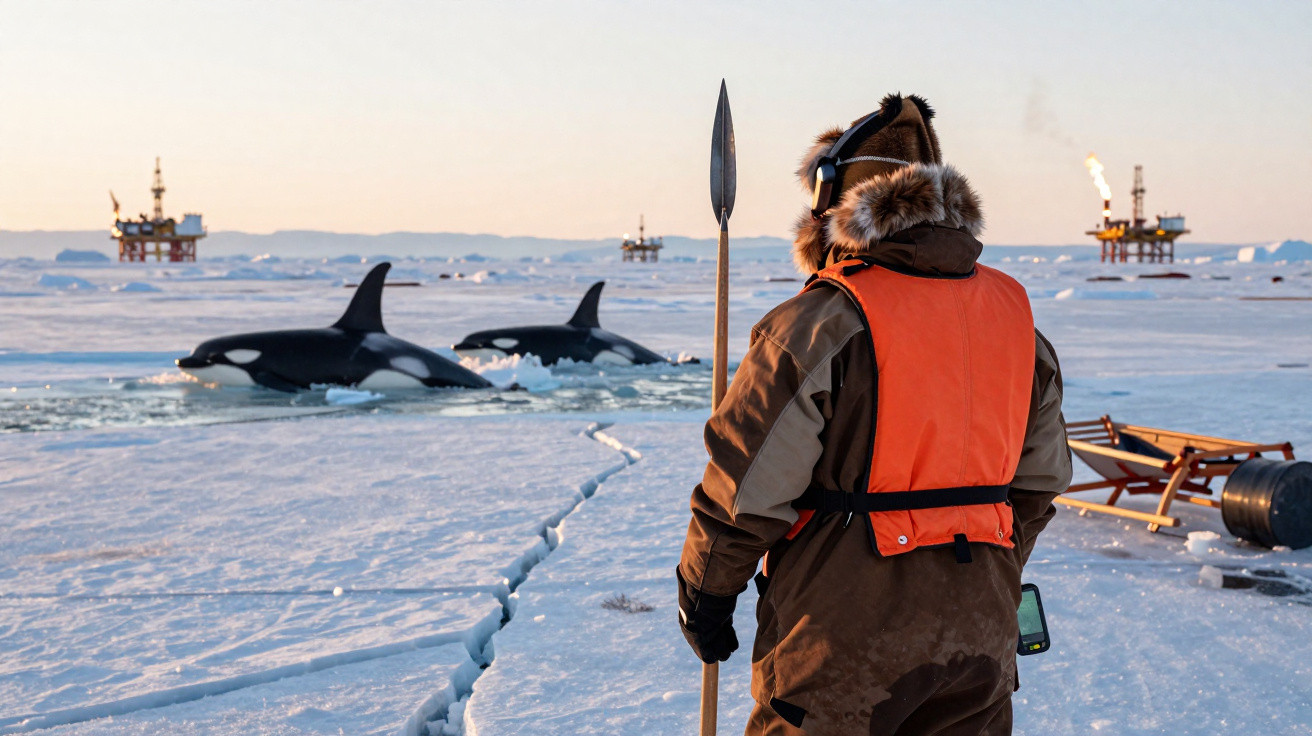
The first sound is not water but air: a damp, weighty breath that appears to rise from the fjord’s own depths. Then a black dorsal fin, higher than a person, cuts through the steel-grey water, moving without a sound among floating sheets of rotten ice. Above, on the cliff in Tasiilaq on Greenland’s east coast, several people pause and watch. Nobody can recall orcas appearing this close or this regularly. Not in January. Not beneath a sky that ought to be storm-white rather than faded blue.
Below them, ice that once supported hunters and sled dogs for months can now scarcely carry a snowmobile for a week. The government has declared an emergency in response to arriving orcas and retreating sea ice.
Further offshore, however, a different industry is observing the same thaw with an entirely different reaction.
Orcas where they do not belong, and ice that will not hold
Walk around Nuuk harbour this winter and the evidence is hard to miss, although the streetlights still cast their familiar weary orange glow. Fishing boats sit idling for longer than they ought to. Older men linger at the quay, narrowing their eyes at an ice edge that seems to retreat each year. During a weather update, local radio breaks in with news of yet another orca sighting near a village more accustomed to narwhals.
No scientific study is needed for residents to know that something has changed. The sea has a different sound. The air feels unfamiliar against the skin. The old ice calendar has slipped out of place.
In a west-coast settlement with only a few hundred residents, a hunter called Jon takes his sled towards sea ice he believes to be secure. For decades, the route was so reliable that people used cracks in the ice, rather than street names, when giving directions. This year he heads back sooner than planned. Black, slushy areas spread across the frozen surface like bruises, shifting open and shut with the tide.
Then the orcas appear. Residents record them on their phones: black-and-white torpedoes passing through water that, until recently, formed a solid transport route. Elders remember these “killer whales” as unusual summer visitors. They now turn up while Christmas decorations remain in place. Already confronting failing fishing seasons, the government in Nuuk declares a climate-related emergency. It may read like bureaucratic language on paper; in daily life, it resembles a drawn-out eviction.
Scientists use a restrained term for this process: “range expansion.” With Arctic waters becoming warmer and sea ice becoming thinner, orcas-fast, intelligent apex predators-are moving north after prey that once sheltered beneath dense winter ice. Their arrival disrupts already delicate balances. Narwhals and seals, confined to diminishing safe areas, must confront a danger they did not previously need to consider. Hunters reliant on those animals for food and income now find themselves competing with a predator unconcerned with quotas or seasons.
Greenland’s emergency declaration concerns more than striking whales. It reflects a chain reaction: shrinking sea ice, arriving orcas, changing fish stocks, and centuries of knowledge about surviving in this landscape losing their foundation. While local people struggle to adjust, much of the world watches social-media clips of “beautiful” orcas beneath a blood-red Arctic sunset.
Oil money, melting ice, and an unequal game
In glass-walled offices thousands of kilometres away, the same disappearing ice is presented in a very different slideshow. Arctic maps once covered by thick white now reveal longer blue stretches during summer. To the fossil-fuel sector, that blue represents an opening. More open water can mean easier access to seabed reserves and extended tanker shipping seasons.
Geologists indicate seismic surveys. Executives refer to “frontier basins”. Aware that public opinion is uneasy, they have softened their wording. “Boom” is seldom used now. The calculations beneath the language, however, have changed little.
Over recent years, Greenland has repeatedly considered, then withdrawn from, major oil exploration. Officially, its autonomous government aims to turn away from fossil fuels. In practice, the prospect of billions is difficult to dismiss in a society still dealing with the legacy of Danish colonialism and a limited economic base.
Oil companies grasp that reality completely. They bring offers of partnerships, training schemes and even climate-adaptation funding. Their polished brochures promise jobs for young Greenlanders and infrastructure that could finally link remote communities. Read between the lines, and melting ice is presented as a benefit rather than a danger. Meanwhile, global oil giants report record profits, driven by volatile energy prices and continued reliance on fossil fuels.
This is where the account becomes painful. East Greenland hunters are instructed to “adapt” to changing ice and unfamiliar predators, while the industry most responsible for greenhouse-gas emissions continues to secure profits large enough to purchase entire coastal towns ten times over. The logic is quiet and harsh: as the Arctic grows warmer, its resources become easier to reach.
Let’s be honest: nobody really believes the oil majors have suddenly grown a conscience just because their sustainability reports use softer fonts and more photos of smiling kids in parkas. As Greenland declares an emergency over orcas and melting ice, the economic system beneath it continues to deliver the same message: extract first, consequences later. In the space between local losses and corporate gains, frustration-and something more troubling-starts to take root.
Living on thinning ice while others profit
What do you do when you are standing on weakening ice rather than trading futures from a comfortable London office? Adaptation has never been an abstract concept for Greenlanders. It means changing hunting routes weeks earlier than normal. It means putting money into stronger boats rather than new sleds. It means young people attempting to combine traditional expertise with marine-biology degrees, in the hope of protecting both their culture and coastline.
One understated but powerful act is to document what is happening. Residents film the season’s first orcas, mark the date when the fjord does not freeze, and preserve elders’ memories before they are lost. Those images and records become evidence in struggles reaching far beyond the Arctic Circle.
For everyone else watching from heated flats, there is a temptation either to scroll in panic or simply move on. Most of us know that moment: another climate headline appears, bringing both guilt and helplessness. The answer is not to act as though you can repair the Arctic alone. You cannot.
Yet you can choose where your money, attention and pressure are directed. That can mean backing journalism that puts Arctic voices first, rather than relying only on iceberg drone footage. It can mean urging banks and pension funds to divest from Arctic drilling schemes. It can mean challenging greenwashed advertising from companies that describe melting sea ice as a “new corridor for global trade”, rather than recognising it for what it is: evidence of crisis. These actions may appear modest, until you recall that the fossil-fuel industry depends on public licence to survive.
Oil companies will tell you they’re simply responding to demand. Greenland’s hunters are being told they must adapt faster. Somewhere between those two sentences sits the truth about who bears the weight of this warming planet.
- Pay attention to who frames the Arctic story
- Seek out local Greenlandic voices, rather than only outside experts
- Track the money behind “innovation” in the far north
- Recognise when melting ice is called an opportunity rather than a warning
- Question whether emergency declarations produce action or merely headlines
Between the orcas and the oil rigs
Greenland currently sits in a strange, almost surreal convergence. In waters where orcas are unexpectedly travelling beneath winter skies, seismic-survey vessels have also been charting the seabed. On certain days, the planet seems to be sending an unmistakable message, only to receive a PowerPoint presentation about “enhanced Arctic competitiveness.”
The emergency declaration over melting ice and orcas is a human warning: the former rules have disappeared and the safety net is coming apart. The next stage remains undecided. Greenland might become the emblem of another extractive rush, this one wrapped in the language of sustainability. Or it could become one of the places that compels the world to face a simple, uncomfortable question: who is allowed to profit from a warming Arctic, and who is left on cracking ice?
That question extends far beyond Greenland. It touches our energy bills, savings accounts, the adverts in our feeds and the stories we decide to circulate. Between orcas’ black fins and oil traders’ spreadsheets, a new map of responsibility is taking shape. Whether we see it-or continue scrolling past another haunting Arctic video-will reveal much about the future we are prepared to inhabit.
| Key point | Detail | Value for the reader |
|---|---|---|
| Orcas as a warning sign | Fresh winter sightings in Greenland indicate rapid Arctic warming and disturbed ecosystems | Allows readers to understand a complex crisis through a clear, vivid symbol |
| Emergency vs. profits | Greenland confronts a climate emergency as global oil companies increase profits from the same thaw | Underlines the moral and economic divide fuelling public anger and activism |
| Where individual power sits | Decisions about media, finance and pressure campaigns influence the social licence for Arctic drilling | Provides realistic starting points for readers overwhelmed by climate news |
FAQ:
- Is Greenland actually seeing more orcas, or is it just social media? Both. Residents and researchers describe increasingly frequent orca sightings in places and seasons where they were previously uncommon, while phones make those encounters more visible to the wider world.
- Why did Greenland declare an emergency over orcas and melting ice? The declaration reflects the speed with which altered sea ice and new predators are weakening hunting, food security and traditional knowledge-not simply a wildlife-viewing issue.
- Is Greenland actively drilling for oil right now? Large-scale oil production has not begun, and political signals have varied, but interest in exploration and pressure from companies and some politicians remain in the background.
- How are orcas affecting other Arctic species? As apex predators, orcas may hunt narwhals, seals and other marine mammals that once used thick sea ice for shelter, placing further pressure on populations that are already vulnerable.
- What can someone outside Greenland realistically do? Support reporting centred on Arctic communities, back groups opposing Arctic drilling, press financial institutions to move away from fossil-heavy portfolios, and remain alert to greenwashed messages portraying melting ice as a commercial opportunity.




Comments
No comments yet. Be the first to comment!
Leave a Comment