
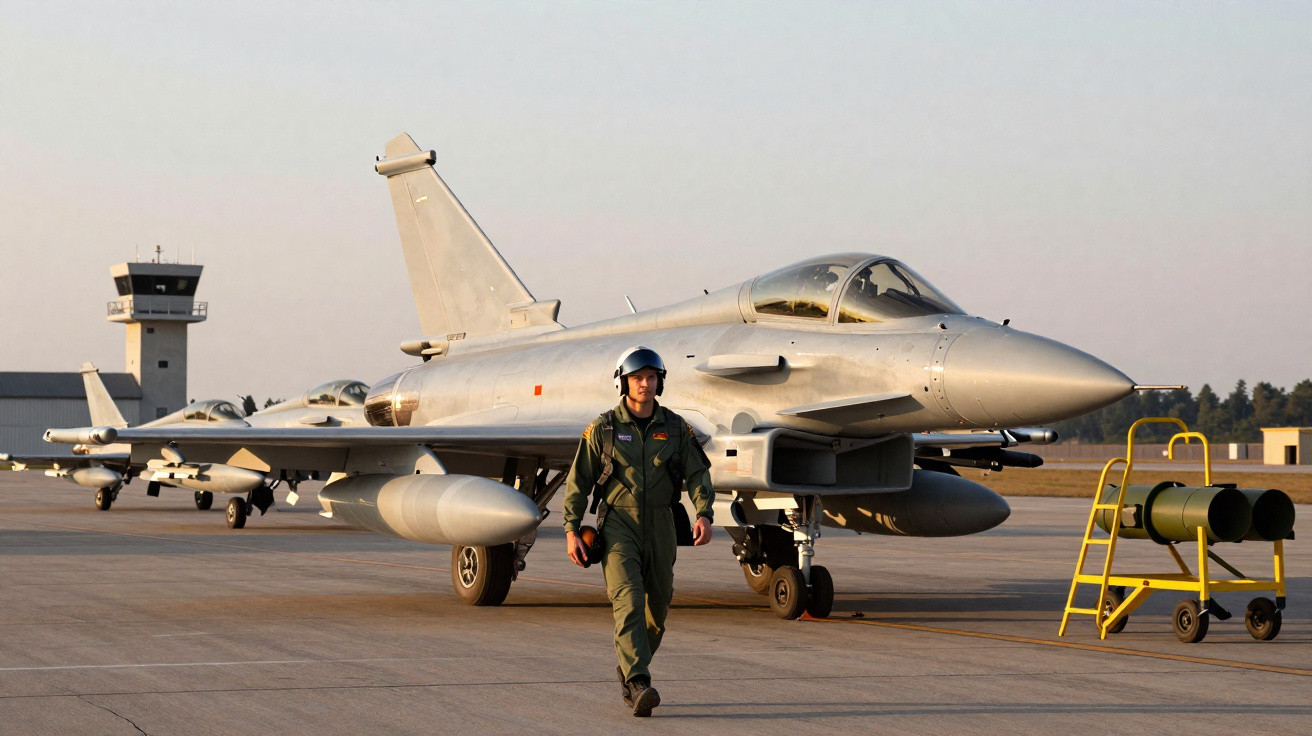
Over the North Sea, engines roar while radar screens hum quietly in the background.
Behind the scenes, choices are being made that will shape Europe’s skies for decades to come.
The German Federal Government is investing in a new batch of Eurofighter jets, sending a clear message to industry, allies and potential adversaries. The Airbus order not only reinforces Germany’s control of its airspace, but also gives Europe’s defence-industrial base fresh momentum at a time of heightened security concerns.
New Eurofighters for the Bundeswehr: what has been agreed
Germany is purchasing 20 additional Eurofighters from Airbus. The aircraft are intended to strengthen the Luftwaffe in a targeted way, gradually replace ageing jets and, at the same time, prepare the ground for future technologies. Airbus Defence and Space is responsible for development and final assembly, with major sites in Bavaria and North Rhine-Westphalia.
With the new order, Germany is relying on a proven combat aircraft that is also being progressively developed towards future air-combat systems.
Delivery of the aircraft will take place over several years. Industry sources expect the first jets to be handed over to the armed forces before the end of this decade. Alongside the aircraft themselves, the contract covers modernisation packages, training services and logistical support.
Why Germany is rearming now
The timing of the purchase is deliberate. Europe’s security environment has changed dramatically in recent years. Countries on NATO’s eastern flank are calling for a greater air presence, airspace surveillance is increasing, and the time available to respond in an emergency is getting shorter.
At the same time, older aircraft types in the Bundeswehr fleet are reaching the end of their economically viable service life. Spare parts are becoming more expensive and maintenance intervals more frequent. Effective fleet management requires new platforms to enter service in good time, before capability gaps emerge.
A signal to NATO partners and industry
With this move, Berlin is communicating several messages:
- to NATO: Germany intends to meet its air-defence commitments more visibly and on a more lasting basis
- to industry: European combat aircraft remain a central project, despite parallel programmes such as the Future Combat Air System (FCAS)
- to the public: the security-policy “turning point” is being reflected in tangible military equipment
The Eurofighter order also helps secure European supply chains. Production is shared among several countries, including Germany, the United Kingdom, Italy and Spain, while sustaining highly skilled jobs in specialised fields.
What the Eurofighter can do today – and the upgrades planned
The Eurofighter is a multirole combat aircraft. Although it was originally designed as a superior air-superiority fighter, it has since been optimised for air-to-ground operations too. This allows it to perform a wide range of missions, from protecting summit meetings to carrying out deterrence patrols along NATO’s borders.
| Capability | Importance for air sovereignty |
|---|---|
| Air-to-air armament | Rapid interception of hostile aircraft and round-the-clock protection of airspace |
| Modern radar | Earlier detection, target tracking and improved mission planning in complex scenarios |
| Networked data links | Connected operations with ground forces, AWACS and other jets |
| High rate of climb and manoeuvrability | Advantages in air combat and close interception situations |
The new tranche will receive further modernisation measures, including enhanced avionics, new sensors and software upgrades that keep the aircraft digitally interoperable. Specialists often describe it as a “bridge” to the future FCAS. The Eurofighter is therefore expected to retain a key role in European air defence for many years.
Jobs and industry: who gains from the order?
The Luftwaffe and Airbus are not the only beneficiaries of the decision. Each jet is supported by an extensive network of suppliers, ranging from engine manufacturers and electronics companies to medium-sized component providers.
In Germany, the effects will be focused chiefly in the following areas:
- assembly and final production at Airbus sites in southern Germany
- development and testing of software, radar and communications systems
- maintenance and upgrade centres operated by the Luftwaffe and industrial partners
The 20 new Eurofighters secure thousands of skilled jobs throughout the entire value chain – often in regions where aerospace plays a crucial role.
The Federal Government is also pursuing industrial-policy objectives through the purchase. Strong national expertise in military aircraft manufacturing makes participation in future major European programmes easier and reduces dependence on manufacturers outside Europe.
How the order specifically strengthens Germany’s air sovereignty
Air sovereignty means that a country can control, monitor and, if necessary, defend its airspace. Achieving this requires jets that are available around the clock, well-rehearsed operational plans and sufficient trained pilots.
Greater availability and faster response times
With 20 extra aircraft, the Luftwaffe can improve its operational readiness in several ways:
- additional quick-reaction alert pairs able to take off rapidly following airspace violations
- increased reserve capacity during maintenance periods
- a stronger presence on NATO missions in Eastern Europe or over the North Sea
Exercises repeatedly demonstrate that greater aircraft availability enables more flexible responses, better shift planning and less strain on crews. The new Eurofighters provide operational planners with room to manoeuvre, an important factor during prolonged periods of tension.
Deterrence through visible presence
Air sovereignty is about more than technology; it also has a psychological dimension. Regular patrols, participation in international exercises and swift responses to unidentified aircraft send unambiguous signals. States with a modern, operationally ready air force appear less vulnerable.
The procurement of 20 new jets will not radically alter the balance of power. It will, however, raise the threshold for potential provocations in German and neighbouring airspace. At a time when border violations and airspace testing are becoming more frequent, every modernly equipped aircraft matters.
Risks, debates and drawbacks of the decision
Defence projects on this scale are politically contentious. Critics point to the high costs and ask whether investment in diplomacy, cyber defence or civil protection might not be more urgent. Others caution against an arms-race spiral in Europe.
At an operational level, heavy reliance on one aircraft type entails risks. If a technical issue temporarily grounds the fleet, every unit is affected. Diversification is consequently a constant issue in military planning, both for platforms and for armaments.
There is also the challenge of recruiting enough personnel. Modern jets require highly qualified pilots and technicians. Training takes years, while competition from civil aviation remains intense. Without well-trained crews, part of the technical capability cannot be used.
What non-specialists should know about terms such as “air superiority” and “multirole fighter”
In discussions about the Eurofighter, the term “air superiority” appears frequently. It refers to the ability to dominate opposing air forces so decisively that they effectively cannot influence the battle. This is not merely about winning individual dogfights, but about maintaining control over entire areas of airspace.
A “multirole fighter” such as the Eurofighter can undertake both air-to-air and air-to-ground missions. This simplifies the fleet structure. Rather than operating several specialised types, the Luftwaffe can focus on one flexible system in different configurations. The downside is that perfect specialisation for a single mission gives way to a balanced compromise.
Possible scenarios: how the new jets could be used
Plausible scenarios range from a seemingly routine quick-reaction launch to highly complex networked operations. For example, an unidentified aircraft without radio contact approaches German airspace. Within minutes, two Eurofighters take off, approach it, identify the aircraft and escort it until the situation is clarified. Such missions are now carried out almost routinely.
The situation becomes more complex when Eurofighters operate alongside drones, reconnaissance aircraft and ground forces. The new software updates are specifically intended to improve these networked scenarios. Over the longer term, Eurofighters could also act as “motherships” for uncrewed escort drones carrying out reconnaissance or electronic jamming.
This also creates realistic simulation environments for training. Pilots already practise scenarios involving several nations, platforms and electronically simulated opponents. The new aircraft will be integrated directly into this complex training.



Comments
No comments yet. Be the first to comment!
Leave a Comment