
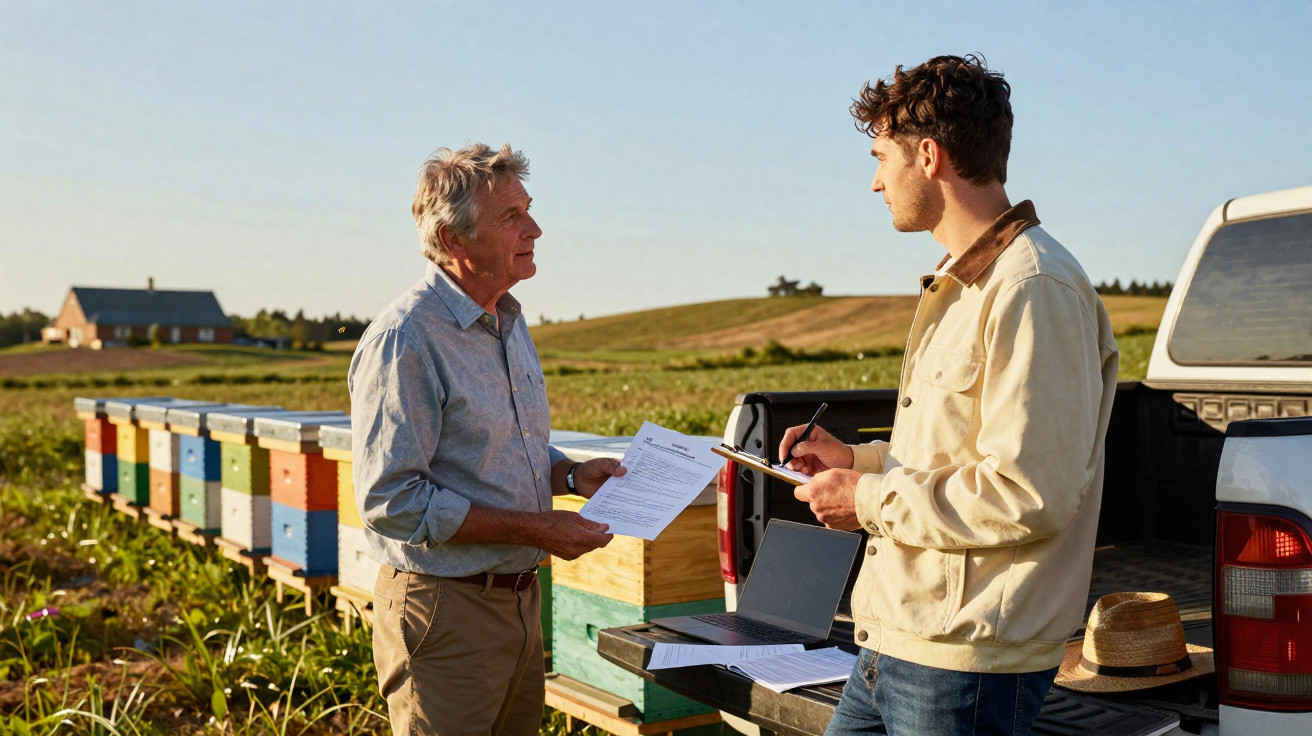
A bare strip of ground behind a modest brick bungalow was lent “between neighbours” with nothing more than a handshake and a smile. Before long, however, it had become a steady background drone: white bee boxes stood in lines beside the hedge, resembling miniature holiday caravans. Honey began to pour in, jars started selling, and the local beekeeper’s side business rapidly took off. Then an envelope bearing the tax office logo arrived, and the retired owner went pale as he sat at his kitchen table. The borrowed field had turned into a buzzing source of wealth. On the paperwork, though, that wealth appeared to be his.
A neighbourly favour that became an expensive problem
One mild spring morning in the English countryside, it all seemed harmless. A retired man in a threadbare cardigan rested on his walking stick while watching a neighbour unload hives from a pickup. Birds sang overhead and the scent of wet earth lingered in the air. The beekeeper assured him it would be “just a small setup”, intended to support the bees while putting otherwise unused land to work.
There was no discussion of a contract, and no one mentioned “income”. The retiree liked the prospect, having always enjoyed observing wildlife from his rear window. First the hives arrived individually, then more were added, followed by several others. As the hum intensified, so did the gossip at the village shop. Somebody said the beekeeper was making substantial sums by selling “artisanal honey” online. At that point, the tale ceased to be sweet and began to cause pain.
The crucial moment came in the form of a brown envelope. It contained a letter from the tax authorities mentioning “agricultural use” and “undeclared income”. The retiree stared at terms he did not understand but immediately dreaded. Officially, the use of the land had altered. That could mean different rules, possible additional taxes and perhaps a bill addressed to him. He had received none of the money from the honey jars displayed at the Saturday market. Nevertheless, in legal terms, the land - and the activity carried out on it - remained his responsibility.
This goes beyond a single bad-tempered dispute between neighbours. It is a classic illustration of the rural sharing economy colliding with a tax system that does not quite use the same language. Casual arrangements, borrowed fields and friendly gestures run into regulations designed for major farms and formal tenancies. The consequences can fall most heavily on vulnerable people: older landowners who believed they were merely being helpful. What was one person’s buzzing success became another’s administrative nightmare.
How beehives on borrowed land can become a business
What unsettled the retiree most was not that somebody else was earning money, but the possibility that the law viewed those wooden hives as part of his own “activity”. The beekeeper had registered his small business at his home address, proudly shared hive photographs online and used the borrowed field as the setting for polished advertising. Local maps and satellite imagery now showed what had once been empty land as a clearly organised commercial venture.
At first, people in the village loved the narrative: “Local honey, local bees, local land.” The beekeeper told buyers that he had “teamed up” with a neighbour, wording that sounded like a partnership. He did not intend to cause difficulty; he regarded it as simple promotional language. Yet to a tax officer reviewing social posts and land use, it could resemble a joint venture. The retiree, still accustomed to writing cheques at the post office, had no idea that his name might quietly become associated with online sales and an expanding brand.
In numerous countries, regular commercial activity on land - whether hives, solar panels, rented storage or grazing rights - can change the applicable rules. Authorities may decide to reclassify how that land is used. Such a decision may affect local taxation, business rates, agricultural subsidies and even inheritance planning. The baffled retiree discovered that several rows of hives might, in theory, be regarded as productive assets on his property. The beekeeper might say he was merely “using space”, much as someone parks a vehicle. A tax inspector might instead say the owner had permitted a business to trade there. It is the same field and the same humming, but radically different interpretations.
Protecting yourself while lending out land
This situation could have been prevented in one very practical way: with a brief written agreement in plain English. It need not be a 20-page legal document. A couple of pages could state who receives the income, who is responsible for each tax and who deals with matters if the authorities make enquiries. It should clearly confirm that the beekeeper operates the business, while the landowner only grants access: no partnership is intended and no profits are shared.
For the retiree, even a handwritten document could have made a difference. A date, signatures and straightforward terms would have provided evidence that the “goldmine” was not his enterprise, even though it stood on his land. It could also record a token rent of a few pounds annually or payment in jars of honey. The aim is not to extract more from a neighbour. It is to record the real arrangement before algorithms and officials give it a different meaning. Paper may seem old-fashioned, but it is better than panicking over a tax letter.
When relations are warm, people seldom consider the worst possible outcome. They think of birds and bees, and of the pleasure of bringing life to a quiet field. Yet goodwill does not remove legal obligations where land is concerned. A simple checklist can make all the difference: who holds insurance? Who registers the activity? Who accepts liability if a visitor is stung and makes a claim? Who answers the local council’s questions about noise or traffic? The land may appear calm and unmoving, but in official records it can suddenly become very active.
Lessons learned the hard way - and how to avoid them
Many small countryside disputes begin in precisely this way. Along another lane, a widow allowed a young farmer to use one corner of her paddock for “a few chickens”. Over three years, that modest arrangement developed into a substantial egg business supplying restaurants. When a fox attack led to an insurance claim, investigators connected the site to her property. Almost overnight, she was being asked about hygiene requirements, business registration and responsibility for staff working on site.
There is another quiet warning story. A retired couple let their nephew keep beekeeping equipment in their barn “for a while”. As his brand grew, so did the stream of parcels and visitors. Social media posts tagged their farm as the location. When the council investigated access and parking for “customers”, the couple were bewildered: they had never planned to open anything to the public. They cared deeply for their nephew, but disliked the sudden digital footprint placed on their front gate. Let us be honest: nobody really reads the small print in local regulations until everything blows up.
Survey data from several rural areas across Europe shows that informal land-sharing has increased steadily over the past decade, fuelled by hobby farmers, environmental projects and small producers. Legal awareness, however, has not risen at the same pace. Many older owners still see these arrangements as “favours” or as “helping the youngster get started”. Tax systems do not see them that way. They identify areas of land, uses, revenue and names linked to parcels. Trouble begins in the gap between emotional reality and administrative reality.
Turning a potential disaster into a fair written agreement
What, then, can a landowner do before the first hive, shed or chicken coop arrives? A straightforward approach often works well: treat every “borrowed corner” as a miniature commercial lease, even where the rent is purely symbolic. Mark the boundaries on a rough plan. Specify the period for which the person may use the space. Include a clear statement that they own and operate the business, declare its income and deal with associated tax and insurance.
Legal jargon is unnecessary. What matters is putting the reality in writing. A landowner can also ask not to be presented in marketing material or on online maps as a “partner” unless that description is genuinely accurate. This allows a well-intentioned beekeeper to share attractive photographs without implying an unspoken commercial alliance. A single short clause stating that “no partnership is created by this agreement” may separate a restful night from anxiety over an unexpected demand.
There is a further sensible step: speak to a local adviser early, before the hives are delivered or the first post is published. A short conversation with an accountant, a notary or even the local farmers’ union can uncover issues that might otherwise be missed. They have generally encountered every version of “It’s just a few hives” developing into a problem. If you are the beekeeper or a young entrepreneur, offer the written agreement yourself. It demonstrates respect and shows that you are not attempting to conceal a goldmine behind somebody else’s name.
On a personal level, this type of dispute can hurt deeply. The retiree in this account does not simply feel misled by the system; he feels exposed by someone he trusted.
“I didn’t mind the bees,” he muttered, staring at the letter on the table. “What I mind is finding out I’m the one on the hook, while everyone else counts the jars.”
How can you preserve good relations while still allowing small projects to flourish? A few practical reminders may help:
- Record who operates the business and who is only lending the land.
- Set out tax, insurance and responsibilities in one short document.
- Agree how the land and its owner will be described publicly.
- Revisit the agreement annually, particularly if the activity expands.
- Walk away if the other party will not accept any written record whatsoever.
Instinct often tells you when a “favour” is quietly becoming a full-scale operation. Listen to that feeling. We have all experienced the moment when a small favour ends up taking a huge place in our lives without our ever really choosing it. Land can do the same: it gradually changes from background space into centre stage.
What this beekeeping dispute reveals about modern rural life
Beyond tax codes and irritated letters, this story carries a deeper tension. Rural communities are changing quickly. New arrivals bring ideas involving permaculture, honey brands, farm yoga and tiny homes. Long-standing residents bring land, memories and a different view of what counts as “normal”. When those worlds meet across a fence, a handshake can seem sufficient - until money quietly enters through the back door.
It would be easy to cast the beekeeper as the villain and the retiree as a powerless victim. The truth is less clear-cut. Both are trapped in a system that values enterprise and visibility, while still assigning responsibility through land titles and traditional registers. The beekeeper probably never expected his online shop to deprive somebody else of sleep. The retiree never imagined a neighbour’s side business could be regarded as his own undeclared enterprise. They are not necessarily opposing sides; they are simply following different scripts.
This small dispute over a borrowed field raises an uncomfortable question: who truly owns a rural success story? Is it the person with the idea and the bees, or the person whose name sits quietly on the land registry? Perhaps the answer is not one or the other. Perhaps it is shared, and needs to be recorded, signed and reviewed before the first jar of honey leaves the shelf. The next time you spot orderly white hives at the edge of a peaceful field, you may look twice - not only at the bees, but at the unseen agreement beneath them.
| Key point | Detail | Why it matters to the reader |
|---|---|---|
| Informal land use can appear to be a business | Beekeeping, chickens or storage on “borrowed” land can lead to tax and legal consequences | Helps you recognise when a friendly favour is moving into risky territory |
| Simple written agreements can change everything | Brief, clear documents can distinguish the landowner’s role from the entrepreneur’s | Offers a practical way to protect yourself without damaging the relationship |
| Online visibility creates a legal trail | Social posts, websites and maps can make authorities perceive a “joint venture” that was never intended | Encourages you to think carefully before you or others tag and promote your land |
FAQ:
- Can I lend my field to a beekeeper without paying extra tax? You can, but you should have a written agreement confirming that the beekeeper operates the business and declares all related income, while your role is limited to providing access to the land.
- Do we really need a contract if we are only neighbours? Yes. A short, friendly document safeguards both parties and prevents uncomfortable surprises if the project expands or attracts official attention.
- Could I be liable if someone is injured near hives on my land? Potentially. This is why liability, insurance and responsibility for visitors should be clearly set out in writing from the outset.
- What if the beekeeper refuses to sign anything? That is a warning sign. If someone benefits from your land but will not agree even to a simple document, walking away may be safer than accepting an unclear arrangement.
- Is sharing land for small projects always risky? Not at all. Shared use can be enjoyable and rewarding, as long as roles, money and responsibility are clear on paper before the first hive or coop arrives.




Comments
No comments yet. Be the first to comment!
Leave a Comment