
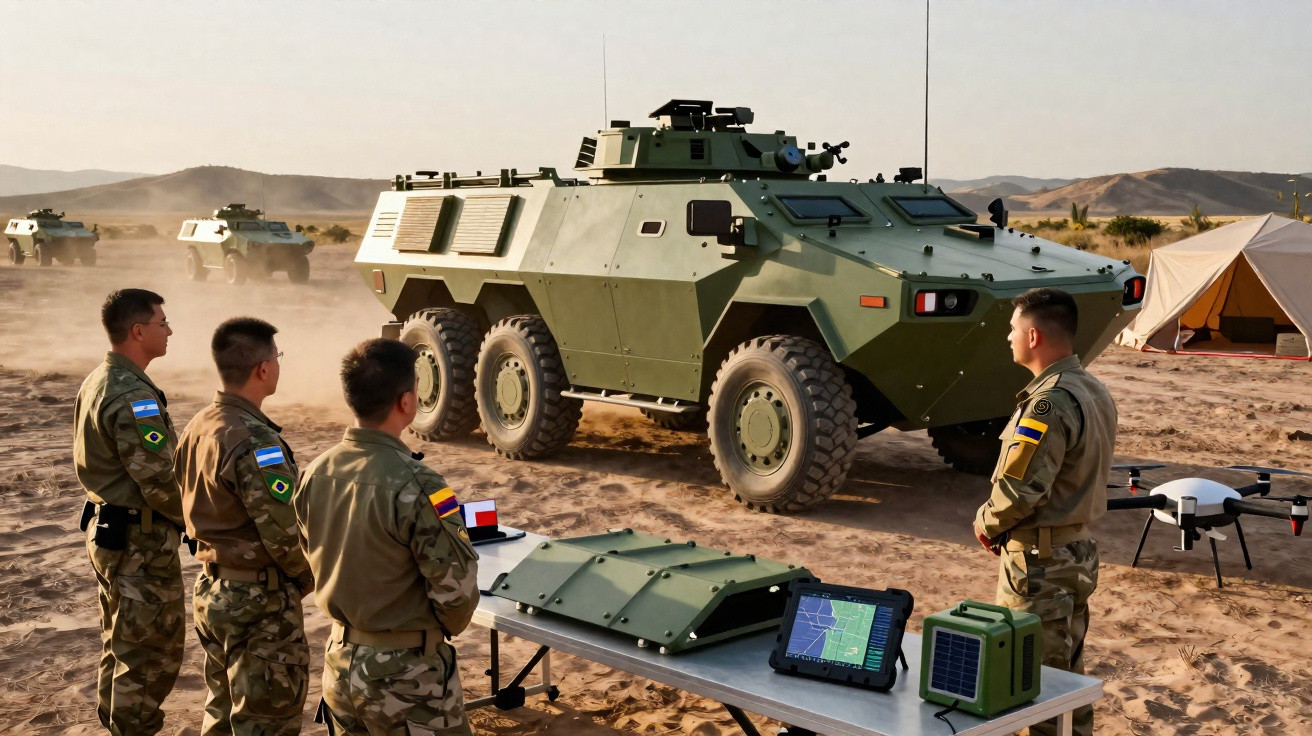
Over recent years, South America’s various armed forces have shown increasing interest in re-equipping their units with new armoured platforms known in the region as Wheeled Armoured Combat Vehicles, or VCBR by their Spanish acronym. These systems historically stemmed from the concept of armoured vehicles primarily intended to carry troops, but have progressively developed in technical and operational terms to offer strategists a broader range of capabilities. This article therefore provides a brief overview of the VCBR concept, the current position of these systems in the region’s principal countries, their origins and capabilities, as well as ongoing modernisation programmes.
Establishing the VCBR concept
Before examining individual cases, it is useful to establish what is meant by a VCBR and distinguish these vehicles from other land platforms found in each country’s inventories. A VCBR is generally a wheeled armoured system in 6×6 or 8×8 configurations that can perform a variety of roles. Troop transport has already been mentioned, but such vehicles can also undertake reconnaissance and infantry fire-support missions, emergency medical evacuation, and serve as command-and-control posts in the field.
Their wheeled configuration also gives them a major advantage over tracked counterparts in terms of speed, flexibility and logistics. This translates into greater deployability and lower long-term maintenance requirements, factors of considerable importance for countries in the region when investing in a new system.
Although they are less stable than tracked vehicles, which affects the use of large-calibre weapons during offensive operations, the VCBR concept has repeatedly demonstrated its ability to integrate different weapons systems and become a versatile alternative. Available options range from 120 mm main guns and 30 mm or 25 mm turrets to 7.62 mm machine guns.
Argentina’s new VCBR fleet
The first case concerns the Argentine Army and its latest acquisition: 8×8 M1126 Strykers bought from the United States following a lengthy process marked by repeated changes, generally caused by shifting political positions towards the countries offering their respective models. This pattern has also been evident in other national re-equipment programmes. Systems assessed included Norinco’s Chinese VN-1 (ZBL-09), the Pandur II from Excalibur/GDELS promoted by Israel, and Iveco Guaranís built in neighbouring Brazil, for which the Argentine Government even signed a Letter of Intent.
The induction process remains under way. The first four vehicles arrived last December, nearly five years after the relevant request was made to the Department of State. These units will form the foundation of the institution’s long-sought Wheeled Mechanised Brigade, for which the aim is to acquire more than 200 vehicles. The political element, namely the current administration’s explicit alignment with the United States, was also decisive in the selection.
That does not mean that, despite not being the most modern VCBR available on the market, they are not highly capable platforms with proven combat effectiveness. They have served in theatres including Afghanistan, Syria and Iraq, among others. The design has also generated a family of 27 variants since its introduction. The Argentine Army’s vehicles belong to the 8×8 M1126 ICV infantry carrier variant, which has room for a team of up to nine personnel, a 350HP Caterpillar C7 engine, independent hydropneumatic suspension, and high-hardness steel armour providing all-round protection against 7.62 mm fire and frontal protection against 14.5 mm rounds. Protection can potentially be enhanced through the integration of MEXAS 2C ceramic panels and is supplemented by NBC protection.
They are also known to feature an AN/VAS-5 thermal sight for the driver, supplementing three M-17 periscopes. The commander uses an M151-series Protector remote weapon station equipped with a thermal imaging module. This system can accept weapons including the 12.7mm M2 machine gun, an FN MAG/M240, or a 40mm MK19 automatic grenade launcher.
In terms of performance, each vehicle can reach 101 km/h, while road range is between 450 and 500 kilometres. The Stryker measures 7.31 metres long, 2.87 metres wide and 2.69 metres high, with a fording capability of around 1.3 metres.
Brazil’s extensive capabilities and strategic industrial project
Brazil has the region’s strongest VCBR capabilities, relying on two main models to equip the Brazilian Army’s armoured units. These are the 8×8 Centauro II BR, produced by the Italian Iveco-Oto Melara consortium, and the previously mentioned Iveco Guaraní.
Regarding the first of these two VCBR, its significant firepower is impossible to overlook, most clearly represented by its stabilised 120 mm L45 gun. Deliveries to the Brazilian Army began in 2024, when Brasília received a batch of two vehicles for technical and operational evaluations intended to confirm the manufacturer’s stated performance. This was the preliminary stage before the purchase of a further 96 vehicles, which began arriving with the 6th Mechanised Cavalry Squadron from May 2025. The Brazilian Army was thus able to begin replacing its ageing EE-9 Cascavel systems, which had been in service since the 1970s.
Beyond its powerful 120 mm gun, with a range of up to 4 kilometres, the vehicle is fitted with two 7.62 mm machine guns, one coaxial and one anti-aircraft, as well as grenade launchers. It is also known to have advanced aiming, fire-control and communications systems. Its tyre-pressure control system provides substantial mobility across different terrain types, while its range is approximately 800 kilometres.
The Iveco Guaraní began entering Brazilian service in 2012 to replace EE-11 Urutu and EE-9 Cascavel vehicles. The current fleet exceeds 700 delivered units. Among other features, the platform can be fitted with remotely operated 7.62 mm or 12.7 mm machine guns and a 40 mm grenade launcher. Progress has also been made in developing and integrating the new UT-30BR turret with its 30 mm ATK Bushmaster MK44 gun. Furthermore, its V-shaped hull offers improved protection against landmines.
Beyond technical considerations, and to explain the chosen subheading more fully, the Guaraní has become an important strategic asset for Brazil’s defence industry. It has contributed to job creation, export revenues and the consolidation of domestic capabilities. An illustrative example is the Philippines’ purchase of 28 vehicles despite a German embargo based on human-rights violation allegations. Brazil worked to replace components through agreements with local industry in order to complete that sale.
Chile: LAV III induction and the need to replace Mowag Pirañas
Chile presents a notable particularity: it has acquired a batch of VCBR specifically for the country’s Navy. These are LAV III vehicles formerly operated by the New Zealand Defence Force. In exchange for approximately USD 19.85 million, Chile acquired 22 vehicles from a fleet originally comprising 105, and they now equip the Chilean Marine Corps.
The original operator introduced these vehicles from 2003, when the LAV III became known as the NZLAV. They were manufactured in Canada at General Dynamics Land Systems facilities. The company lists equipment including a turret armed primarily with a 25 mm M242 Bushmaster cannon, accompanied by a 7.62mm MAG-58 coaxial machine gun and two 76 mm smoke-grenade launchers. The platform also has combat experience, particularly in operations conducted by New Zealand in Afghanistan, where one vehicle was lost and many others were struck by improvised explosive devices.
Their transfer to the Andean country was enabled by a New Zealand Government assessment in 2012, which concluded that the number of VCBR held by its forces exceeded established strategic requirements. This opened the possibility of selling vehicles to interested partners. At that stage, around 20 vehicles were considered surplus, although this figure increased by a further 10 units by 2019.
The Chilean Army, meanwhile, operates its own VCBR fleet, in this case the 6×6 Mowag Piraña I. These vehicles were locally manufactured under licence by Cardoen and FAMAE, with more than 200 examples operated by the institution’s various Armoured Cavalry Regiments.
During more than four decades of service, a period that makes a near-term replacement necessary, the vehicle has fulfilled several roles: troop carrier, mortar carrier fitted with 120 mm systems, air-defence vehicle with two 20 mm guns, anti-armour platform armed with a 25 mm Oerlikon gun, ambulance and command post. To extend their operational life, Mowag Piraña Is have also undergone modernisation programmes such as Huracán III, in which re-engining units was one of the principal measures.
Colombia and a controversial acquisition
As in Argentina’s case, the purchase of new systems for armed forces frequently attracts as much, if not more, attention for surrounding controversy as for the arrival of the equipment itself and its effect on national defence capabilities. This has unquestionably been the situation with the 8×8 LAV III VCBR now operated by the Colombian Army, whose contractual process began on 30 December 2022.
Requiring an investment of more than US$300 million, the deal became the subject of an extensive investigation by the Office of the Attorney General of Colombia. Various reports pointed to cost overruns and a lack of transparency in the selection process, amid the possibility that either more VCBR could have been purchased for the same sum or that models with greater technological capabilities could have been acquired. In practical terms, this led to several summonses for the then Defence Minister, Iván Velazquez, as well as for numerous ministry officials linked to the project.
Among the issues raised at the time was the unit cost of US$5.54 million for the armoured vehicles. This stood out compared with LAV IIIs acquired just over a decade earlier, at US$2.62 million per vehicle. Suspicions were reinforced by Chile’s purchase of second-hand vehicles at US$900,000 per unit, which was seen as a questionable use of resources by Bogotá.
Colombia also has its own fleet of Textron M1117 4×4 vehicles, a troop carrier with broadly similar LAV III performance in terms of troop capacity, armour and proven combat experience. The model was first acquired in 2011, with 67 vehicles delivered by 2016. These were joined by another 145 used vehicles purchased from the United States at substantially lower cost.
The issue becomes even more problematic given the use of VCBR in combat operations against insurgent groups, as less expensive options with equally suitable technical characteristics existed. In particular, the locally built Hunter and Titán vehicle families were already proven designs in the Colombian Army and cost only US$500,000 per vehicle. This advantage was partly offset by the impetus provided to domestic industry. In simple terms, one LAV III required virtually the same outlay as 10 Titáns.
Peru highlights its link with South Korea
Finally, Peru must be considered, particularly its prospective major VCBR acquisition from what is becoming its principal arms supplier: South Korea. Lima has concluded a framework agreement with Hyundai Rotem to pave the way for the incorporation of 141 K808 White Tiger VCBR, together with 54 new K2 Black Panther tanks to further reinforce its Army. For Seoul, this would be its most significant armoured-vehicle sale to a regional customer, underscoring the close relationship between the two countries.
Although this acquisition has not yet been completed, it should be assessed not only from a technical standpoint but also in industrial terms, given the beneficial impact the deal would have on the country. The South Korean company has already expressed its willingness to establish an assembly plant in Peru during the forum “The Defence Industry as State Policy”. This would also guarantee maintenance for the acquired armoured vehicles and create new jobs for more than a decade.
As for current capabilities, Peru has a fleet of LAV II 8×8 Caimán VCBR for its marine infantry units. The first two were delivered to the Amphibious Expeditionary Brigade in 2015, beginning deliveries of up to 32 vehicles acquired from the Canadian Commercial Corporation for an investment of around US$67 million. Since then, they have actively participated in various activities, including the RIMPAC and UNITAS exercises, among others.
This batch belongs specifically to the APC variant, designed to transport teams of up to eight personnel in addition to the two crew members required to operate it. It is also known that, when acquired, Lima’s agreement divided the 32 vehicles into two main groups: 24 equipped with 12.7 mm M-2HB QCB machine guns, and the remaining 8 with 40 mm MK-19 grenade launchers.
Finally, the Peruvian Navy retains a now-reduced BMR-600 fleet, which it began receiving during the 1980s and eventually totalled 24 units. Over time, reports indicated that the fleet had fallen to only around 16 armoured vehicles by 2014, with some examples donated to the National Police. When overhaul work was undertaken in 2023 in preparation for deployment to the United Nations peacekeeping mission in the Central African Republic, MINUSCA, only 6 units were included.
Images used for illustrative purposes



Comments
No comments yet. Be the first to comment!
Leave a Comment