
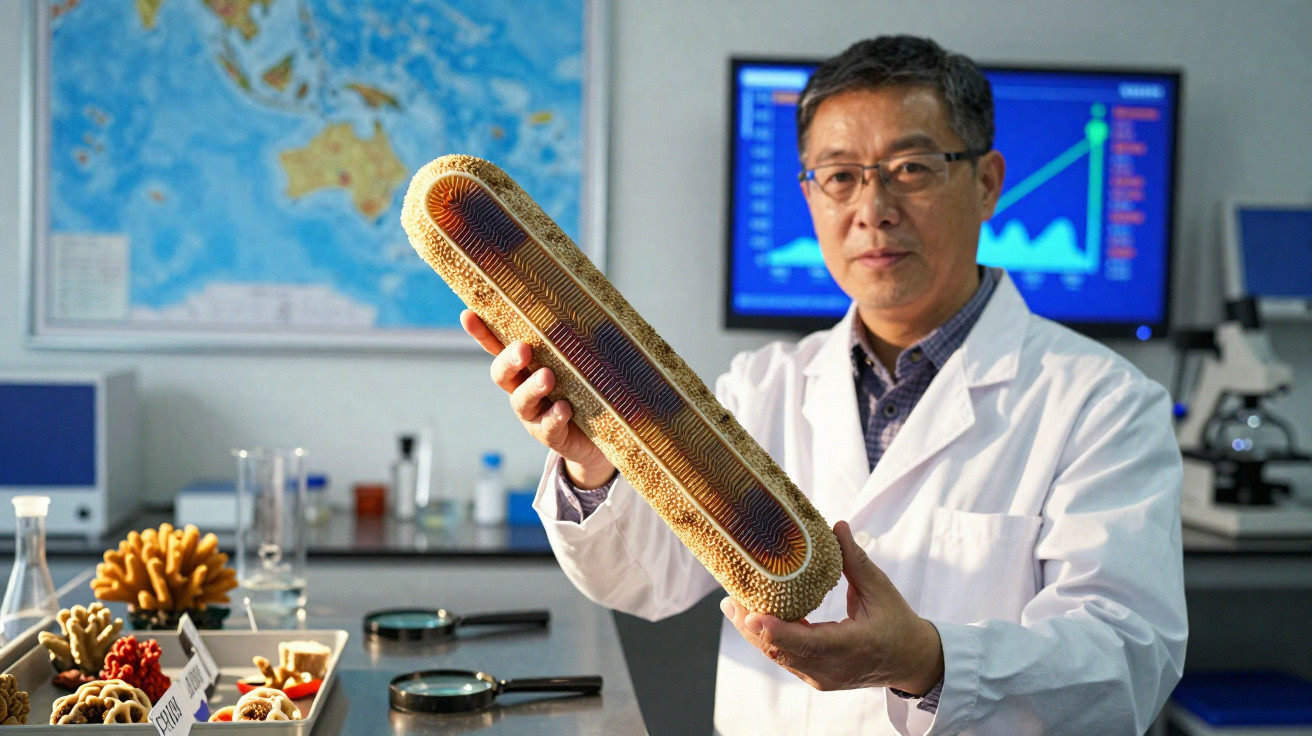
A single coral in Fiji, aged at more than 600 years, has preserved a record of changing Pacific Ocean temperatures throughout its exceptionally long lifespan.
Scientists already know that the Pacific has, overall, warmed across the centuries. In recent years, human-caused climate change has brought marine heatwaves and extensive coral bleaching.
However, the ocean is also believed to have experienced cooler and warmer years, and even decades, during that time. Establishing the extent of this variability is difficult, as very few uninterrupted records extend back over hundreds of years.
Our research, published in Science Advances, helps address these missing details. We examined a sample from one enormous Diploastrea heliopora coral, also called a honeycomb coral. This unusually ancient specimen was found in 1998, when researchers drilled it to obtain a sample. We have now assessed that material using modern scientific methods.
By combining this extended coral record with records from other corals across the Fijian archipelago, we created a master temperature chronology for Fiji's waters. For the period from the 1990s onwards, it can be combined with extensive observations from weather buoys, satellites and other instruments.
The coral record therefore extends for 627 years and reveals sea temperatures around Fiji from 1370 to 1997. It is the longest continuous temperature record of its kind from any tropical ocean location.
Coral offers a window on the past
Massive corals can survive for many years while continually building a calcium carbonate skeleton in layers above the older structure. The living tissue occupies only the uppermost few millimetres. As fresh layers form, the coral leaves the earlier skeleton behind, creating a record of past environmental conditions.
We particularly examined the balance of two elements in the skeleton, strontium and calcium, which provides a proxy for seawater temperature. A lower amount of strontium relative to calcium in the coral skeleton indicates that the water was warm while the coral was living, and the reverse is also true.
These elements were measured with mass spectrometry instruments, which can determine a material's elemental composition even when concentrations are extremely low.
Temperature information preserved in the coral shows how climate patterns, including the interdecadal Pacific oscillation, have changed over centuries. This provides essential context for interpreting current and future climate trends.
The Pacific Ocean is a major influence on climate variability worldwide. Its best-known pattern is the shift between El Niño and La Niña every few years, in which ocean temperature changes cause substantial differences in rainfall and cyclone formation.
That cycle is itself moderated by the interdecadal oscillation, involving changes in temperature across the northern, southern and tropical Pacific every 15 to 30 years.
Modern Pacific warming in context
The growth histories and skeletal chemistry of giant boulder corals can contain stories spanning centuries. For example, this coral points to a marked warm phase from 1370 to 1553, when seas around Fiji were nearly as warm as they are today. This highlights the Pacific climate system's natural variability.
Yet our coral can be considered alongside other palaeoceanographic records from throughout the Pacific to provide a broader view. Taken together, they show that Pacific-wide warming during the past century, largely linked to human-caused global warming, represents a substantial departure from the natural variability documented in previous centuries.
In the past, some Pacific regions could be warmer while others experienced a cooler decade or two, and then the pattern could reverse. That relationship is now breaking down. Warming is becoming ever more synchronised across the tropical and subtropical Pacific Ocean.
This can bring major changes to rainfall, drought and flood cycles, because rainfall is often produced by water vapour evaporating from warmer seas.
Such warming, marked by a comparatively small variation in ocean temperatures across the Pacific, is unlike the pattern of the previous six centuries. It indicates that warming in the Pacific since the beginning of the 20th century may be causing unprecedented changes to the interdecadal oscillation.
Implications for future climate
Understanding the interdecadal Pacific oscillation's behaviour over the long term is essential to predicting future climate change.
A recent separate study of corals from Australia's Great Barrier Reef and the surrounding Coral Sea found that reef temperatures during five recent bleaching events were the highest of the last 407 years. The world's largest reef is in serious danger.
Our research likewise finds that the ocean surrounding Fiji is hotter than at any point in at least the past 653 years. These changes may produce more extreme weather, including extended droughts or stronger tropical cyclones, with major consequences for the millions of people who live in the region.
Our study demonstrates why long-lived massive corals are such important archives of earlier climate change, although ocean warming is placing their future at risk. Protecting these giant corals is essential.
Juan Pablo D'Olivo, Senior Researcher, Institute of Marine Sciences and Limnology, Universidad Nacional Autónoma de México (UNAM); Ariaan Purich, Lecturer in Climate Variability and Change, Monash University; and Jens Zinke, Professor of Palaeobiology, University of Leicester
This article is republished from The Conversation under a Creative Commons licence. Read the original article.


Comments
No comments yet. Be the first to comment!
Leave a Comment