
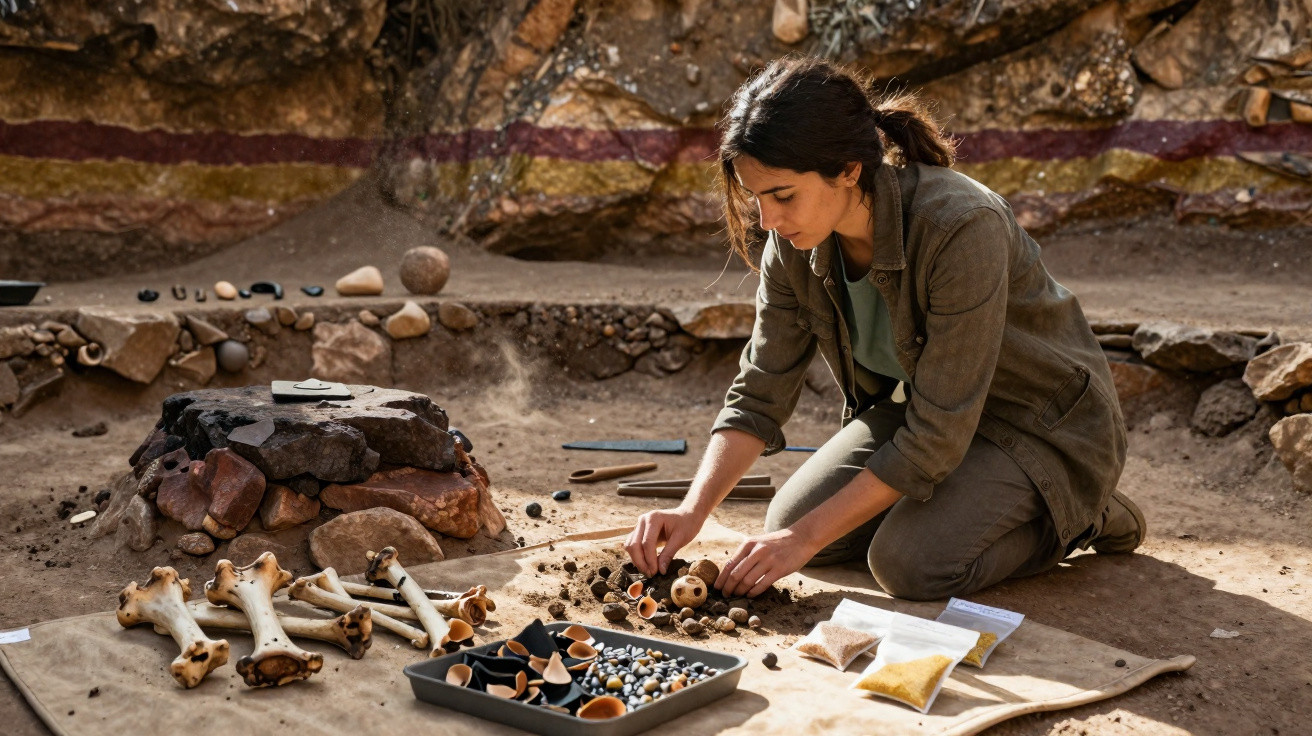
On an unremarkable morning many thousands of years ago, in the foothills of what is now the Pyrenees on Spain’s Iberian Peninsula, a group of Neanderthals awoke, welcomed the day and began their work as the light strengthened.
They had no way of knowing that, tens of millennia later, modern humans digging through the soil would uncover evidence of their presence and reconstruct aspects of their daily lives. Yet this is precisely what archaeologists have achieved, finding that Neanderthals were considerably more resilient than previously thought.
Excavations at the recently identified rock-shelter site of Abric Pizarro have yielded thousands of artefacts dating from 65,000 to 100,000 years ago. These include stone tools and animal bones, offering rare insight into the Neanderthal way of life during an era from which little evidence survives.
Abric Pizarro reveals adaptable Neanderthals
Remarkably, the bone assemblage includes remains from numerous small animals. This indicates that Neanderthals were flexible hunters who could adjust their way of life according to the food available.
"Our surprising findings at Abric Pizarro show how adaptable Neanderthals were," says zooarchaeologist Sofia Samper Carro of the Australian National University.
"The animal bones we have recovered indicate that they were successfully exploiting the surrounding fauna, hunting red deer, horses and bison, but also eating freshwater turtles and rabbits, which imply a degree of planning rarely considered for Neanderthals."
Neanderthals (Homo neanderthalensis) were among the closest hominid relatives of modern humans (Homo sapiens). The two species interbred repeatedly and may not even have been entirely separate species. Nevertheless, the idea has persisted that Neanderthals were primitive, uncultured and less cognitively developed than people today.
An increasing number of recent discoveries has challenged that view. Neanderthals produced sophisticated tools and adorned their surroundings with several forms of art.
What the artefacts and animal bones show
The greatest obstacle to understanding Neanderthal lives is how poorly the material they left behind survives. Neanderthals died out around 40,000 years ago, and most traces of their lives have been lost to time, decay and erosion. The evidence recovered so far has suggested that Neanderthals hunted only large prey, including horses and rhinoceroses.
Abric Pizarro, a Neanderthal rock shelter, was discovered in 2008, and archaeologists have been carefully uncovering its secrets since 2009. Samper Carro and her colleagues have now completed a detailed assessment of some of the artefacts recovered there.
The team used optically stimulated luminescence dating to establish the age of the sediment that contained the finds. This method determines when a mineral sample was last exposed to sunlight.
They also examined pollen grains and bones from the site, assessing the bones for evidence of cut marks and gnawing. In addition, they investigated the stone tools to evaluate the knapping methods and technologies available to the people who once occupied Abric Pizarro.
The dating showed confidently that Neanderthals inhabited the site roughly 70,000 years ago, while the artefacts demonstrated their skill.
"The bones on this site are very well preserved, and we can see marks of how Neanderthals processed and butchered these animals. Our analysis of the stone artifacts also demonstrates variability in the type of tools produced, indicating Neanderthals' capability to exploit the available resources in the area," Samper Carro says.
"They clearly knew what they were doing. They knew the area and how to survive for a long time."
This is not especially surprising. Before their extinction, Neanderthals had lived successfully in Europe for about 300,000 years.
Neanderthal extinction remains uncertain
However, the causes of Neanderthal extinction are still not fully understood. A rigid response to changing food availability might have offered one explanation. Their adaptability, however, may also reveal something about why they disappeared.
The swift decline of Neanderthals after such a long period of survival coincided with the arrival of modern humans. That overlap casts an unsettling light on the possible part our own species played in their disappearance. It is entirely possible that the actions of Homo sapiens are why so little remains of Neanderthals beyond a sparse archaeological record and DNA traces in our genome.
Abric Pizarro now adds to that record, and researchers are eager to examine its evidence further to understand more about the enigmatic lives of these distant cousins.
"Future studies will characterize the Neanderthal occupations documented in Abric Pizarro in more detail," the authors write.
The research was published in the Journal of Archaeological Science.






Comments
No comments yet. Be the first to comment!
Leave a Comment