
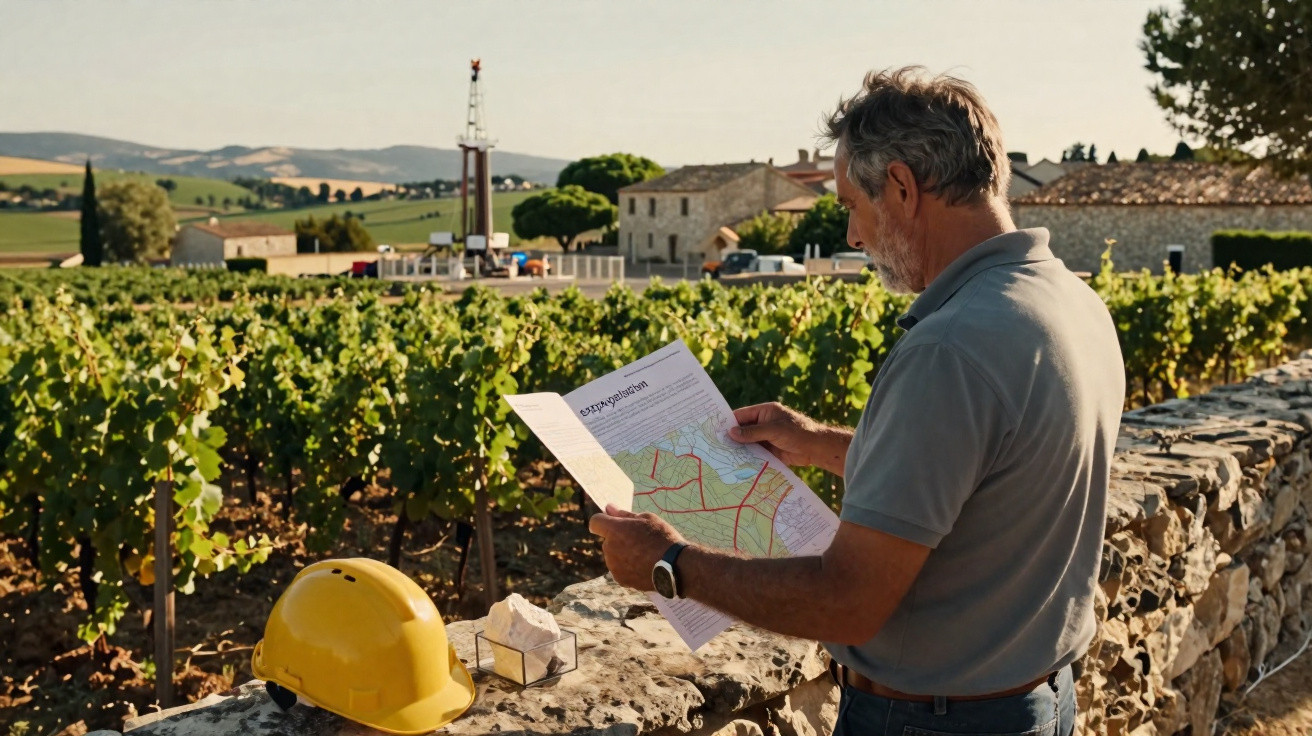
At the village café, gossip arrived before any geological maps. People are talking about lithium beneath the ground in Aude, an eye-catching figure of €33 billion, and homes that could supposedly be at risk. Messages spread quickly on mobile phones: “They are going to take our land and give us nothing.” In a rural community, words like these can send a chill through people. A plot is not merely an entry on the land register: it may be a grandfather’s vegetable garden, a barn repaired on Sundays, or a view assumed to be there forever. Yet a mining prospect, a financial estimate and an actual compulsory purchase are separated by very specific rules. Those rules make a major difference.
The €33 billion figure: an announcement that needs unpacking
When €33 billion enters a local debate, it immediately captures attention. Residents picture lorries, drilling rigs, investors and, sometimes, the end of a peaceful way of life. However, a mineral-resource valuation is not money waiting in a vault. It may be calculated from an estimated volume of ore, an assumed lithium price and a theoretical recovery rate. Numerous studies, permissions, industrial costs and uncertainties lie between the ground and the market. A possible deposit is not yet a mine. The distinction may sound technical, but it is central to the concern felt in some Aude villages.
Lithium has become strategically important as batteries for electric cars, phones and energy-storage systems expand. For instance, its price can fluctuate sharply according to global demand, refining capacity or decisions made in China, Australia and South America. A multi-billion-euro figure may therefore be a gross in-ground value, before the costs of extraction, processing, transport and remediation have been deducted. Locally, residents mainly hear the headline number. Thirty-three billion: it is hard not to ask who will genuinely benefit, and who will live with the project’s day-to-day effects.
At this point, any claim about a lithium discovery in Aude should be checked carefully: there should be an identifiable geological publication, an exploration permit, a company leading the project, a public inquiry and administrative decisions. Without these elements, the most dramatic claims remain assumptions or incomplete accounts. Let us be honest: few people choose to read dozens of pages in a mining file after dinner. Yet those documents often reveal whether the activity is early-stage prospecting or a genuinely advanced proposal. The first question is therefore not simply “what is the lithium worth?”, but “which estimate is being cited, and who produced it?”
Compulsory purchase without compensation: what French law actually provides
When people fear being forced out of their homes, the most useful first step is to request the official documents. Compulsory purchase cannot be triggered by a rumour, an unclear letter or a surveyor visiting the site. In France, it requires a public-interest process, usually preceded by a public inquiry, an impact assessment and a period in which owners can submit their views. Keep all correspondence, photograph notices displayed at the town hall and record the relevant land-register references. A local association, notary, public-law solicitor or public-inquiry commissioner can help make sense of administrative language that is often discouraging.
The notion of compulsory purchase “without compensation” must also be put into perspective. French law establishes the principle of fair, prior compensation when ownership is transferred through compulsory purchase in the public interest. Disputes commonly concern the amount, whether a loss has been recognised or the property’s true value, rather than whether compensation exists at all. One frequent mistake is accepting an amicable offer too quickly, through exhaustion or fear of legal costs. That reaction is understandable. A house does not necessarily carry the same value for a family as it does on an assessment schedule, particularly when it contains an entire life story.
Before signing anything, affected residents can ask for the complete paperwork and arrange an independent valuation of their property. The French Compulsory Purchase Code states a straightforward principle:
“Compulsory purchases of buildings, in whole or in part, or of real property rights may be ordered only where they serve a public interest that has been formally established in advance.”
A few practical steps can prevent people from facing an opaque process alone:
- check whether a public inquiry exists and confirm its exact dates;
- request the environmental studies and relevant land-register plans;
- obtain a valuation from an independent professional;
- seek legal advice promptly if an offer to buy or an official order arrives;
- speak to neighbours, while avoiding the sharing of unverified information as fact.
In Aude, the lithium debate goes far beyond the value of ore
Projects involving critical metals revive a tension already familiar to many rural areas: the green transition is presented as essential, but its impact is felt somewhere specific, near lived-in homes and cherished landscapes. Lithium extraction can be supported in the name of European industrial sovereignty and reduced dependence on imports. Residents, meanwhile, consider the local road, groundwater, vineyards, potential noise and the value of their homes. These perspectives are not incompatible. They become explosive when information arrives late, in the form of enormous figures or promises that cannot be checked.
Transparency remains the most practical starting point. A credible project developer should be able to set out the exploration areas, proposed methods, water needs, identified risks, anticipated jobs and measures planned in the event of damage. Local elected representatives also face a delicate task: they must inform people without playing down the issues, and listen without turning every public meeting into an improvised court. The right to information does not ensure that every resident will agree, but it at least allows discussion to be based on facts. A clear map is often more useful than a reassuring twenty-minute speech.
We all know the moment when worrying news feels too big to be true, but too specific to dismiss. In Aude, the announcement of lithium valued at €33 billion feeds this grey area between economic hope and fear of dispossession. Compensation does not make everything right: it cannot replace neighbours, a view or the routines of a lifetime. Even so, it remains a fundamental right where compulsory purchase is properly carried out. Residents benefit from asking simple, repeated and sometimes uncomfortable questions: who decides, on what basis, when, and with what safeguards? That is often how a debate moves beyond rumour and becomes a genuine collective choice.
| Key point | Detail | Benefit for the reader |
|---|---|---|
| The announced €33 billion | A resource estimate does not automatically mean real profit or an operating mine. | Better understand what lies behind a striking figure. |
| Compulsory purchase | It follows a regulated process and, in principle, gives entitlement to fair, prior compensation. | Avoid confusing rumour, an amicable negotiation and a legal procedure. |
| Local steps | Public inquiries, land-register documents, impact assessments and independent valuations are practical tools. | Act methodically rather than endure uncertainty. |
FAQ
- Has Aude lithium really been valued at €33 billion? Such a figure must be linked to an identifiable source: a geological study, technical estimate and calculation method. Without a specific public document, it should be treated cautiously.
- Can someone be compulsorily purchased without receiving compensation in France? In a lawful compulsory purchase for public interest, the guiding principle is fair, prior compensation. A dispute may concern its amount.
- Does an exploration permit allow a mine to open immediately? No. Exploration, extraction and industrial works are separate stages, each subject to particular authorisations and checks.
- What should I do if a mining project affects my plot? Ask for the land-register references, consult the documents at the town hall, retain every written exchange and obtain an independent assessment before signing anything.
- Can residents take part in the decisions? Yes, notably through public inquiries, local meetings and consultations required by administrative procedures. Their involvement should rely on verifiable information.





Comments
No comments yet. Be the first to comment!
Leave a Comment