
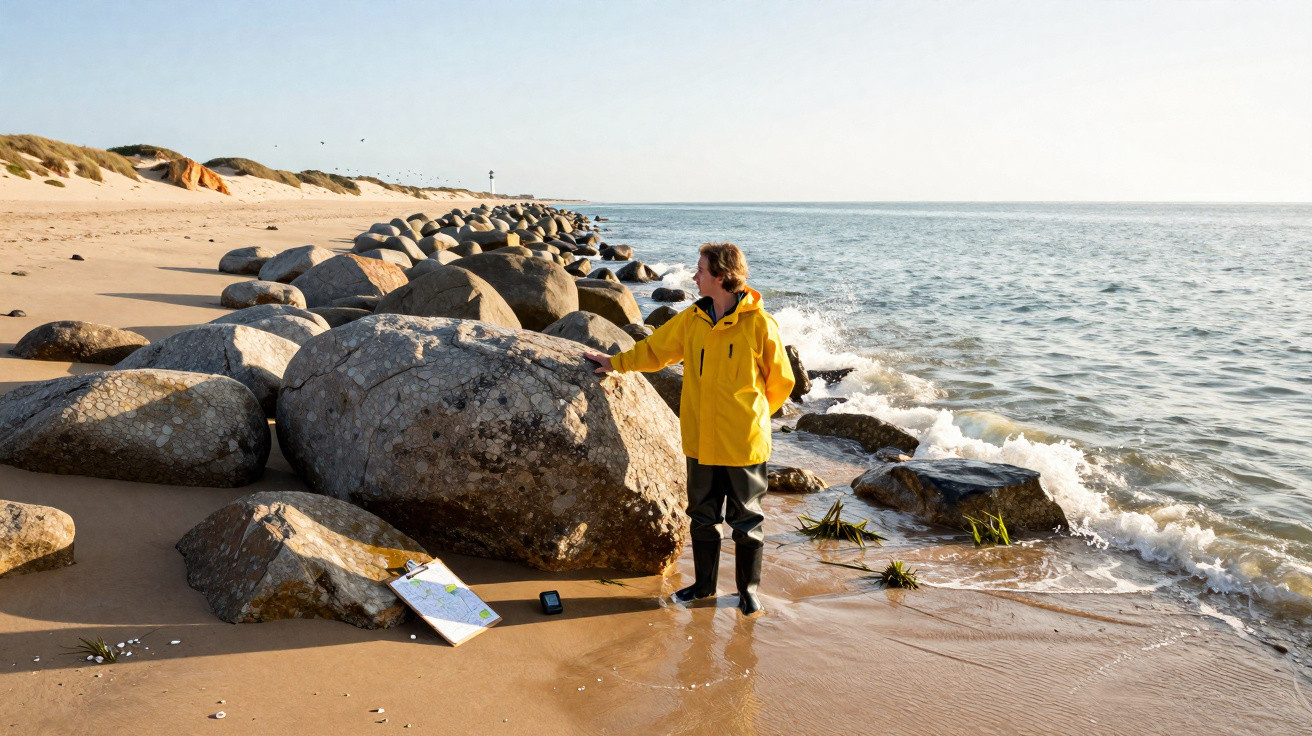
At low tide, the Banc d’Arguin looks from afar like nothing more than a pale strip set between the Atlantic and the bay. Up close, everything is in motion: wind lifts the sand, terns wheel low overhead, and boats slow as they approach an area whose outline shifts almost from one season to the next. Since 140,000 tonnes of rocks were laid down, the landscape has retained that restless appearance, yet something has changed in the subtle balance of the currents. Bay residents know it well: here, the ocean never enters in quite the same way twice. It brings sand, seaweed and nutrients, as well as concern at times. The rock armour has not stopped the sea; it has altered the exchange between the sea and the bay. That exchange must now be read differently.
On the Banc d’Arguin, the rocks have altered the way the sea shapes the coast
When 140,000 tonnes of rocks were placed on the Banc d’Arguin, the purpose was straightforward: to reinforce a vulnerable area exposed to repeated wave action and the constant movement of sand. From La Salie beach or the deck of a boat, it is not always easy to grasp what such a volume represents. Beneath the water, however, each block acts as an obstruction, a wall and a foothold, breaking the force of the swell and reshaping the small routes followed by water masses.
The figure is staggering: 140,000 tonnes is equivalent to thousands of fully loaded lorries, brought in to stabilise part of one of France’s most mobile coastlines. The Banc d’Arguin is not a fixed breakwater; it is a living sandy area beside the Dune of Pilat, at the entrance to a bay where every channel matters. An observant fisher or leisure boater may already notice that eddies, deposition areas and water passages no longer tell exactly the same story.
It is not only the bank’s visible shape that is changing. The rocks affect the local circulation of currents and, as a result, the way sediment is carried, deposited or swept offshore. The ocean still delivers salt water, sand and organic matter, but these inputs may now take different paths or arrive at a different pace. The sea cannot be engineered without responding in its own way. In a bay as sensitive as this, a shift of just a few metres can affect an entire landscape.
What the Arcachon Bay now receives is about more than sand
To understand this development, water needs to be seen as a moving carrier. It transports grains of sand, broken shells, seaweed, larvae, plankton and countless invisible particles that sustain the living food chain. Rock armour can form calmer areas in its lee while accelerating flows along its sides. For users, the most useful step remains simple: check up-to-date nautical charts, navigation notices and the channel’s actual condition before setting out.
A common mistake is to assume that the Banc d’Arguin is known once and for all because it was crossed last summer or because a boat has been anchored there for years. We all know the moment when routine takes over, especially when the sun is out and the trip seems risk-free. Let us be honest: nobody truly does this every day. In this part of the bay, a passage that was navigable yesterday can become difficult after a sequence of swells, a gale or a period of high tides.
Bathymetric monitoring, wildlife observations and feedback from mariners will need to help separate normal changes in the bank from the lasting effects of the works. This is not about setting rocks against nature, but about assessing plainly what they create within a system that is already unstable.
“The Banc d’Arguin is a national nature reserve, but it is also a coastal area in perpetual motion.”
- For leisure boaters: check local information before every trip, even when taking a familiar route.
- For walkers: comply with marked areas and keep clear of nesting sites, which are often close to reshaped zones.
- For residents: report visible changes, without drawing conclusions too quickly after a single sea event.
A living bay, between urgent protection and a balance to monitor
Arcachon Bay has always lived with transformation: channels move, beaches advance or retreat, oyster farmers work with the tides, and residents learn to read the sky. The placement of 140,000 tonnes of rocks nevertheless shows that human intervention, even when designed to provide protection, immediately becomes part of this vast mechanism. The real issue is not to fix the Banc d’Arguin in place-an impossible task against the Atlantic-but to track what the development changes over months and years. What the ocean brings into the bay is no longer quite the same, because its route has changed. One question remains for everyone watching the tide rise: how far can the sea be guided without profoundly changing what it sustains?
| Key point | Detail | Value for the reader |
|---|---|---|
| 140,000 tonnes of rocks | Major rock armour was placed on the Banc d’Arguin. | Assess the true scale of the intervention. |
| Altered currents | The blocks locally influence swell and sediment movement. | Understand why familiar reference points may change. |
| Monitoring required | Navigation, biodiversity and sand dynamics require long-term observation. | Adopt the right habits both on the water and along the shore. |





Comments
No comments yet. Be the first to comment!
Leave a Comment